
Business Debt in India: Recovery Suit, Arbitration or IBC?
Reviewed by Manu Shankar, Advocate, ManAT Legal
Recovery suit vs arbitration vs IBC is a route-selection question, not a choice among interchangeable ways to chase the same invoice. Each path has different jurisdictional gates, decision-makers and outcomes.
- A recovery suit asks a civil or commercial court to adjudicate an individual claim and, if established, grant a money decree or other relief.
- Arbitration asks a private tribunal to decide disputes covered by an arbitration agreement and make an award.
- IBC initiates a collective corporate insolvency-resolution process when the statutory conditions are met. It is not primarily an individual debt-recovery remedy.
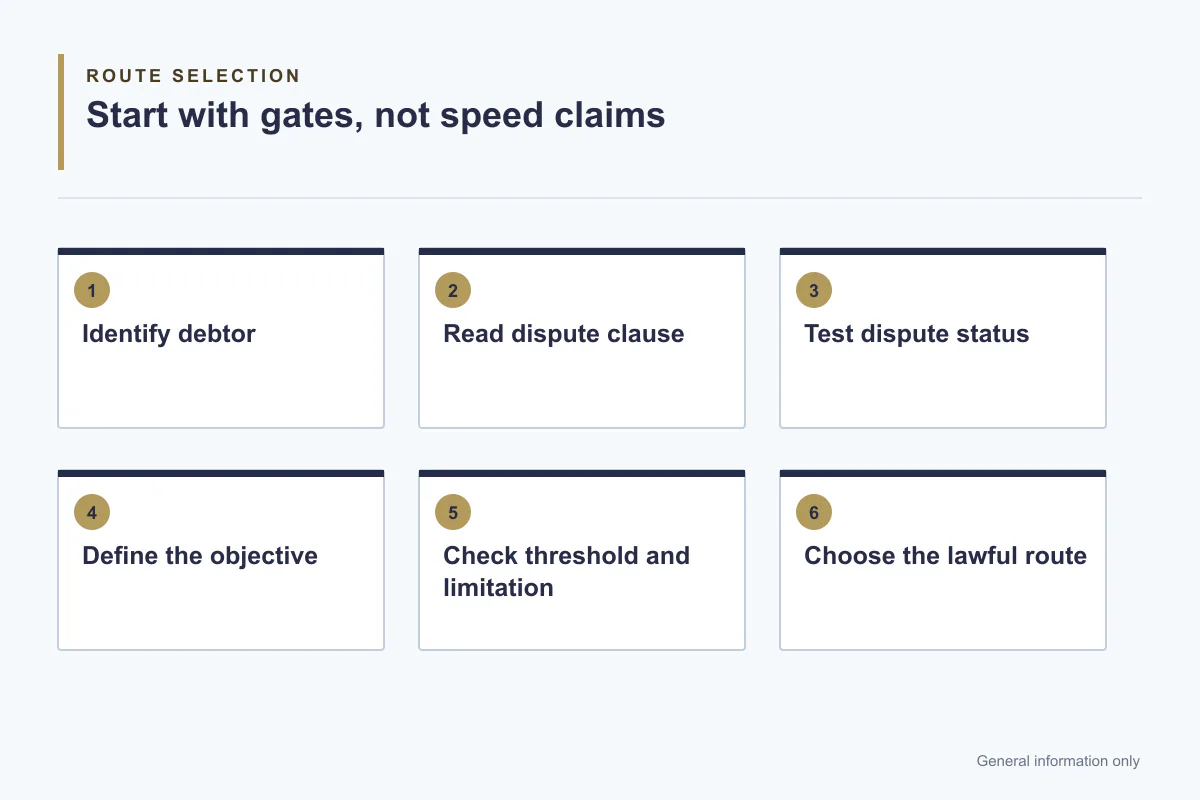
A recovery suit vs arbitration vs IBC analysis usually begins with the documents before a notice is issued. Start with the legal identity of both sides, the contract, the nature of the debt, whether liability is genuinely disputed, the debtor’s status, the amount/default, limitation and the outcome actually required.
Start with the objective
Ask what the claimant needs:
- adjudication and a money decree against a person or business;
- a private decision under a contract containing an arbitration agreement;
- collective insolvency resolution of a qualifying corporate debtor;
- urgent protection of assets or evidence;
- negotiated payment, security or restructuring; or
- a specialist statutory remedy such as MSEFC, cheque proceedings, DRT or SARFAESI.
Choosing the forum only because it appears faster or more coercive can result in dismissal, wasted limitation time and increased cost.
When may a recovery suit fit?
A civil recovery suit is a general adjudicatory route where the claimant seeks a decree for an enforceable debt or damages and no exclusive statutory forum or binding arbitration route displaces the suit.
The analysis includes:
- cause of action and legal basis of the claim;
- territorial and pecuniary jurisdiction;
- whether the dispute is a “commercial dispute” under the Commercial Courts Act and meets the specified value;
- pre-institution mediation requirements and exceptions where urgent interim relief is contemplated;
- ordinary versus summary procedure where legally available;
- court fee, pleadings, evidence and limitation; and
- the defendant’s assets and eventual execution.
A signed invoice does not always make a claim suitable for summary procedure. Order XXXVII CPC applies to defined categories and should be tested against the actual written instrument and relief.
The detailed filing sequence remains with ManAT Legal’s guide to filing a money-recovery suit in India. This article does not repeat plaint, summons, trial and decree steps.
When may arbitration fit?
Arbitration requires an arbitration agreement that covers the dispute. The first task is not to send an “arbitration notice,” but to review the clause and contract set.
Check:
- whether a Section 7-compliant agreement exists;
- the parties bound by it;
- scope of covered disputes;
- seat, venue, governing law and jurisdiction wording;
- mandatory negotiation/mediation steps;
- appointment mechanism and institutional rules;
- limitation and Section 21 invocation;
- tribunal cost relative to the claim; and
- where an award would need to be enforced.
If a suit is filed despite a valid arbitration agreement, Section 8 of the Arbitration Act may become relevant when its conditions are met. A claimant should not assume it can freely choose court litigation after agreeing to arbitrate.
Arbitration can be useful for specialised, confidential or cross-border commercial disputes, but privacy, speed and lower cost are not assured. Tribunal fees, institution, hearing length, court applications and enforcement can materially affect the result.
Readers assessing the underlying dispute clause can use the arbitration clause checklist for Indian contracts.
When may IBC be relevant?
IBC applies only when the Code’s debtor, debt, default, threshold and procedural conditions are met. For an operational creditor, Sections 8 and 9 add a prescribed notice, ten-day stage and pre-existing-dispute screen.
The Supreme Court explained in Swiss Ribbons Pvt Ltd v Union of India that the Code focuses on revival and continuation of the corporate debtor, with liquidation as a last resort, rather than being mere recovery legislation. A later 7 November 2024 judgment expressly distinguishes insolvency proceedings from suits, decree execution and arbitral claims: insolvency addresses the company’s debt collectively, while recovery proceedings pursue an individual creditor’s dues.
Ask:
- Is the respondent a corporate debtor covered by Part II?
- Is the claimant a financial or operational creditor under the Code?
- Has a legally relevant default occurred?
- Does the default meet the current Section 4 threshold?
- For operational debt, is there a genuine pre-existing dispute?
- Is the claim within limitation and outside Section 10A’s permanent bar?
- Is insolvency resolution genuinely the objective?
- What would admission and a moratorium mean for all stakeholders?
An IBC application does not produce a private money decree. Recovery, if any, occurs through the collective process and may differ from the amount claimed.
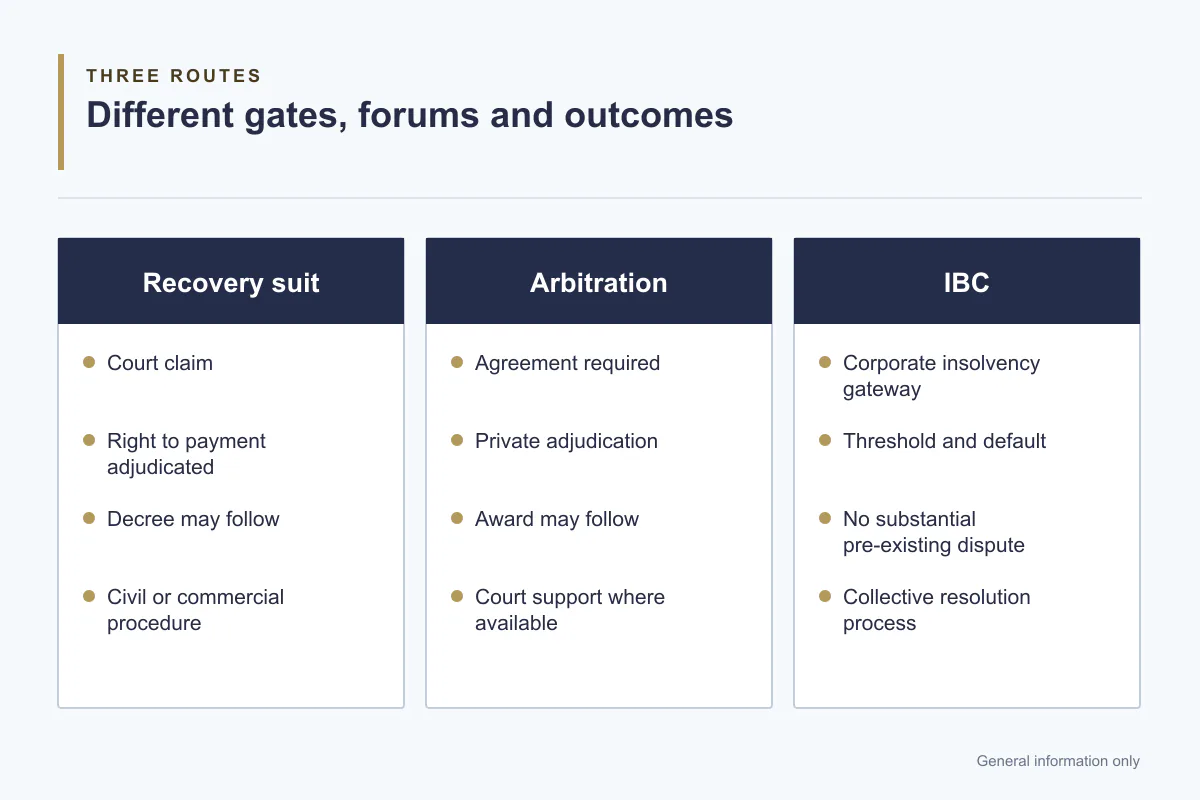
Recovery suit vs arbitration vs IBC: comparison table
| Question | Recovery suit | Arbitration | IBC |
|---|---|---|---|
| Primary function | Adjudicate individual civil/commercial claim | Decide disputes under arbitration agreement | Resolve insolvency of corporate debtor collectively |
| Consent/contract gate | No arbitration agreement required, but other forum bars matter | Valid, applicable arbitration agreement required | Statutory creditor/debt/default conditions required |
| Decision-maker | Civil/commercial court | Arbitral tribunal | NCLT initiates process; creditors and resolution framework follow |
| Ordinary outcome | Judgment and decree | Arbitral award | CIRP, resolution plan or possible liquidation:not a private decree |
| Genuine merits dispute | Court can try it | Tribunal can decide if arbitrable and within scope | Pre-existing dispute can defeat operational-creditor Section 9 admission |
| Threshold | Pecuniary/specified-value and court rules; no universal IBC-style minimum | Contract/rules may affect cost; no single statutory claim minimum | Current Section 4 minimum default and other conditions |
| Confidentiality | Court record generally not private | Greater procedural privacy may be available, subject to law/court stages | Statutory process with creditor/public dimensions |
| Interim relief | CPC/Commercial Courts framework | Sections 9 and 17 | Interim effects flow from Code/admission; not a substitute for claim-specific security |
| Enforcement | Decree execution under CPC | Award enforcement under Arbitration Act | Resolution plan/process outcomes under IBC |
This is a screening table, not a universal answer. Special statutes and facts may change the route.
Five facts that often decide the route
1. The debtor’s legal identity
A company or LLP may fall within the corporate insolvency framework; a sole proprietor is an individual. A trade name can conceal this distinction. Obtain current registration and contracting records.
2. The contract and dispute clause
Read the signed agreement, purchase orders, standard terms, amendments and guarantees. An arbitration clause may cover the claim; an exclusive forum or specialist statute may also matter.
3. Whether liability is admitted or genuinely disputed
A court or tribunal can adjudicate a merits dispute. An operational creditor’s IBC route is not designed to try a plausible pre-existing dispute. Identify the first objection, not only the latest response.
4. The amount and default date
Claim amount affects court jurisdiction, commercial-court treatment, proportionality of arbitration and IBC threshold. Default/accrual dates drive limitation and Section 10A analysis.
5. Solvency and asset reality
A successful decree or award still requires enforcement. Investigate lawful, reliable indicators of assets and solvency before selecting a route. Rumour that a debtor is “shutting down” is not a substitute for evidence.
Limitation must be analysed before route selection
Limitation rules differ by claim and proceeding. Relevant dates can include invoice due date, breach, termination, acknowledgment, part-payment, arbitration invocation and prior proceedings.
Do not assume that sending repeated notices extends time. Acknowledgment and part-payment provisions have formal and timing requirements. Time spent in the wrong forum may not automatically be excluded.
Create a limitation table before negotiations or notices consume the remaining period.
| Event | Date | Document | Possible limitation significance |
|---|---|---|---|
| Performance/delivery | |||
| Invoice/due date | |||
| First default | |||
| Written acknowledgment | |||
| Part-payment | |||
| Dispute notice | |||
| Arbitration invocation/prior filing |
What evidence is needed whichever route is chosen?
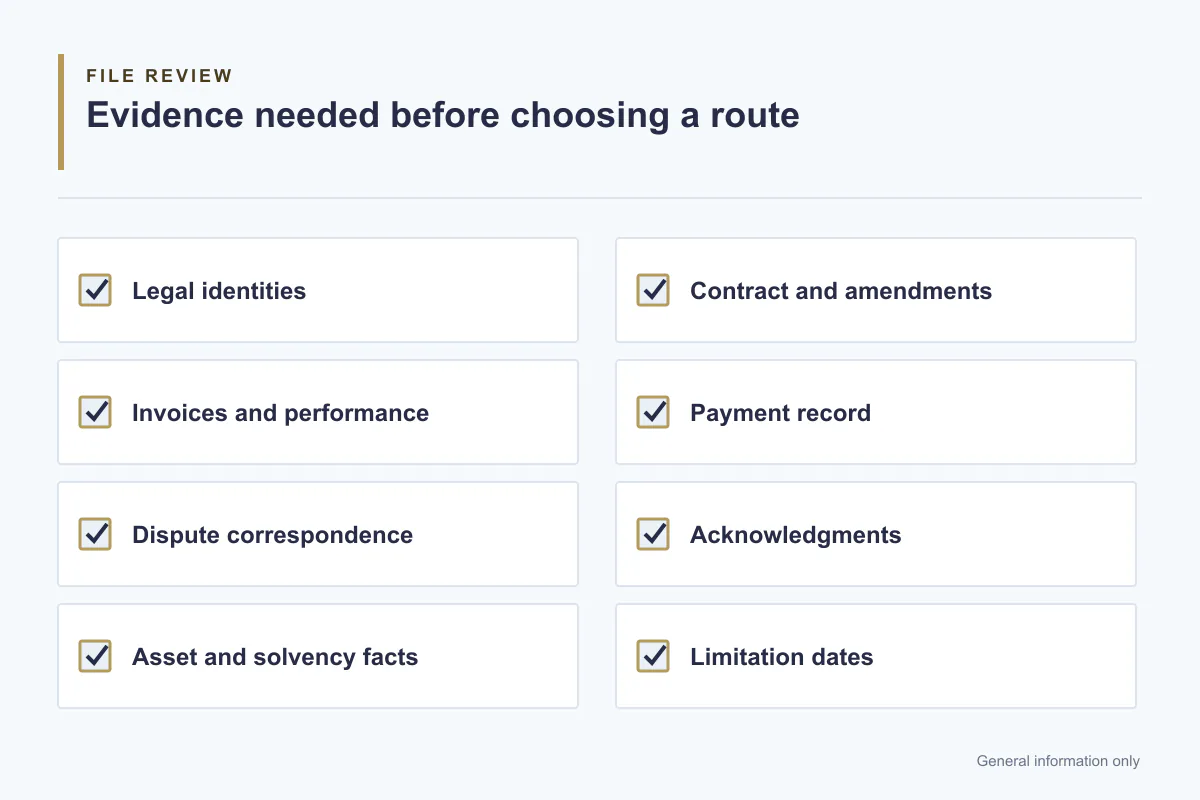
Build one reconciled core file:
- signed contracts, incorporated terms and amendments;
- purchase/work orders and specifications;
- delivery, acceptance and performance evidence;
- invoices, debit/credit notes and tax records;
- ledger and bank payment reconciliation;
- notices and complete correspondence;
- admissions, disputes, set-offs and settlement communications;
- corporate identity and address records;
- interest/damages calculation and legal basis; and
- asset information obtained lawfully.
The same core documents will be organised differently for a plaint, arbitration claim or statutory IBC application.
Interim protection may change timing, not route ownership
If assets, goods or evidence are at immediate risk, urgent interim relief may be considered. In a civil suit, the CPC/Commercial Courts framework applies. In arbitration, Sections 9 and 17 may be relevant. IBC should not be selected merely to obtain leverage comparable to an asset-freeze order.
For the arbitration branch, the Section 9 interim-relief guide explains court protection and the Section 17 hand-off.
Other routes that may need priority
The three-way comparison is not exhaustive.
- MSEFC/MSMED Act: An eligible micro or small enterprise may have a statutory facilitation route. Registration timing, supplier status and current law require review.
- Negotiable Instruments Act: A dishonoured cheque may create a distinct proceeding with strict notice and limitation requirements. It does not replace the underlying civil analysis.
- DRT/SARFAESI: Banks, notified financial institutions and secured creditors may have specialist remedies not available to ordinary suppliers.
- Mediation/settlement: A documented payment plan, security or settlement can be commercially preferable, but limitation and enforceability must be protected.
- Consumer, employment or sector forum: The nature of the relationship can displace a general recovery route.
Can proceedings run in parallel?
Different remedies may coexist before a statutory bar, referral, admission, moratorium, res judicata, election or case-management principle intervenes. Parallel filings can also create inconsistent positions, disclosure duties and cost.
Counsel should map every pending or threatened notice, suit, arbitration, cheque case, insolvency application and enforcement step before commencing another process. Admission of CIRP triggers a moratorium under Section 14 with significant effects on proceedings against the corporate debtor.
A ten-question route-selection framework
- Who exactly owes the alleged debt?
- What legal relationship and document create it?
- Is the claimant entitled to the amount, and how is it calculated?
- Is there a valid arbitration agreement covering the dispute?
- Is liability admitted, partly disputed or genuinely disputed?
- What is the accrual/default date and limitation position?
- Is the respondent a corporate debtor and does the IBC threshold apply?
- Is insolvency resolution the real objective or is individual adjudication required?
- Is urgent interim protection needed, and in which forum?
- Where are assets, and how would the decree, award or resolution outcome operate?
Illustrative scenarios
Signed supply contract, no arbitration clause, disputed quality
A civil/commercial suit may be the adjudicatory route, subject to jurisdiction, Commercial Courts Act and other statutes. An operational-creditor IBC filing may fail if the quality dispute is genuine and pre-dates the demand notice.
Services contract with a valid arbitration clause
Arbitration may be required for covered disputes. Review invocation, seat, appointment and interim protection. Filing a suit without analysing Section 8 can waste time.
Large unpaid operational debt from a distressed company, no pre-existing dispute
IBC may merit assessment if the corporate debtor, threshold, default, limitation, Section 10A and notice requirements are satisfied. It remains a collective resolution route, not an assured payment process.
Decree already obtained but unpaid
Route selection has ended. The issue is enforcing the civil court decree in Karnataka.
Common mistakes
- Choosing IBC because the notice sounds stronger.
- Ignoring an arbitration agreement.
- Assuming every invoice claim qualifies for summary suit.
- Treating a real dispute as a mere delay tactic without reviewing records.
- Comparing advertised timelines rather than jurisdiction and outcome.
- Allowing negotiation to consume limitation.
- Filing against a trade name or wrong entity.
- Failing to investigate enforcement before spending on adjudication.
Frequently asked questions
Is IBC faster than a recovery suit?
That comparison can be misleading because the routes seek different outcomes. IBC is available only on its statutory conditions and does not grant an individual money decree.
Can I choose court instead of arbitration?
Not freely where a valid arbitration agreement covers the dispute. Section 8 and the contract must be analysed.
Does a genuine dispute prevent a recovery suit?
No. Adjudication is the purpose of a suit. A genuine pre-existing dispute is especially significant for an operational creditor’s Section 9 IBC application.
Which route guarantees payment?
None. A decree or award may require enforcement, and an insolvency process may yield only the outcome provided by the resolution/liquidation framework.
Should a legal notice name every possible route?
Not automatically. Over-inclusive threats can be inaccurate and strategically unhelpful. The notice should reflect routes actually available on current facts and law.
Related ManAT Resources
- Debt recovery and debt-related matters
- How to file a money recovery suit in India
- Arbitration and dispute resolution
- Insolvency and NCLT matters
This recovery suit vs arbitration vs IBC guide is general information, not legal advice. Route selection requires review of the complete contract, dispute record, debtor, limitation, threshold, pending proceedings and enforcement facts.
For the civil-procedure branch, see when a qualifying summary suit may be available; for guarantees linked to corporate debtors, see the personal-guarantor process under Part III IBC.