

Section 9 Interim Relief in Arbitration: When Courts May Protect the Process
Reviewed by Manu Shankar, Advocate, ManAT Legal
Section 9 Arbitration Act interim relief allows a party to ask a court for protective measures connected with an arbitration under the Arbitration and Conciliation Act, 1996. Its purpose is to preserve property, evidence, money or the effectiveness of the arbitral process until the tribunal or enforcement process can address the dispute.
Section 9 Arbitration Act interim relief is not a shortcut to a final award. The court does not ordinarily decide the full contractual merits on a Section 9 application. The applicant must connect the requested measure to an arbitration agreement, an existing or genuinely contemplated arbitration, and a present need for protection.
When can Section 9 Arbitration Act interim relief be used?
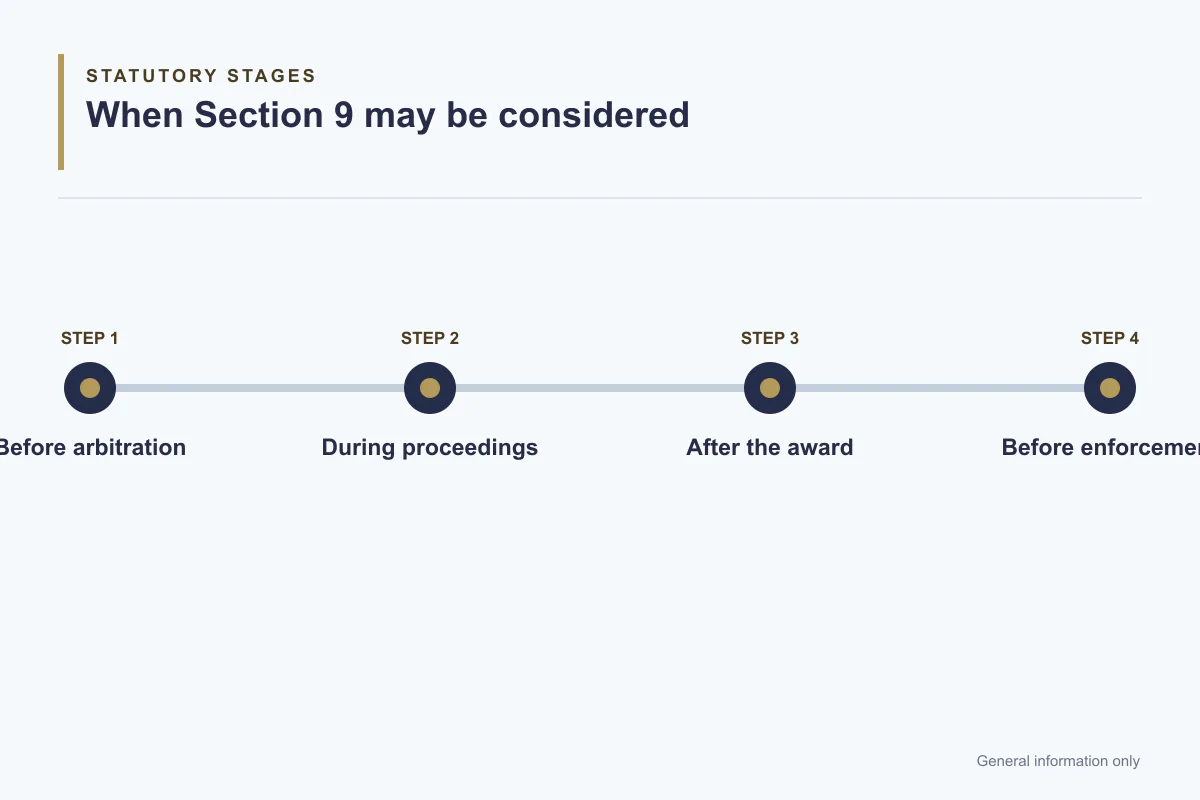
Under Section 9, a party may apply:
- before arbitral proceedings commence;
- during arbitral proceedings; or
- after an award is made but before it is enforced under Section 36.
The correct stage matters. Before arbitration, the applicant must be prepared to commence proceedings. After the tribunal is constituted, Section 9(3) directs attention to the tribunal’s Section 17 powers. After an award, the requested measure must still be protective and within the statutory period before enforcement.
The Supreme Court confirmed in an important 24 April 2026 judgment that a party to the arbitration agreement, including an unsuccessful party, is not automatically excluded from invoking Section 9 at the post-award stage. The Court also emphasised careful exercise of the power. The exact effect of that ruling should be reviewed against the facts and any later authority.
What Section 9 Arbitration Act interim relief can a court grant?
Section 9(1) includes measures concerning:
- appointment of a guardian for a minor or person of unsound mind for arbitral proceedings;
- preservation, interim custody or sale of goods that are the subject matter of the arbitration agreement;
- securing the amount in dispute;
- detention, preservation or inspection of property or a thing connected with the dispute;
- entry, samples, observation or experiments needed to obtain information or evidence;
- an interim injunction;
- appointment of a receiver; and
- another interim measure that appears just and convenient.
The list does not mean relief is automatic. The requested order must be legally available, factually justified, workable and proportionate.
Section 9 Arbitration Act interim relief before arbitration: the ninety-day rule
Section 9(2) addresses an order made before arbitral proceedings commence. Arbitration must then be commenced within ninety days from the order, or within a further period the court determines.
This is more than a diary reminder. A pre-arbitration applicant should have:
- the arbitration agreement and complete contract set;
- a prepared or near-ready invocation notice;
- a clear respondent and service plan;
- an appointment or institutional filing strategy; and
- a limitation analysis.
An emergency application should not be filed with no genuine plan to arbitrate. Failure to move the arbitration forward can affect continuation of protection and the applicant’s credibility.
Section 9 Arbitration Act interim relief versus Section 17
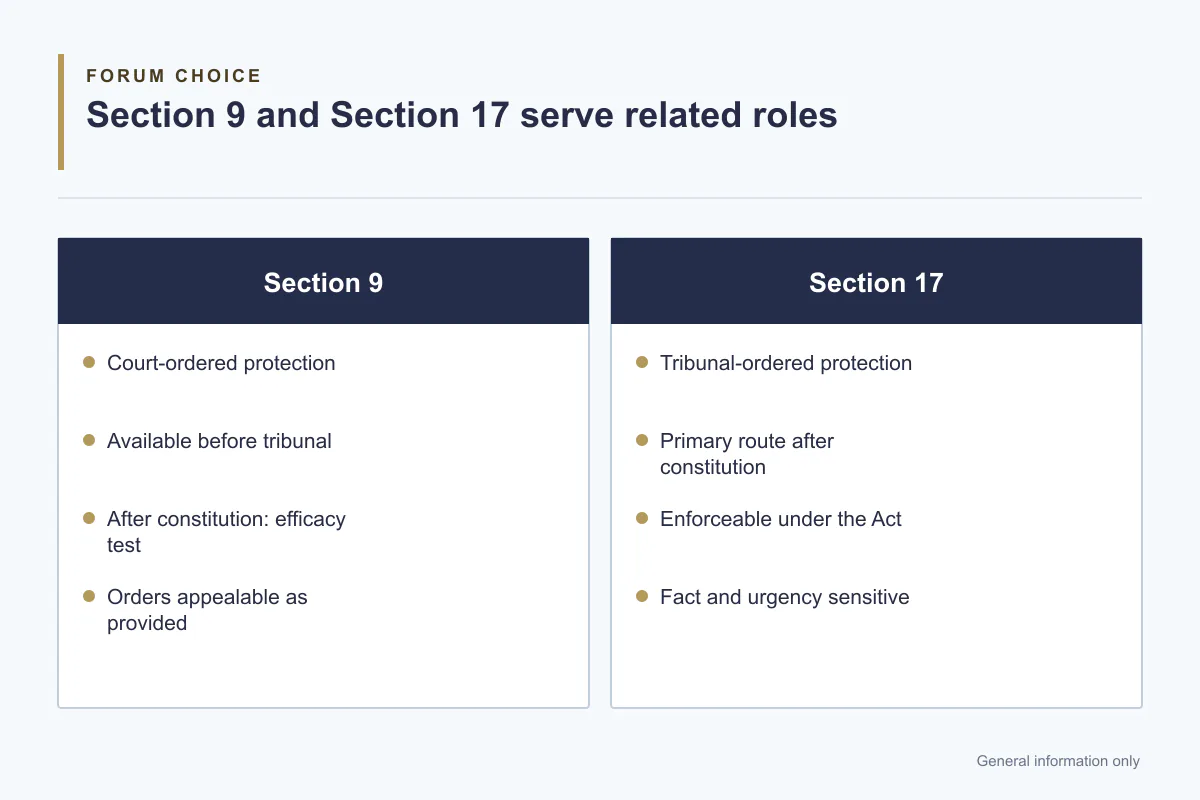
Section 17 gives the arbitral tribunal power to order interim measures. Section 9(3) states that once the tribunal has been constituted, the court shall not entertain a Section 9(1) application unless it finds circumstances that may render the Section 17 remedy inefficacious.
| Stage | Usual statutory focus | Key question |
|---|---|---|
| Before tribunal constitution | Section 9 court relief | Is urgent protection necessary and is arbitration genuinely contemplated/commenced? |
| After tribunal constitution | Section 17 tribunal relief | Can the constituted tribunal grant effective relief in time and in the circumstances? |
| After award, before enforcement | Section 9 may remain available | Is the measure protective, justified and within the statutory stage? |
The exception in Section 9(3) is fact-sensitive. It is not enough to prefer a court to the tribunal. Evidence may need to show why Section 17 cannot provide an efficacious remedy:for example, because of timing, the nature of the target, the relief or another practical/legal constraint.
Fresh Supreme Court material in 2026 continues to address when parties should move to Section 17 once a tribunal is functioning. Any draft petition should be checked against the latest binding authority on the filing date.
What must an applicant generally show?
Section 9 gives the court protective powers, but discretion is guided by settled interim-relief principles and the Arbitration Act’s purpose. Depending on the measure, the court may examine:
- a prima facie contractual/arbitration basis;
- a real risk to property, evidence, funds or the efficacy of the proceedings;
- urgency and the applicant’s promptness;
- balance of convenience and risk of irreparable prejudice;
- whether damages or the final award would be an adequate answer;
- conduct, candid disclosure and compliance with the contract;
- proportionality and clarity of the proposed order; and
- whether Section 17 is available and efficacious.
The Supreme Court’s 24 April 2026 ruling describes a good prima facie case, balance of convenience and reasonable expedition as relevant considerations and cautions that the threshold may be higher for an unsuccessful party after the award.
These principles are applied in an arbitration-specific statutory setting. Readers seeking relief in a pending ordinary civil suit should consult the separate guide to temporary injunctions in civil cases, which addresses Order XXXIX CPC.
Evidence for Section 9 Arbitration Act interim relief
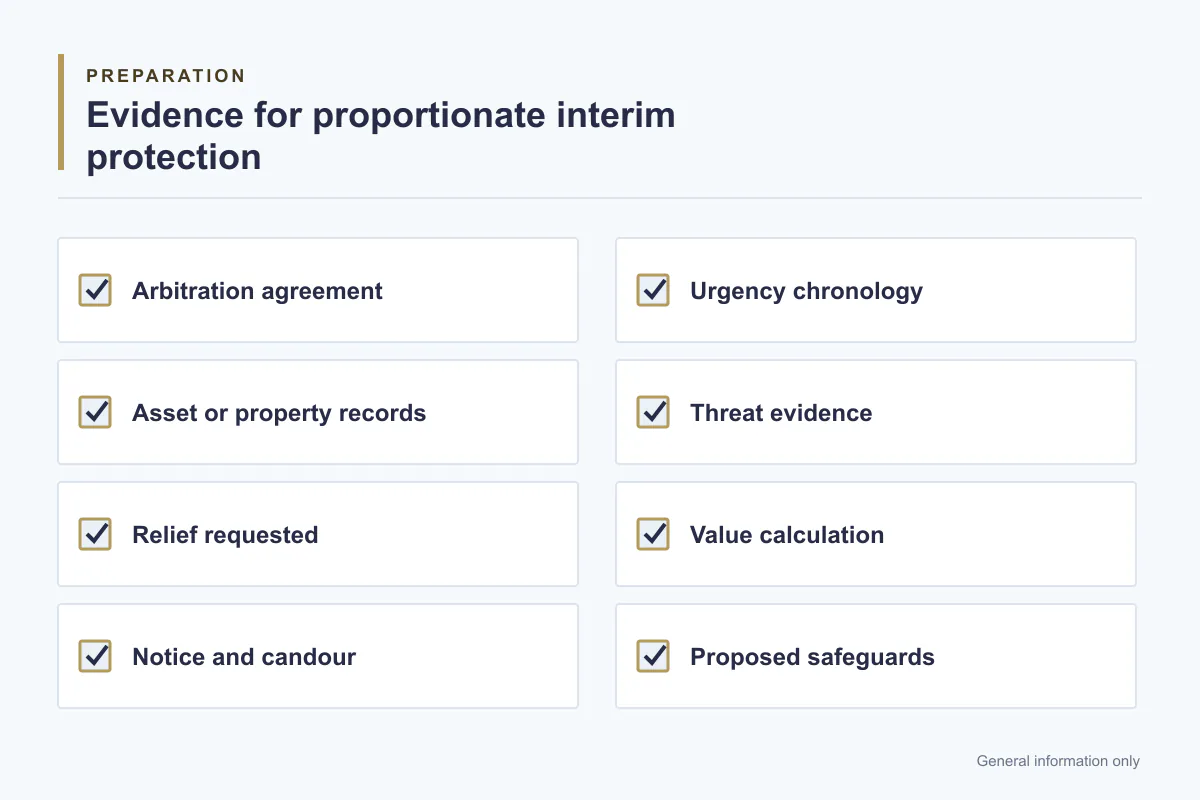
A Section 9 file commonly requires:
- signed contract and arbitration clause;
- amendments, schedules and incorporated terms;
- notices and proof of receipt;
- chronology of breach, threatened conduct and discovery of urgency;
- invoices, ledgers, payment records or performance documents;
- title, inventory or location evidence for relevant goods/property;
- bank, corporate or public records lawfully available;
- communications showing proposed transfer, disposal, dissipation or obstruction;
- photographs, inspection records or technical material;
- the proposed arbitration invocation and appointment steps; and
- a precise draft of the measure sought.
Allegations that a respondent “may dispose of assets” are usually weaker than specific evidence. At the same time, an applicant must not collect or present confidential, personal or third-party data unlawfully.
Can the court secure the amount in dispute?
Section 9 expressly refers to securing the amount in dispute. That does not convert every unpaid invoice into an automatic deposit order. The court considers the arbitration basis, the quality of the claim, the evidence of risk and whether the requested security is justified.
The applicant should explain:
- how the amount is calculated;
- which part is principal, contractual interest, damages or another head;
- what conduct creates a risk to effective relief;
- why a less intrusive measure is inadequate; and
- how the proposed security relates to the dispute.
A vague request to freeze all assets can be disproportionate. The order sought should identify the asset, amount, transaction or restraint as precisely as the evidence permits.
Preservation, inspection and sale of goods
Where goods may deteriorate, be transferred or lose value, Section 9 can support preservation, custody or sale in appropriate cases. The application should address ownership/contention, location, condition, value, storage cost, urgency and how proceeds would be protected.
For inspection or evidence preservation, specify what must be inspected, why it matters, who should attend, how confidentiality will be protected and whether an independent commissioner or expert is proposed.
Interim injunction and receiver
An interim injunction may restrain defined conduct that threatens the arbitration or subject matter. A receiver may be sought where neutral management or preservation is necessary and legally justified. Both are serious discretionary remedies.
The applicant should avoid asking the court to grant the final contractual relief at the interim stage. The order must preserve adjudication, not replace it.
Which court has jurisdiction?
Jurisdiction requires review of the Arbitration Act’s definition of “Court,” the seat, the contract’s jurisdiction clauses, where proceedings have already been filed and Section 42 where applicable. Domestic and international commercial arbitration can raise different forum questions.
Do not choose a court solely because assets or a business office are present there. Counsel should map:
- the juridical seat;
- the relevant court under Section 2(1)(e);
- prior applications under Part I;
- the relief and asset location;
- exclusive-jurisdiction wording; and
- whether the arbitration is foreign-seated and Section 2(2)’s proviso applies.
Forum mistakes can cost the time that made interim relief necessary.
Can Section 9 Arbitration Act interim relief affect a third party?
Applications involving banks, custodians, purchasers or other non-signatories require particular care. Section 9 expressly identifies who may apply, but the permissible target and form of directions depend on the relief, legal rights, notice and current precedent.
Do not assume a court can decide final rights of a non-party within a summary interim application. The affected person, property relationship and enforceability of the proposed direction need specific legal review.
Notice, ex parte orders and candour
Urgency may lead an applicant to request action before the respondent is heard, but such relief is exceptional. The applicant should disclose material facts, including inconvenient documents, prior delay, existing proceedings and the respondent’s known explanation.
The application should also propose a prompt return date and practical service. An order obtained through suppression or an incomplete chronology may be varied or discharged and can affect costs and credibility.
Duration, undertakings and transition to the tribunal
Read the operative order, not a summary of it. The order may expire on a date, continue until tribunal consideration, require an undertaking, impose conditions or direct commencement within a specified period.
Once the tribunal is constituted, parties should consider whether to seek continuation, modification or replacement under Section 17. The court and tribunal records must be kept consistent; parallel requests should be candidly disclosed.
Is a Section 9 order appealable?
Section 37 identifies appealable orders, including specified Section 9 orders. The exact remedy, forum, limitation and effect on the underlying order require review. Filing an appeal does not by itself justify disobeying the operative direction; stay or modification must be sought where needed.
Section 9 Arbitration Act interim relief: practical checklist
- Obtain the complete signed arbitration agreement and amendments.
- Identify the seat and competent court.
- State the exact protective purpose:not the final merits relief.
- Build a dated urgency chronology.
- Match each allegation to admissible supporting material.
- Calculate any secured amount transparently.
- Draft a narrow, enforceable proposed order.
- Prepare the invocation and tribunal-constitution plan.
- Analyse Section 17 efficacy if a tribunal exists.
- Check disclosure, service, undertakings, appeal and expiry dates.
Common mistakes
- Treating Section 9 as a debt-recovery petition.
- Filing without a valid arbitration agreement.
- Ignoring the seat and jurisdiction clauses.
- Seeking the entire final relief on an interim record.
- Alleging asset dissipation without specific evidence.
- Omitting adverse correspondence from an urgent application.
- Missing the ninety-day commencement requirement.
- Returning to court after tribunal constitution without addressing Section 9(3).
- Assuming an appeal automatically suspends the order.
Frequently asked questions
Can Section 9 be filed before sending an arbitration notice?
The provision permits pre-arbitration applications, but an applicant must genuinely contemplate arbitration and, after a pre-arbitral order, comply with Section 9(2)’s commencement timetable or further time allowed by the court.
Does Section 9 decide who wins the contract dispute?
Ordinarily no. It protects the process or subject matter pending arbitral adjudication, although the court must examine the claim sufficiently to decide interim relief.
Must the court refuse relief after a tribunal is constituted?
Section 9(3) directs the applicant to Section 17 unless the court finds circumstances that may render that remedy inefficacious. The exception is fact-specific.
Can a court order security for the full claim?
Section 9 permits securing the amount in dispute, but the quantum and form of security are discretionary and evidence-dependent. The amount claimed is not automatically the amount secured.
Is Section 9 the same as an Order XXXIX injunction?
No. Similar interim principles may be relevant, but Section 9 is a distinct statutory remedy in aid of arbitration. Order XXXIX governs temporary injunctions in civil suits.
Related ManAT Resources
- Arbitration and dispute resolution
- Temporary injunctions in civil cases
- Corporate and commercial legal services
This Section 9 Arbitration Act interim relief guide is general information, not legal advice. Urgent applications require review of the complete contract, seat, evidence, tribunal status, court record and current law.
For the next stage after an award, review the post-award Section 34 and Section 36 stage.