

Arbitration Clause Checklist for Indian Contracts
Reviewed by Ann Finiya Pereira, Advocate, ManAT Legal
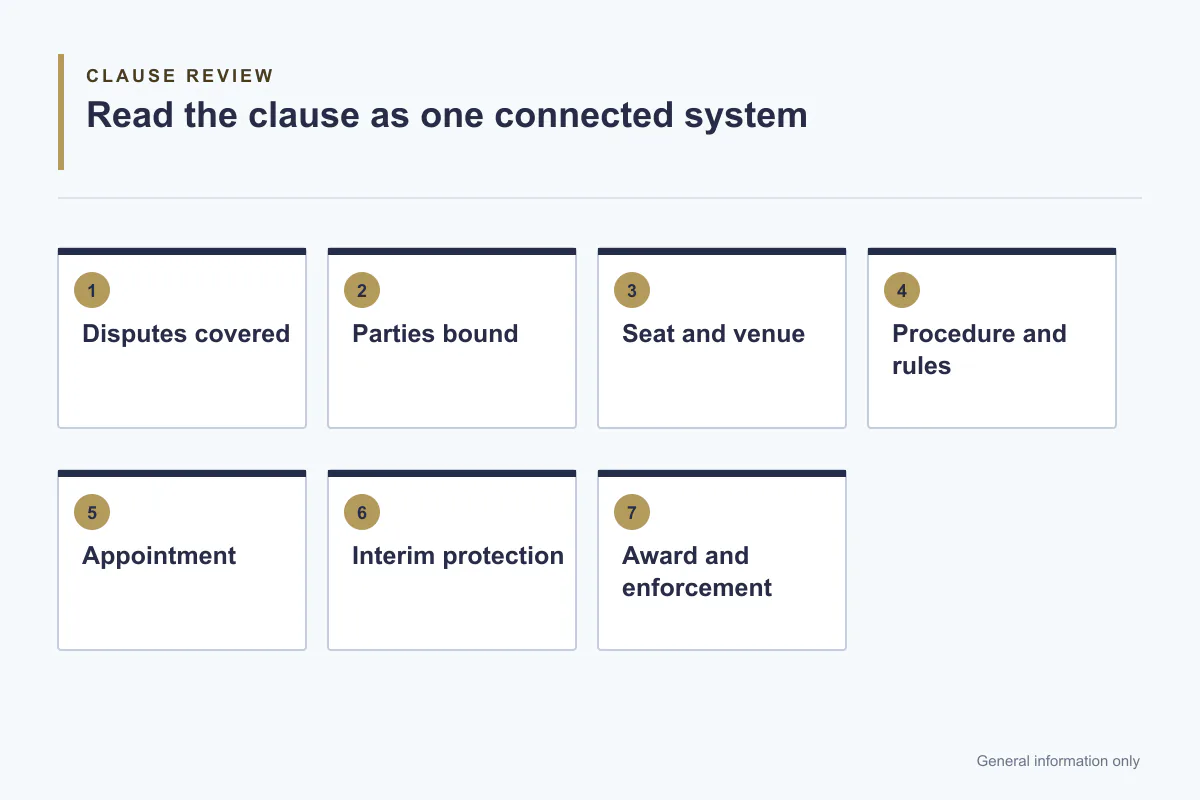
An arbitration clause checklist India businesses use should test more than whether a contract says disputes “shall be referred to arbitration.” A workable clause must identify what goes to arbitration, the legal seat, the decision-making process, the tribunal appointment method and how the clause fits with the rest of the contract.
The safest arbitration clause checklist India businesses can apply is systematic. Read the dispute-resolution clause together with the governing-law, jurisdiction, notice, confidentiality, assignment and multi-party provisions. A clause that works in isolation may become uncertain when another part of the contract points to a different court, procedure or decision-maker.
1. Is there a clear agreement to arbitrate?
Section 7 of the Arbitration and Conciliation Act, 1996 defines an arbitration agreement as an agreement to submit all or certain disputes arising from a defined legal relationship to arbitration. It must satisfy the statutory writing requirement, which can be met in the ways recognised by Section 7.
The clause should use mandatory language that records a present agreement to arbitrate. Phrases such as “the parties may consider arbitration” can create a threshold dispute about whether arbitration was agreed at all.
Check:
- Is arbitration mandatory after the identified trigger?
- Is the clause contained in the signed contract or validly incorporated?
- If another document’s terms are incorporated, is the arbitration reference legally effective?
- Do emails, electronic records or pleadings affect the writing analysis?
- Is mediation or senior-management negotiation a condition before arbitration, and is that condition clear enough to operate?
2. Which disputes and legal relationships are covered?
Scope language determines whether a claim falls inside the clause. “Disputes arising under this agreement” may be argued differently from broader wording that also refers to disputes “arising out of or in connection with” the agreement.
The right wording depends on the transaction. Parties should decide whether the clause is intended to cover:
- formation, validity, interpretation and performance;
- payment, indemnity and warranty disputes;
- termination and post-termination obligations;
- non-contractual claims connected with the relationship;
- disputes under schedules, statements of work or later amendments; and
- claims involving affiliates, guarantors, assignees or other signatories.
An expansive phrase is not a substitute for analysing arbitrability. Some disputes or remedies may be reserved by law for a public forum. The clause should not promise that every conceivable issue can be privately decided.
3. Who is bound by the clause?
Identify every contracting party accurately, including company names, registration details and capacities. In multi-document transactions, confirm whether the same entities sign the main agreement, guarantee, purchase order, licence and security documents.
Do not assume that describing an entity as an “affiliate” automatically binds every group company. The Supreme Court’s decision in Cox and Kings Ltd v SAP India Pvt Ltd explains that the arbitration agreement remains contractual and addresses the legal analysis for non-signatories. A lawyer should examine consent, documents and conduct rather than rely on corporate relationship alone.
4. What is the seat of arbitration?
The seat is the arbitration’s juridical home. It influences the procedural law and the court with supervisory jurisdiction. The venue is the physical place where a hearing may occur. The two should be stated separately when they are not intended to be the same.
Use the word “seat” deliberately. If the contract only names a “venue,” a court may have to interpret the clause and surrounding indicators. The Supreme Court has repeatedly addressed this distinction, including a detailed three-condition discussion in its 7 November 2024 judgment.
Check:
- Is one juridical seat expressly named?
- Is the hearing venue separately described as flexible, if that is intended?
- Does the exclusive-jurisdiction clause point to courts consistent with the seat?
- Does another clause name a different city or country?
- For a cross-border transaction, has counsel analysed the curial law and enforcement consequences?
5. Which laws govern the relationship?
Several legal choices can be relevant:
- the substantive law governing the contract;
- the law governing the arbitration agreement; and
- the procedural law associated with the seat.
They may coincide, but that should not be assumed in a cross-border contract. An imprecise “governed by Indian law” sentence may not answer every question if the seat is elsewhere or another clause selects foreign courts.
6. Will the arbitration be institutional or ad hoc?
An institutional clause incorporates an institution and its rules. An ad hoc clause leaves the parties and tribunal to organise the procedure under the applicable legal framework, sometimes with specified rules.
For an institutional clause:
- use the institution’s correct current legal name;
- incorporate the correct version or formulation of its rules;
- align the number and appointment of arbitrators with those rules;
- consider emergency, expedited and fee provisions; and
- avoid combining two institutions or incompatible procedures.
For an ad hoc clause, decide whether an appointing authority or procedural rules are needed. A bare ad hoc clause may work, but gaps can produce court applications and delay.
7. How many arbitrators will there be?
Section 10 permits the parties to determine the number of arbitrators, provided it is not an even number. The transaction value and complexity may not be known when the contract is signed, so the clause can use a rational mechanism rather than an inflexible three-member tribunal for every dispute.
Consider:
- sole arbitrator versus three-member tribunal;
- value or complexity thresholds, if drafted clearly;
- industry qualifications without making the candidate pool impractically narrow;
- availability, independence and impartiality; and
- how replacement or failure to act will be handled.
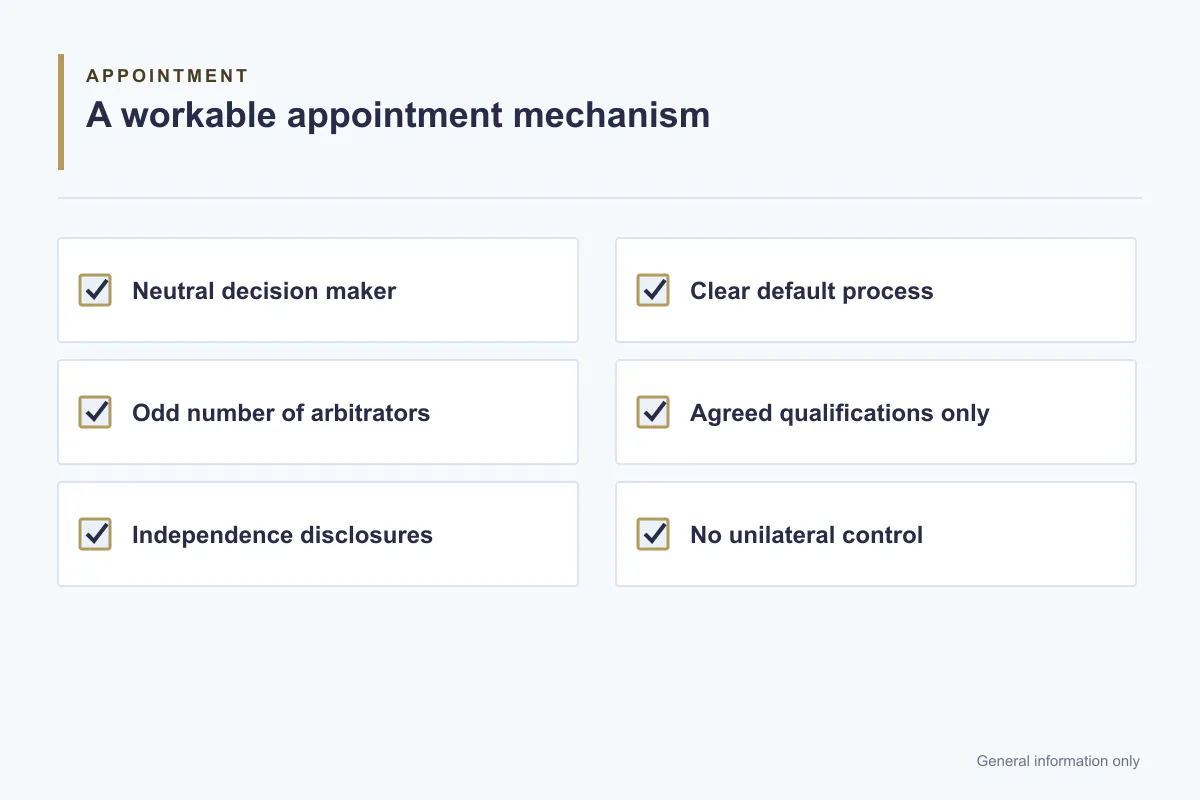
8. Is the appointment mechanism neutral and workable?
Appointment wording is a recurrent source of litigation. A clause should not give one interested party an exclusive right to appoint the sole arbitrator. The Supreme Court’s Perkins Eastman Architects DPC v HSCC (India) Ltd decision and later cases require close review of unilateral mechanisms and statutory ineligibility.
Check:
- Does each side have a balanced role?
- Is the named appointing authority independent and still in existence?
- Does the mechanism work if one party does not cooperate?
- Are Sections 11 and 12 and the Fifth and Seventh Schedules addressed by the design?
- Does any waiver language attempt to operate before a dispute, when the statutory scheme requires a later express agreement in writing for certain waivers?
9. How is arbitration invoked?
Section 21 states the default commencement rule: unless otherwise agreed, proceedings commence when the respondent receives a request to refer the dispute to arbitration. The contract should coordinate that requirement with its general notice clause.
Specify:
- permitted service addresses and electronic channels;
- when a notice is treated as received;
- the information the invocation should contain;
- whether a prior negotiation or mediation step is mandatory;
- time limits that are realistic and legally reviewed; and
- what happens if a named representative or address changes.
Do not create a short contractual period that could unintentionally prejudice a claim without advice on limitation and enforceability.
10. What language and hearing arrangements apply?
Choose the arbitration language, especially where contracts and evidence use more than one language. If virtual hearings or flexible hearing locations are expected, the clause may recognise them without changing the seat.
Operational details should not remove the tribunal’s reasonable procedural control. Over-drafting every hearing step can make the clause obsolete or internally inconsistent.
11. How will urgent interim protection be obtained?
A clause should not accidentally exclude remedies the parties may need to preserve property, evidence, goods or the efficacy of the process. The Arbitration Act provides court measures under Section 9 and tribunal measures under Section 17, subject to their statutory conditions.
The clause review should ask:
- Are court and tribunal interim remedies preserved?
- Do chosen institutional rules provide emergency relief?
- Does a foreign seat affect the availability of Indian court support?
- Are asset location and enforcement realities understood?
The procedure and threshold for Section 9 interim relief in arbitration require separate, case-specific analysis.
12. Are confidentiality and data obligations realistic?
Section 42A addresses confidentiality subject to its terms and enforcement disclosure. Contracts may also contain broader confidentiality, privacy, cybersecurity or regulatory duties.
The clause should allow necessary disclosure to lawyers, experts, witnesses, funders where lawful, courts and enforcement authorities. Absolute secrecy language can be unworkable when a party must seek interim relief, challenge an award or enforce it.
13. Who pays the costs?
The clause can identify applicable rules or a broad costs framework, but it should not predetermine costs in a way that undermines tribunal discretion or applicable law. Section 31A provides a statutory costs regime.
Review filing fees, tribunal fees, deposits, venue expenses, expert costs and currency. A dispute process can become disproportionate where the clause mandates an expensive institution or three arbitrators for a modest claim.
14. Does the transaction need joinder or consolidation language?
Construction, technology, supply-chain and investment structures may involve several contracts and parties. Separate clauses with different seats, institutions or appointment mechanisms can make coordinated proceedings difficult.
Map all related agreements before signing. If consolidation or joinder is desired, align clauses and institutional rules. The clause cannot bind a non-consenting person merely by declaring that all related disputes will be combined.
15. Does the clause survive termination and remain severable?
The arbitration agreement is treated as separable from the main contract for the purposes recognised by Section 16. The contract may also state that the clause survives expiry or termination to reduce avoidable argument.
Review whether termination, rescission, assignment, novation or amendment language unintentionally deletes or replaces the clause.
16. Is the award and enforcement framework coherent?
Avoid language that promises an award can never be challenged. Statutory recourse and enforcement rules cannot be removed by an inaccurate “final and binding” sentence.
Before selecting a seat or institution, consider where counterparties and assets are located, whether the expected award would be domestic or foreign, and which enforcement convention or statutory part may apply.
Red flags in an arbitration clause
- “May arbitrate” language without a clear agreement.
- No defined disputes or legal relationship.
- A venue but no clear seat.
- Seat and exclusive-jurisdiction clauses pointing in different directions.
- A non-existent institution or incompatible rules.
- An even number of arbitrators.
- One interested party exclusively appointing the sole arbitrator.
- Multi-contract clauses with different seats or procedures.
- No workable service mechanism.
- Mandatory pre-arbitration steps with no trigger or end point.
- Absolute confidentiality that prevents lawful court or enforcement disclosure.
- A procedure whose cost is disproportionate to likely claims.
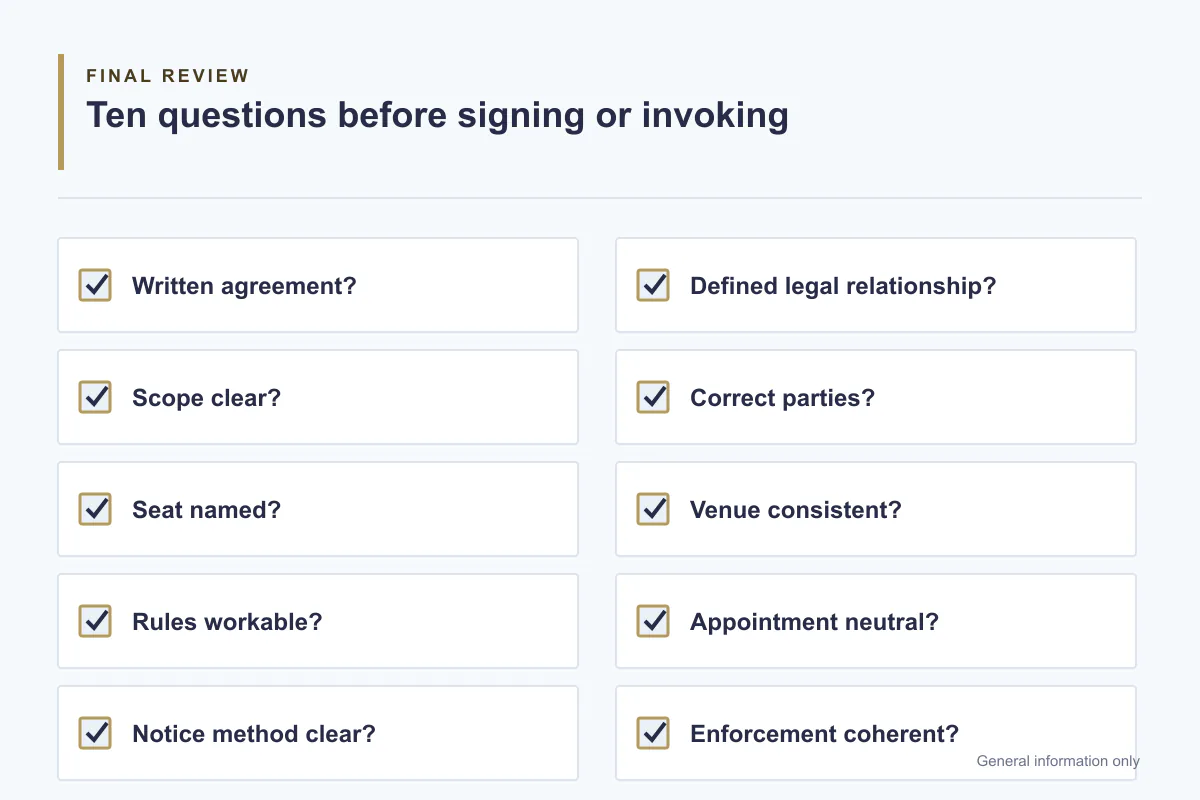
Arbitration clause checklist India: final ten-question review
- Is there an unequivocal written agreement to arbitrate?
- Which disputes and which documents are covered?
- Which entities are actually bound?
- What is the juridical seat, and is venue separate?
- Which substantive and arbitration-agreement laws apply?
- Is the arbitration institutional or ad hoc?
- Is the tribunal number and appointment mechanism neutral and workable?
- How are notice, language and pre-arbitration steps handled?
- Are interim protection, confidentiality, costs and multi-party issues addressed?
- Does the clause fit the jurisdiction, termination and enforcement provisions?
Frequently asked questions
Is a one-line arbitration clause valid?
Length alone does not determine validity. A short clause may record a valid agreement, but missing procedural choices can generate satellite disputes and court applications.
Are “seat” and “venue” interchangeable?
No. Seat is a juridical concept; venue ordinarily describes where hearings occur. Ambiguous wording may require judicial interpretation, so the intended seat should be express.
Can one party appoint the sole arbitrator?
Unilateral appointment language requires close review under the current Act and Supreme Court authorities. A neutral, balanced mechanism is safer.
Should every contract copy the same arbitration clause?
No. Claim size, parties, transaction structure, asset location, confidentiality, urgency and cross-border enforcement can require different choices.
Does an arbitration clause prevent all court proceedings?
No. The Act itself contemplates limited court involvement, including referral, appointment, interim measures, evidence assistance, challenge, appeal and enforcement in defined circumstances.
Related ManAT Resources
- Arbitration and dispute resolution
- Corporate and commercial legal services
- Essential clauses in employment contracts
This arbitration clause checklist India guide is general information, not legal advice. Arbitration wording should be reviewed against the complete contract, transaction, current statute and likely enforcement jurisdictions.
For the later lifecycle stage, see why a post-award challenge is a separate court process.