

IBC Demand Notice for Operational Creditors: Eligibility, Forms and the Ten-Day Stage
Reviewed by Ann Finiya Pereira, Advocate, ManAT Legal
An IBC demand notice operational creditor checklist starts with Section 8 of the Insolvency and Bankruptcy Code, 2016. The prescribed notice is a statutory step before an operational creditor may apply under Section 9 to initiate a corporate insolvency resolution process; it is not merely a strongly worded request for payment.
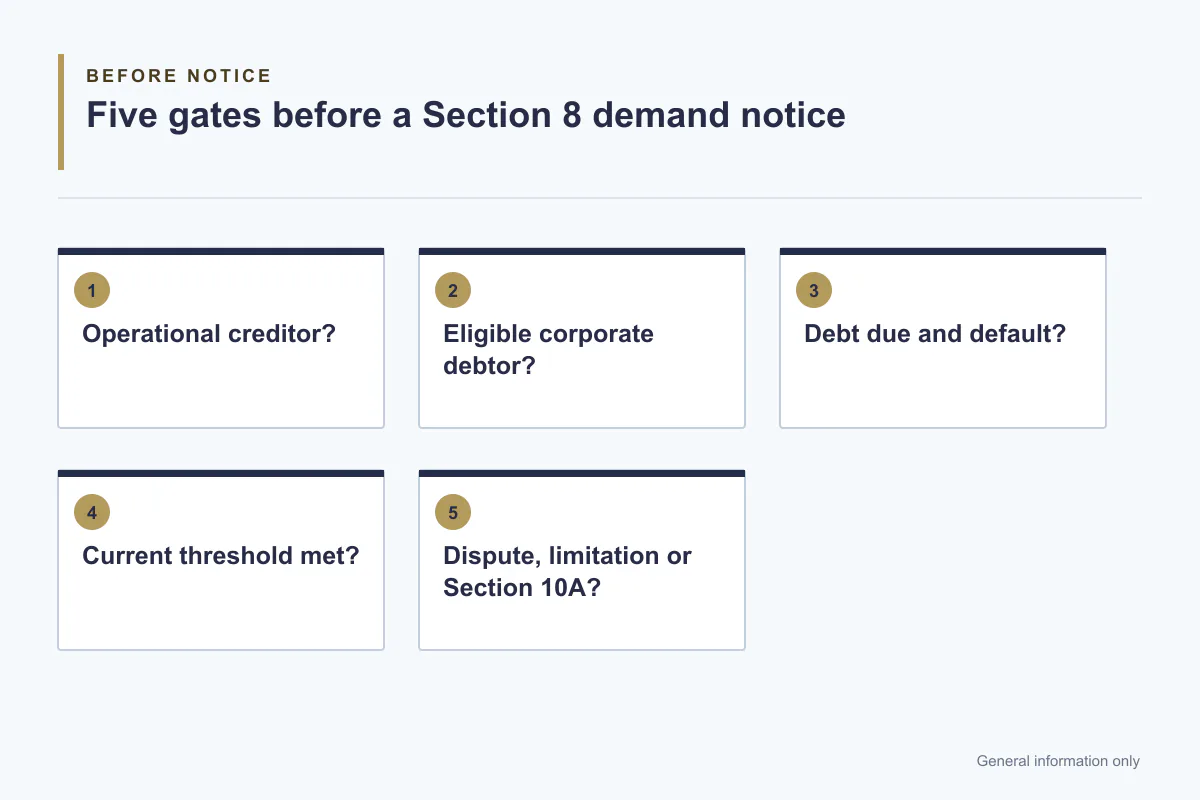
Before using the IBC demand notice operational creditor route, the creditor should test the claim against the Code: Is the claimant an operational creditor? Is the respondent a corporate debtor covered by the process? Is there an operational debt and a legally relevant default? Does the amount meet the current threshold? Is there a genuine pre-existing dispute, complete payment, limitation problem or Section 10A exclusion?
If those gates are not satisfied, an ordinary recovery route may be more appropriate. The IBC is designed for collective insolvency resolution, not to adjudicate every unpaid invoice or pressure a solvent business to pay a disputed claim.
What is the purpose of a Section 8 notice?
Section 8 allows an operational creditor, on occurrence of default, to deliver a demand notice of unpaid operational debt or a copy of an invoice demanding payment to the corporate debtor in the prescribed manner.
The notice creates a defined ten-day stage. Under Section 8(2), the corporate debtor may bring to the creditor’s notice:
- the existence of a dispute or specified pending suit/arbitration concerning the dispute; or
- payment of the unpaid operational debt through the records described by the provision.
The process is therefore an eligibility and dispute screen before Section 9, not an assured route to admission.
Gate 1: Is the claimant an operational creditor?
Section 5(20) defines an operational creditor by reference to a person to whom an operational debt is owed and includes specified assignees/transferees. Section 5(21) defines operational debt in relation to claims for goods or services, including employment, and specified statutory dues.
The label on an invoice or contract is not decisive by itself. Review:
- what goods or services were provided;
- who supplied them and to whom;
- whether the claim has been assigned;
- whether the debt is actually financial rather than operational;
- whether interest is contractual or otherwise legally supportable; and
- whether the claimant and debtor named in the records match the proposed notice.
Mixed or unusual transactions require careful classification.
Gate 2: Is the respondent an eligible corporate debtor?
Sections 8 and 9 operate within Part II’s corporate insolvency framework. Confirm the respondent’s exact legal identity and status through current official corporate records.
Do not issue a Section 8 notice to a trade name, proprietor or unrelated group company merely because it communicated about payment. A sole proprietorship is not transformed into a corporate debtor by using a business name. Partnerships, LLPs, companies, guarantors and individuals can raise different statutory questions.
Verify:
- registered legal name and identification number;
- registered office;
- company or LLP status;
- contracting entity and invoice recipient;
- mergers, name changes, strike-off, liquidation or an existing insolvency process; and
- whether another entity actually assumed the obligation.
Gate 3: Has an operational debt fallen due and default occurred?
Map the contractual path from performance to due date and default. A notice should distinguish:
- total transaction value;
- amounts invoiced;
- credits, returns, deductions or part-payments;
- principal claimed in default;
- interest and its legal basis;
- due date for each invoice or milestone; and
- the date on which default is alleged.
Attach or preserve the contract, purchase orders, work orders, delivery records, acceptance records, invoices, tax documents, ledgers, bank entries and communications. An internally generated ledger alone may not answer a dispute about performance or acceptance.
Gate 4: Does the default meet the current threshold?
Section 4 governs the minimum amount of default for Part II. The Central Government’s 24 March 2020 notification specified one crore rupees as the minimum amount of default for Section 4.
Threshold analysis is not always a simple invoice-total exercise. Counsel should examine:
- the relevant default or aggregation theory;
- legally supportable interest;
- credits and admitted part-payments;
- filing date and the applicable notification;
- whether the claim falls under a distinct statutory process; and
- any later amendment or notification.
Do not inflate a claim with unsupported interest or damages to cross a jurisdictional threshold.
Gate 5: Is the claim affected by limitation or Section 10A?
Section 238A applies the Limitation Act to proceedings before the NCLT/NCLAT as far as may be. The limitation start, acknowledgments, part-payments, invoices, continuing accounts and prior proceedings require document-specific analysis. A notice does not automatically revive a time-barred claim.
Section 10A permanently bars applications for defaults arising during the protected pandemic period specified by that provision and notifications. The date of default must therefore be checked, even years later.
Do not state a universal “three-year rule” without analysing the source of the debt, accrual, acknowledgment, payment and applicable Article.
Is there a pre-existing dispute?
This is a central Section 9 gate. In Mobilox Innovations Pvt Ltd v Kirusa Software Pvt Ltd, the Supreme Court explained the test for a pre-existing dispute and that the tribunal is not to conduct a full merits trial at admission. A plausible contention requiring investigation can be enough; a patently feeble legal argument or unsupported assertion is different.
Before notice, review all correspondence for:
- quality or specification objections;
- delay, non-delivery or incomplete-service allegations;
- rejected invoices or debit notes;
- warranty or rectification demands;
- set-off or counterclaim assertions;
- termination and damages notices;
- pending suit or arbitration; and
- settlement or “full and final” communications.
Silence from the debtor does not prove absence of a dispute. Conversely, a dispute manufactured only after receipt of the Section 8 notice may be analysed differently from a documented earlier dispute.
The Insolvency and Bankruptcy Code (Amendment) Act, 2026 inserted Section 67C concerning concealment in a Section 9 application of a notified dispute or full and final payment. The Central Government’s 22 May 2026 commencement notification brought the relevant amendment provision into force on 26 May 2026. Current rules, regulations and later notifications should still be checked on the intended filing date.
Form 3 or Form 4?
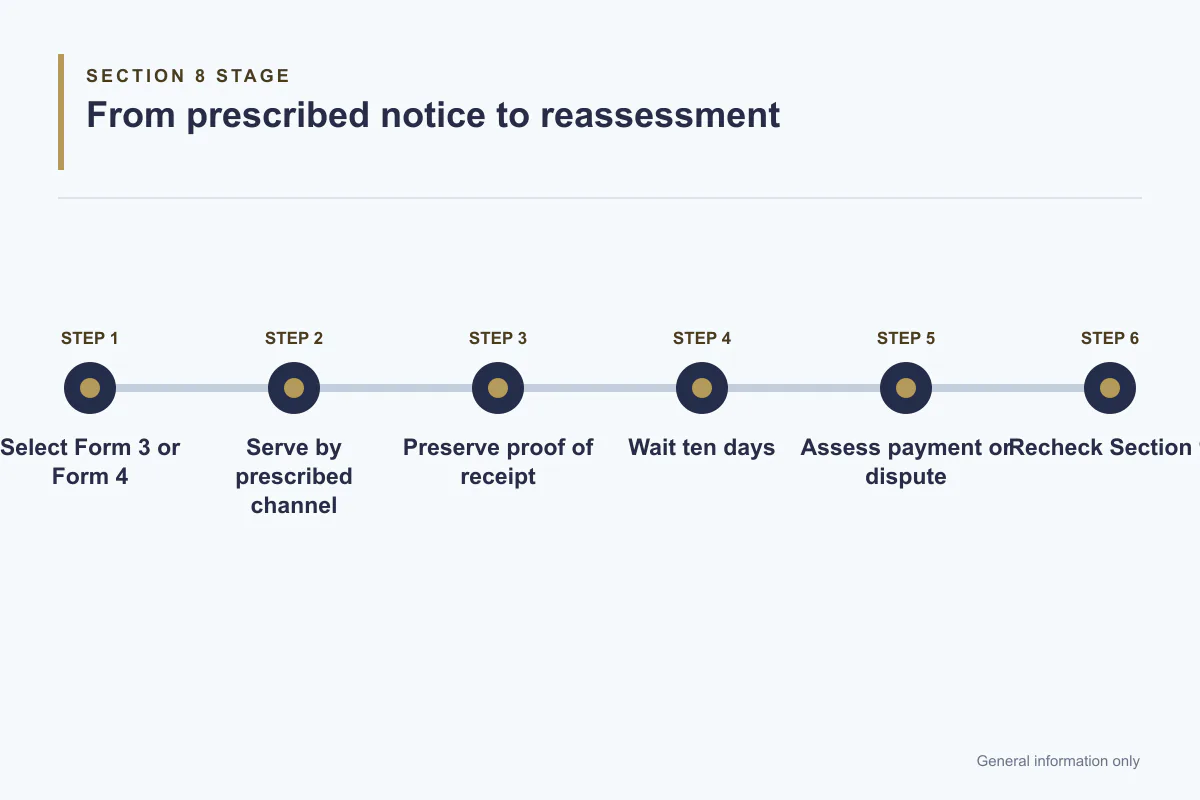
Rule 5(1) of the Insolvency and Bankruptcy (Application to Adjudicating Authority) Rules, 2016 prescribes:
- a demand notice in Form 3; or
- a copy of an invoice attached with a notice in Form 4.
The correct form should be selected after reviewing the nature and documentary basis of the operational debt and current appellate authority. Do not choose a form simply because an online template is shorter.
Form 3 requires detailed particulars of the operational debt, including transaction and default information and documents proving the debt. Form 4 accompanies the invoice demanding payment. Current forms and amendments must be downloaded from the official legal framework at the time of use.
What should be reconciled before the notice is issued?
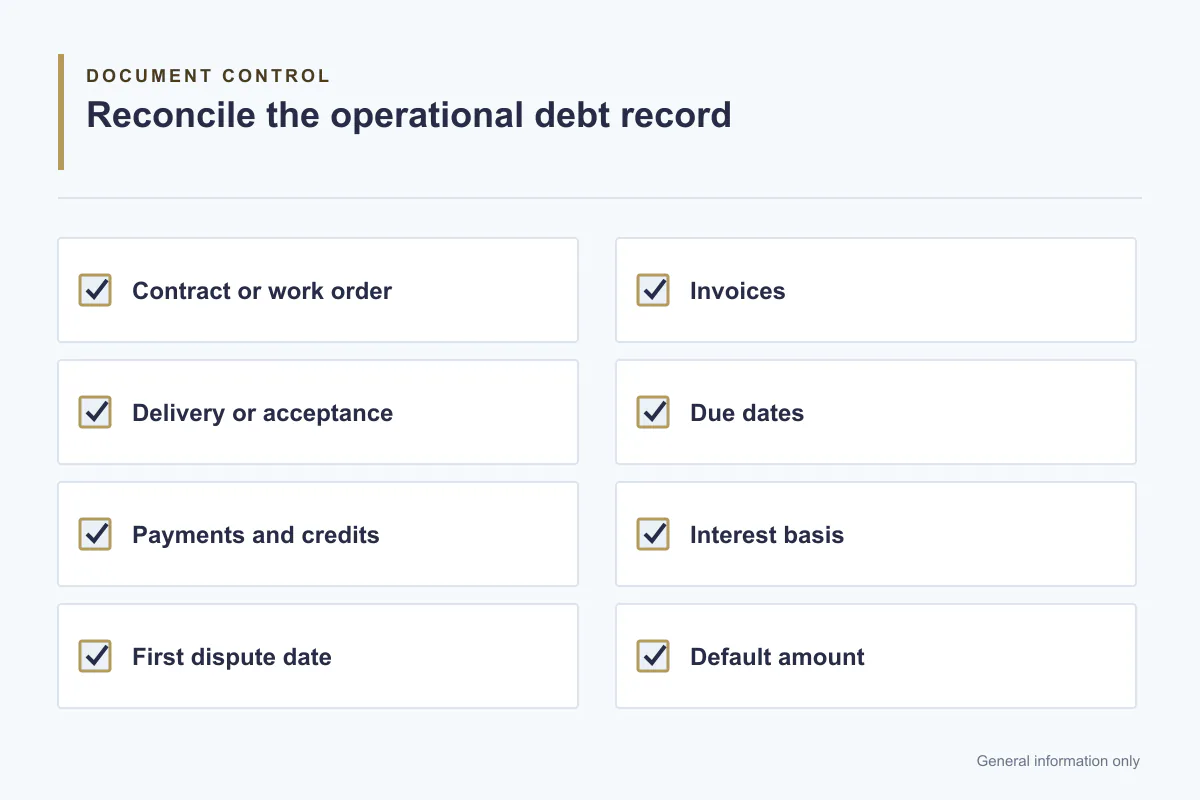
Create a transaction schedule with one row per invoice or obligation:
| Field | Verification |
|---|---|
| Contract/work order | Date, parties, scope, payment term and dispute clause |
| Invoice | Number, date, taxable value and recipient |
| Performance | Delivery, completion, acceptance or usage record |
| Due date | Contractual calculation and any extension |
| Payments/credits | Date, amount, allocation, debit/credit note |
| Default amount | Principal plus separately supported interest |
| Dispute | Earliest objection and supporting communication |
| Limitation | Accrual, acknowledgment, part-payment and proceedings |
The figure in the notice should reconcile with the ledger, bank records, tax records and proposed Section 9 application. Unexplained differences create avoidable objections.
How must the notice be delivered?
Rule 5(2) permits delivery to the corporate debtor at its registered office by hand, registered post or speed post with acknowledgment due, or by electronic mail to specified senior personnel. Rule 5(3) addresses filing a copy with an information utility, if any.
Service should be planned, not improvised. Preserve:
- current registered-office search;
- postal receipt and complete tracking history;
- delivery acknowledgment or returned envelope;
- email headers and delivery information;
- identity/capacity of the electronic recipient;
- the exact signed notice and every enclosure; and
- proof of filing with the information utility where applicable.
Sending only to a salesperson, old office or generic address may not establish prescribed service.
What happens during the ten-day period?
Section 8(2) gives the corporate debtor ten days from receipt to bring the specified dispute or payment information to the creditor’s notice. The creditor should not file a Section 9 application before the statutory period expires.
During this period, record:
- actual delivery date;
- each response and enclosure;
- any payment and whether it is full, part or disputed;
- settlement communications;
- new evidence of an earlier dispute; and
- the date on which the filing window is assessed.
The creditor must evaluate the response honestly. Section 9 is not the correct forum to try a substantial contractual dispute merely because the creditor disagrees with the defence.
What should a corporate debtor do on receipt?
A corporate debtor should immediately preserve the notice, envelope, email and attachments and identify the receipt date. It should gather the contract, invoices, performance records, payments and all pre-notice dispute correspondence.
A response should be fact-specific and supported. It may need to address:
- wrong entity or classification;
- no debt/default or incorrect calculation;
- complete or part payment;
- threshold or limitation;
- pre-existing quality/performance dispute;
- pending suit or arbitration;
- settlement, credit or set-off; and
- defective form or service.
Creating documents retrospectively or making an unsupported denial can damage credibility.
What is required before a Section 9 application?
Section 9 and Rule 6 require a prescribed application, currently Form 5 under the Rules, with the required documents and records. The official Rules identify annexures including the served notice, referred documents, affidavit, application fee proof and proof of service of the application on the corporate debtor and the Board, subject to current amendments.
Before filing, recheck:
- valid Section 8 service and completion of ten days;
- operational-debt classification;
- default and threshold;
- no disqualifying pre-existing dispute;
- no complete payment;
- limitation and Section 10A;
- correct NCLT territorial bench;
- complete, consistent annexures; and
- current electronic filing, information-utility and regulatory requirements.
The 2026 Amendment Act changed a Section 9 information requirement and added a duty to record reasons if the Adjudicating Authority does not decide the application within fourteen days. Section 5 of the Amendment Act came into force on 26 May 2026 under the commencement notification. Current forms, filing rules and implementing regulations must still be checked.
Why IBC is not a recovery notice
Admission affects the corporate debtor and all stakeholders. CIRP is a collective process directed at insolvency resolution, with a moratorium and creditor process:not a private decree for the notice sender.
The Supreme Court has repeatedly distinguished insolvency resolution from ordinary recovery. A creditor seeking adjudication and payment of an individual disputed claim may need a recovery suit, arbitration or another route instead.
IBC demand notice operational creditor: ten-point pre-notice checklist
- Confirm claimant and corporate debtor identities.
- Classify the debt as operational.
- Reconcile contract, performance, invoices, credits and payments.
- Calculate default and current threshold lawfully.
- Identify default date, limitation and Section 10A.
- Audit every pre-notice dispute communication.
- Choose the prescribed form on current law.
- Use verified service channels and preserve proof.
- Wait the full statutory period and assess the response.
- Revalidate Section 9 and all 2026 amendments before filing.
Common defects and risks
- Notice to the wrong legal entity.
- Financial or other debt incorrectly labelled operational.
- Amount below the applicable threshold.
- Unsupported interest used to cross the threshold.
- Limitation or Section 10A ignored.
- Pre-existing dispute omitted or mischaracterised.
- Invoice, ledger and default amounts not reconciled.
- Wrong or outdated form.
- Service only to an unprescribed address/person.
- Section 9 application filed before ten days expire.
- IBC threatened as a substitute for adjudication or collection.
Frequently asked questions
Is a Section 8 notice the same as a legal notice for payment?
No. It is a prescribed statutory step linked to a possible Section 9 insolvency application and must satisfy the Code and Rules.
Can an operational creditor file immediately after sending the notice?
No. Section 8 provides a ten-day response stage after receipt. Filing timing must be calculated from valid delivery.
Does an unpaid invoice automatically qualify?
No. The claimant, debtor, debt, default, threshold, limitation, dispute and statutory exclusions must all be assessed.
What if the debtor raises a dispute?
The creditor must determine whether it is a genuine pre-existing dispute under current law. NCLT admission is not a trial of a substantial contractual dispute.
Will IBC produce a money decree for the creditor?
No. CIRP is a collective insolvency-resolution process. Individual recovery is not its primary relief.
Related ManAT Resources
This IBC demand notice operational creditor guide is general information, not a notice template or legal advice. A Section 8 notice and Section 9 strategy require current-law review of the complete transaction and debtor record.
A Section 8 operational-creditor notice concerns the corporate debtor; review a different process for a personal guarantor.