
Chargesheet Filed? 7 Essential Next Steps in Court
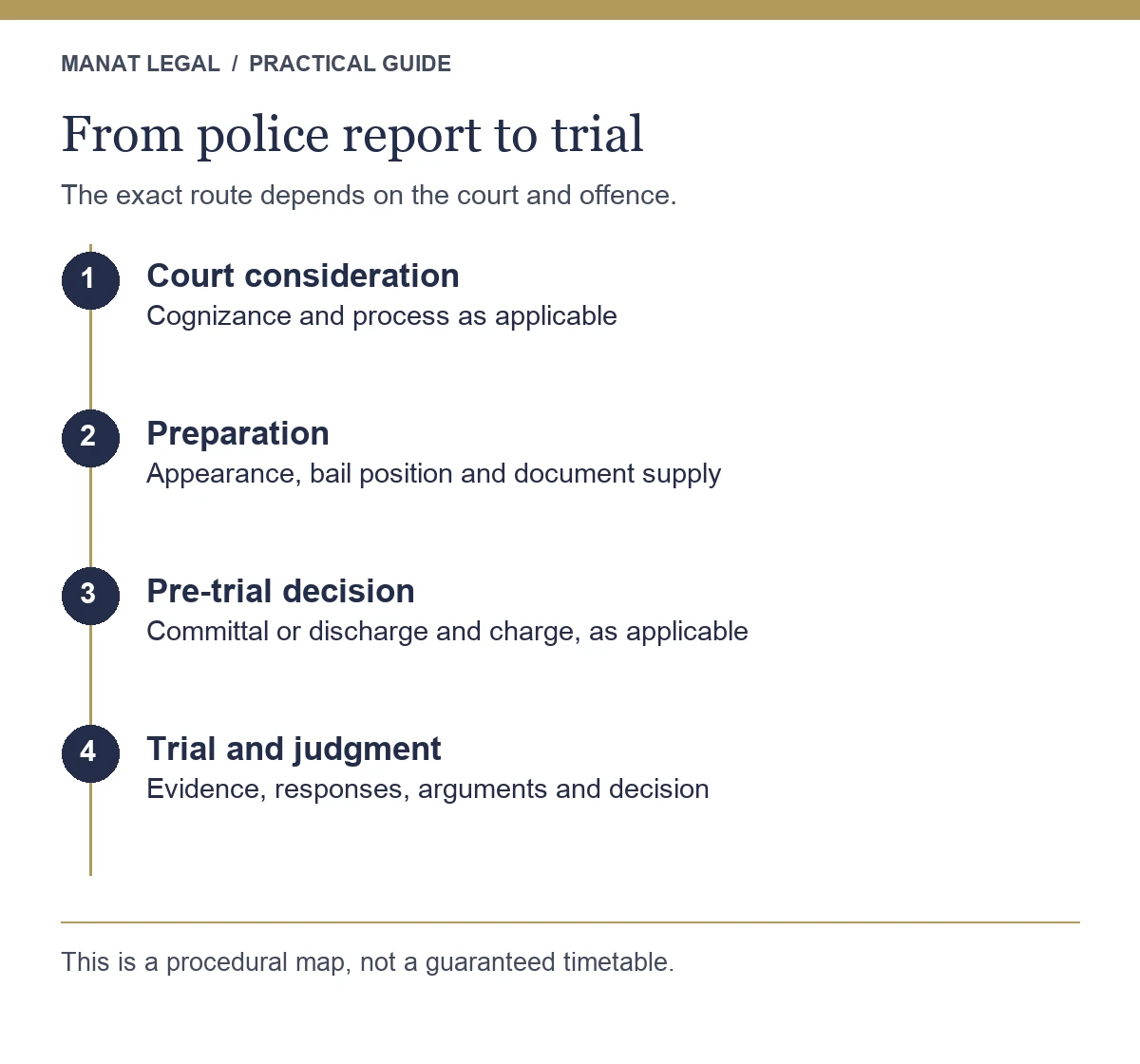
A chargesheet being filed does not mean the accused has been convicted. It means the police have placed their report and supporting material before the court for the next procedural stage. The court’s decisions about taking cognizance, issuing process, discharge, charge and trial are separate steps.
For a family following a criminal case, the immediate task is to find out what has actually been filed, which court has it and what the latest order requires. These seven steps explain what to organise after a chargesheet is filed, while recognising that the route varies with the offence, court and applicable procedure.
1. Confirm the chargesheet and the current court record
Obtain the correct FIR number, police station, court case number and filing information. A statement that ‘the investigation is over’ is not the same as confirmation that the report has been filed and taken up by the court. Check the order sheet or other reliable court record through the proper channel.
BNSS section 193 concerns the police report on completion of investigation. The report addresses the investigation’s outcome and specified particulars, with documents and witness statements forwarded as required. The court is not bound to treat the police’s conclusion as a finding of guilt.
The official BNSS text is the starting point for the current procedure. Older matters may continue under the Code of Criminal Procedure because of the savings provision. Special statutes may also prescribe a different route or court. Confirm the framework before applying a general timeline.
Ask whether the material filed is a chargesheet alleging offences, a closure report or a supplementary report. Those descriptions are not interchangeable. This guide focuses on a report seeking prosecution, not the separate options that may arise when a closure report is filed.
2. Understand cognizance and any process issued
Taking cognizance means the court takes judicial notice of the alleged offence for the purpose of proceeding under the law. It is not the same as conviction or the final acceptance of every witness account. The decision to issue summons or other process is also governed by the applicable procedure.
Read the actual order rather than relying on a short case-status label. Identify who has been summoned, the next date, the court and whether any attendance exemption or other direction exists. An accused person, a complainant and a witness do not necessarily have the same obligation on that date.
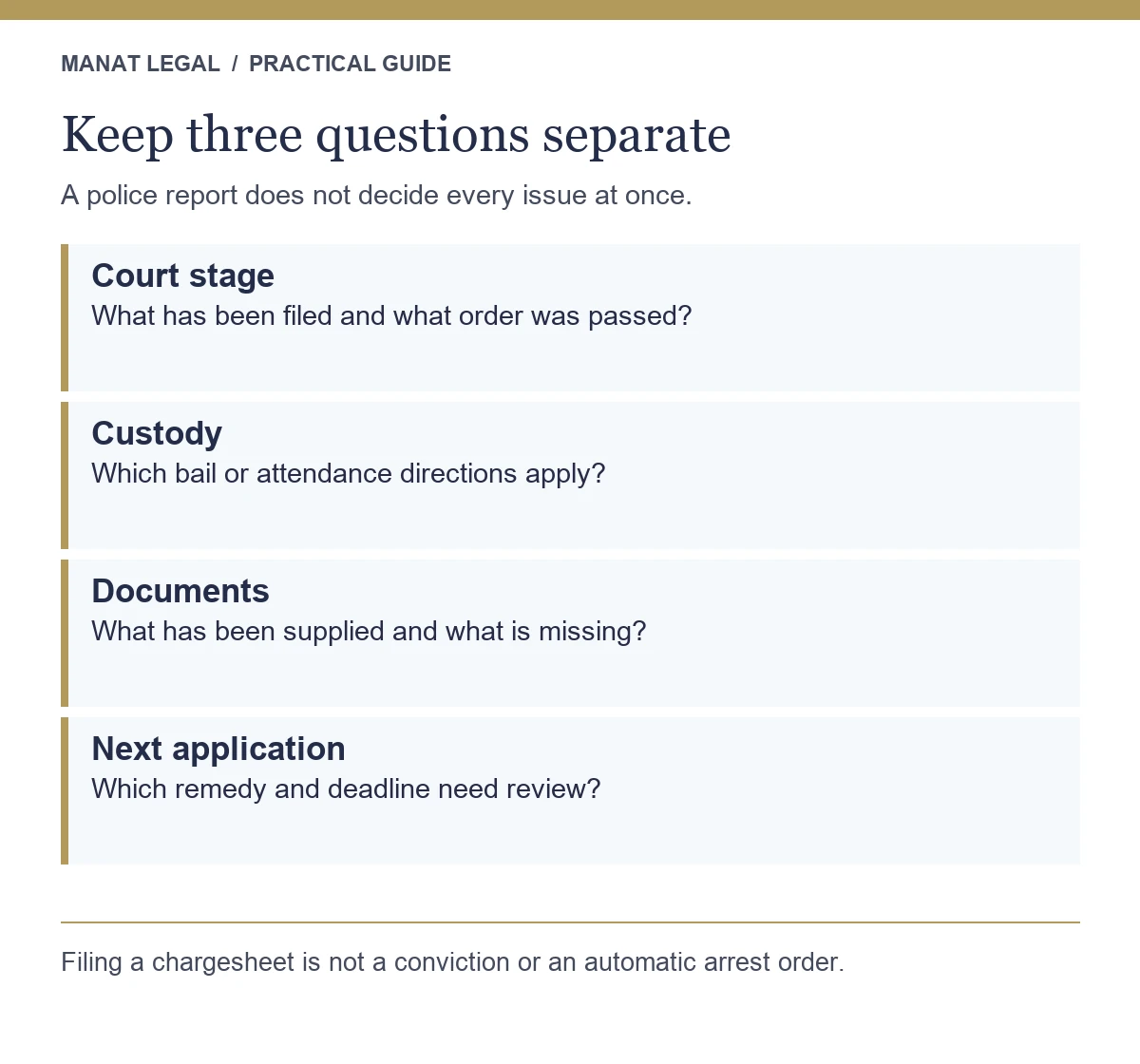
Do not ignore a summons because you were not arrested during the investigation. Equally, do not assume that the filing of a chargesheet by itself requires automatic arrest. The custody position, earlier orders and governing law need separate assessment.
If an order or summons contains an apparent error, such as an incorrect name or address, tell your advocate promptly. Keep the document and service details. Do not simply decide that the whole proceeding can be disregarded because one detail appears wrong.
3. Review bail and attendance separately from the merits
An existing bail order should be read for its duration, conditions and any requirement associated with filing of the report or appearance before a court. Do not assume it expires on filing, and do not assume it continues regardless of what the order says. Counsel should check the actual wording and applicable law.
If the person is in custody, the appropriate regular-bail assessment depends on the facts and stage. If the person has remained outside custody, advice on appearance and any bail or bond requirement should be obtained before the next date. Filing is one event in the case, not a universal answer to custody questions.
Continue complying with lawful directions, including attendance, travel restrictions and conditions about contacting witnesses. Keep records of compliance. Preparing a discharge or quashing application does not automatically suspend those obligations.
Our guide to regular bail before Magistrate and Sessions courts explains the separate bail routes. The immediate priority after a chargesheet is filed is to know which order governs the person’s position today.
4. Obtain and check the prosecution documents
Section 230 BNSS addresses supply of the police report and specified documents where proceedings are instituted on a police report. It provides for supply without delay and no later than fourteen days from production or appearance of the accused, to the accused and to the victim if represented by an advocate, subject to the section’s provisions.
The statutory starting point is important: it is not a blanket fourteen-day period measured from every chargesheet filing. The provision also addresses electronic supply and practical arrangements for voluminous material. Ask what has actually been supplied and whether the set is complete and readable.
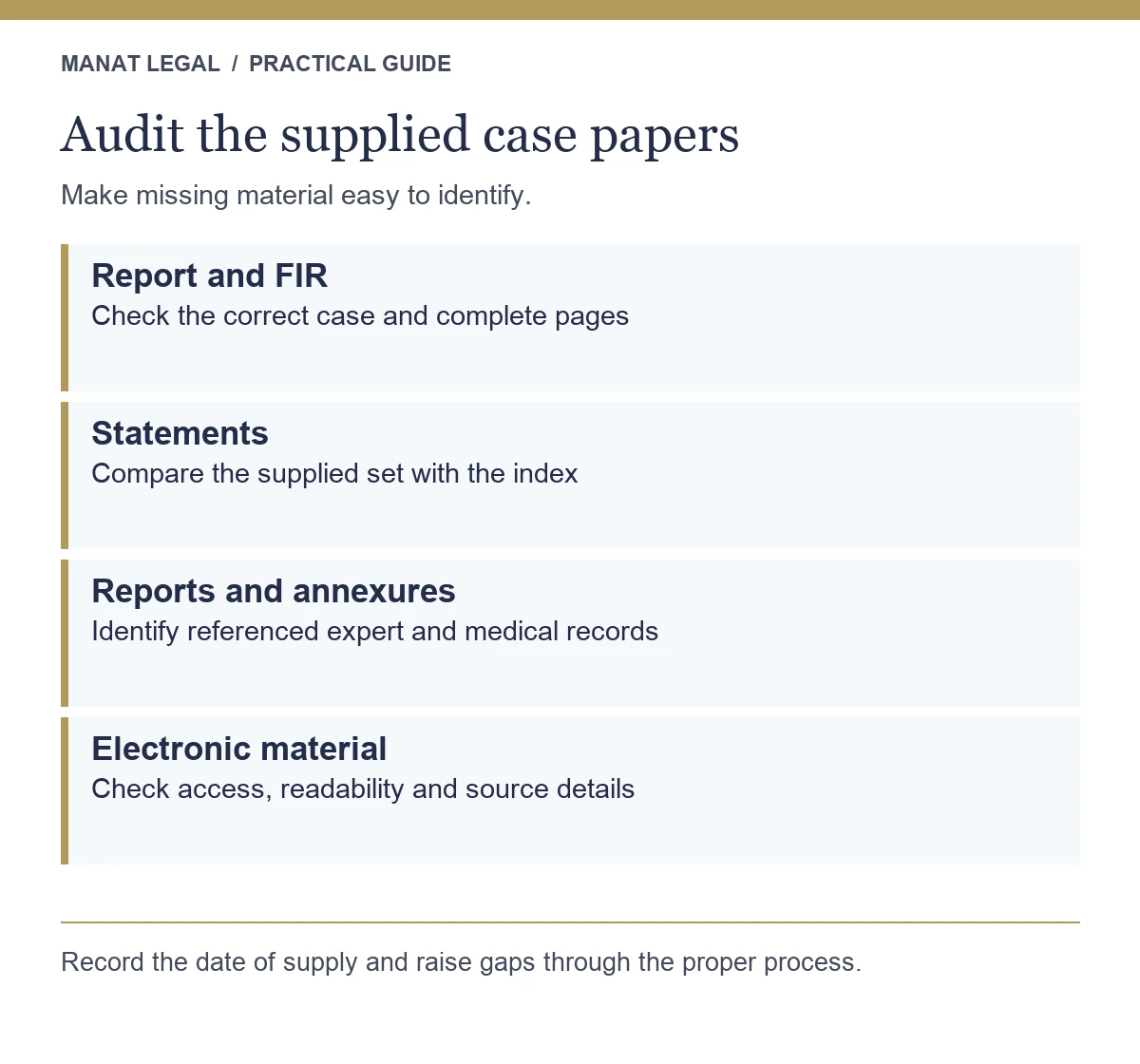
Check the index against the papers received. Identify missing pages, illegible statements, unavailable annexures, referenced expert reports and electronic material that cannot be opened. Record the issue clearly so that an appropriate request can be made; do not assume an omitted document will never be relied upon.
Preserve the received set without marking the only copy. Use a working copy for notes and keep a simple record of when documents were supplied. That date can matter for the next procedural step. Do not confuse entitlement to specified documents with an unrestricted right to inspect the entire police case diary.
5. Identify the trial route and any discharge application
Where an offence is exclusively triable by the Court of Session, the committal procedure under section 232 BNSS is relevant. Other cases follow the applicable Magistrate procedure. A warrants case, summons case and special-statute proceeding should not be treated as the same pathway.
For a Sessions case, section 250(1) provides that the accused may apply for discharge within sixty days from commitment under section 232. For a warrant-case instituted on a police report before a Magistrate, section 262(1) specifies sixty days from supply of copies under section 230. The triggers differ, so record the correct event and obtain timely advice.
A discharge application asks the court to apply the relevant pre-trial test to the record and submissions. It is not a full trial in which every disputed defence assertion is resolved. Counsel should identify the legal grounds available at that stage rather than filing a general statement that the allegation is false.
Discharge and quashing are different remedies. A High Court petition is not a routine substitute for every trial-court application, and filing one does not itself stay proceedings. If a deadline may have passed or the procedural history is unclear, seek advice promptly rather than assuming the same answer applies to every case.
6. Understand framing of charges and the trial ahead
Framing of charges is the court’s formal identification of the offences for which the accused is to be tried under the applicable procedure. It is different from the police filing a chargesheet. A charge is not a conviction; the prosecution must establish its case through the legal process.
The court reads and explains the charge and deals with the plea as provided by law. Subsequent stages may include prosecution evidence, cross-examination, examination of the accused, defence evidence where applicable, arguments and judgment. The precise sequence depends on the type of trial.
Prepare for hearings by identifying the issue each document or witness addresses. Keep factual instructions to your advocate accurate and consistent. Do not contact witnesses to influence their account or try to improve the record by altering messages, receipts or other material.
There is no reliable universal promise that a case will finish a fixed number of weeks after the report is filed. Witness availability, applications, the court’s schedule and the nature of the evidence affect progress. Track actual orders and next steps instead of treating a general flowchart as a guaranteed timetable.
7. Keep watch for further reports and changing directions
Section 193 permits further investigation and additional reports in the circumstances it describes. Its proviso addresses further investigation during trial with the court’s permission and the stated period, which the court may extend. The first chargesheet should therefore not be assumed to be the last document that can ever enter the prosecution record.
When additional material is filed, ask how it affects document supply, the allegations and any pending application. Keep the original and supplementary sets clearly labelled. Do not silently replace the earlier file and lose track of what was available when a particular order was made.
For a complainant or victim, keep contact details current and follow advice about participation, representation and any witness summons. For an accused person, maintain the attendance and compliance calendar. Neither role benefits from relying only on informal updates from the other side.
A practical case folder should contain the current order sheet, bail orders, supplied report and documents, a list of missing material, and the dates relevant to discharge or other applications. That makes each conversation with counsel about a concrete decision instead of the broad question, ‘What happens now?’
Frequently asked questions
Does a chargesheet mean the case is proved?
No. It is a police report placed before the court. Cognizance, charge, evidence and the eventual judgment are separate stages governed by the applicable law.
Will I be arrested as soon as the chargesheet is filed?
Filing alone does not provide a universal answer. Review the custody history, summons, bail orders and applicable law with your advocate before the next court date.
When should I consider a discharge application?
Seek advice promptly after identifying the trial route and receiving the relevant documents or committal order. BNSS sections 250 and 262 use different sixty-day triggers for their respective procedures.
Can the police file more material later?
Further investigation and supplementary reports may be possible under the applicable procedure. Section 193 BNSS includes conditions relating to further investigation during trial. Check the actual order and stage.
Is framing of charges the same as filing the chargesheet?
No. The police file their report; the court considers whether and what charges should be framed under the relevant trial procedure. Neither event is itself a conviction.
For advice after a chargesheet is filed in Bengaluru, ManAT Legal’s criminal-law team can review the report, orders and upcoming procedural deadlines. This is general legal information; the correct route depends on the applicable law, court and case history.