

Cheating vs Breach of Contract: 5 Crucial Differences
Cheating vs breach of contract is often the real question behind a failed business transaction. Money was paid, a promise was not kept and the other side has stopped responding. Those facts can justify serious concern, but they do not answer whether the dispute is a civil claim, a criminal offence or both.
The key is to examine what was represented when the transaction began, what induced the payment or other action, and what the available records show about intention. Calling someone a ‘fraud’ in a demand notice cannot replace that analysis. These five distinctions help organise the evidence before choosing a legal route.
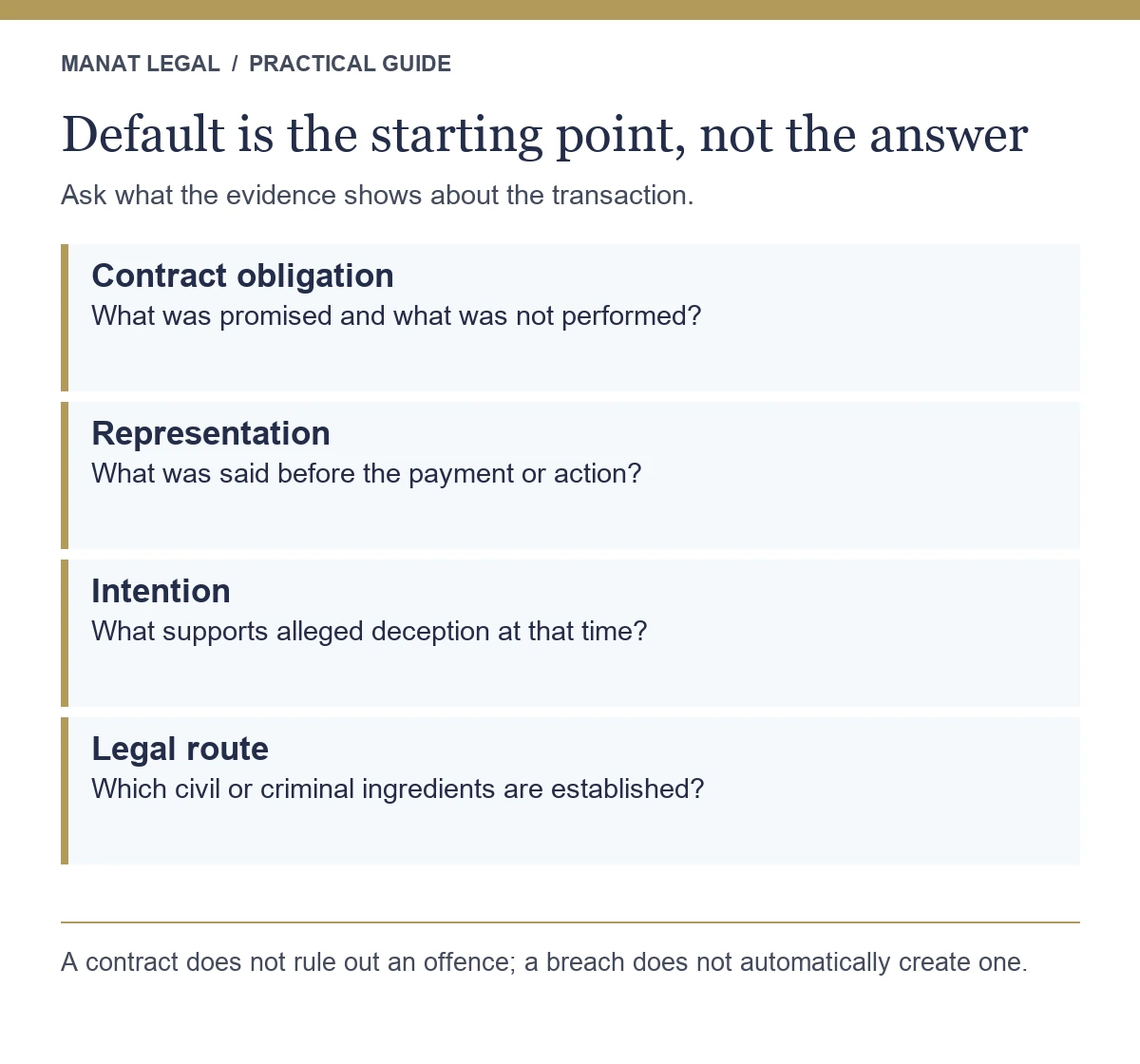
1. Cheating vs breach of contract turns on more than non-performance
A contractual claim starts with the parties’ obligations: what had to be supplied, paid, transferred or completed, and whether that obligation was breached. The reason for failure may affect the remedy, but a disappointed promise does not become criminal cheating simply because the loss is large.
Cheating involves the statutory ingredients of deception and the relevant inducement. In a contractual cheating allegation, dishonest intention at inception is central. The question is whether the person had the relevant deceptive intention when making the representation or promise, not merely whether the transaction later failed.
A supplier may genuinely intend to deliver goods and then encounter a serious production problem. That can still lead to contractual liability. A person who knowingly claims to possess goods that do not exist to obtain an advance raises a different factual issue. These are hypothetical examples; the records, explanations and applicable law determine the actual case.
Subsequent conduct can help assess the original intention, but later default alone is not a conclusive substitute for it. Avoid both shortcuts: ‘no delivery means cheating’ and ‘there is a contract, so it can only be civil’.
2. The timing of the representation changes the analysis
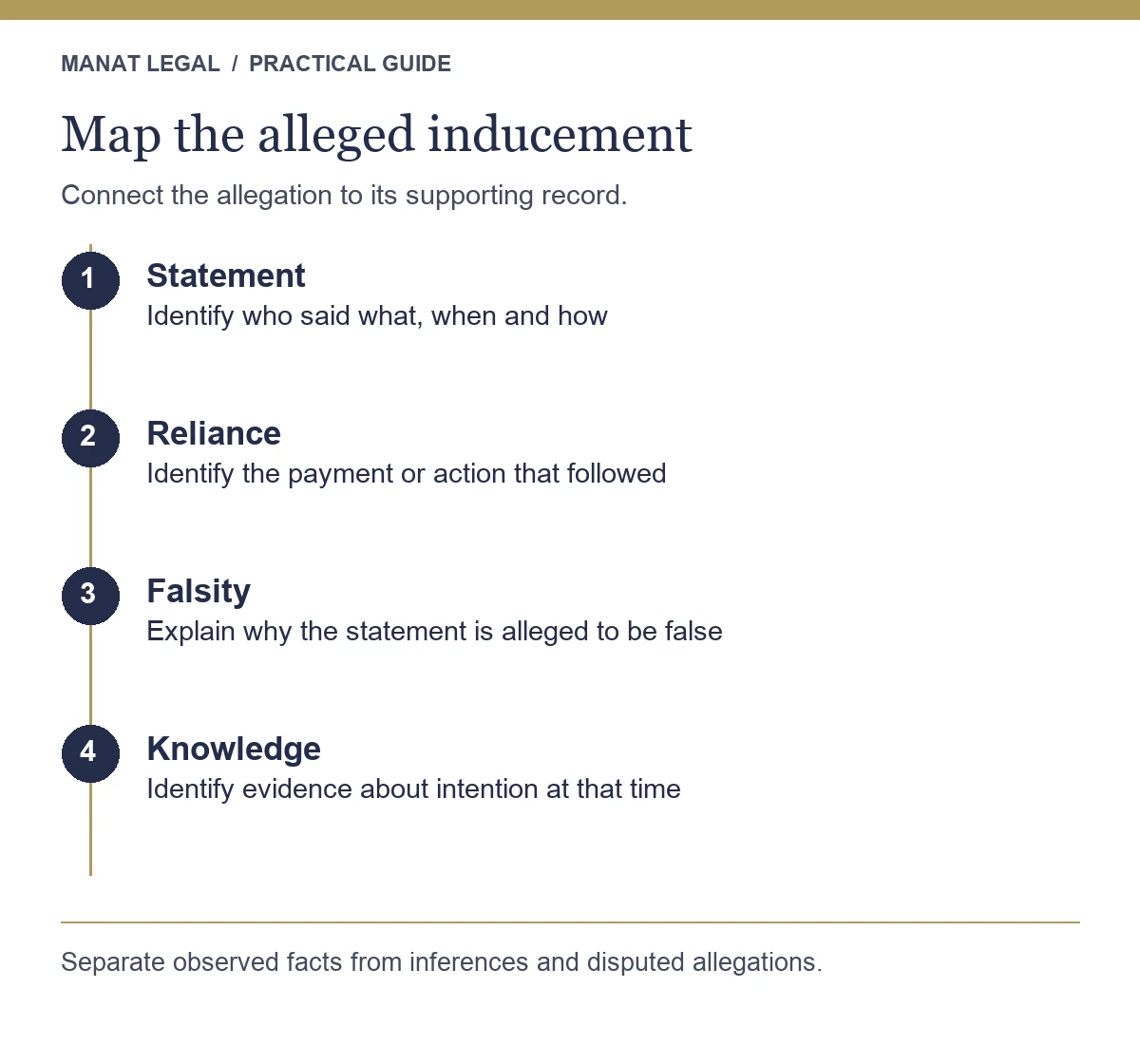
Place the events on a timeline. Identify the statement made before payment, the person who made it, how it reached the other party and the action allegedly taken because of it. An inaccurate statement discovered later needs to be connected to the original inducement; a general sense of betrayal is not enough.
Compare pre-contract emails, proposals, product descriptions, ownership documents and negotiations with later events. If a promised approval did not exist, ask what was actually said: was approval claimed to be already secured, or was obtaining it an acknowledged future condition? Those are materially different representations.
A later refusal to refund may support a recovery claim and may be relevant evidence, but it does not automatically prove the original state of mind. Likewise, partial performance or a partial refund is relevant without automatically disproving cheating. A court considers the overall circumstances rather than one reassuring or suspicious fact in isolation.
In its judgment of 16 April 2025 concerning Rikhab Birani and Sadhna Birani, the Supreme Court reiterated the distinction between breach of contract and cheating, including the importance of dishonest intention at the beginning of the transaction. The decision concerned IPC provisions; it should be read for its reasoning and facts, not treated as a guarantee that every payment dispute will be quashed.
3. A contractual loss and a criminal ingredient need different evidence
For a civil claim, the agreement, invoices, delivery records, payment trail and correspondence may establish the obligation, default and claimed loss. For cheating, the file must also address the alleged deception and inducement. The same document may be relevant to both, but the legal questions are not identical.
BNS section 318 sets out cheating in the Bharatiya Nyaya Sanhita, 2023. Its provisions distinguish forms of the offence; the subsection and alleged facts matter. Older transactions may engage the IPC and the applicable repeal-and-savings framework. Do not replace ‘420’ with a new number without examining the date and conduct alleged.
Prepare an evidence map rather than a collection of accusations. For each important statement, identify the document or witness supporting it, why it is said to be false and what action followed. If knowledge of falsity is inferred, explain the basis for that inference instead of presenting it as an observed fact.
Criminal breach of trust is a separate offence with its own requirements, including entrustment and dishonest dealing with the property. A normal payment under a sale transaction should not simply be labelled ‘entrustment’ because the deal went wrong. Your advocate should analyse the specific ingredients instead of adding offences for emphasis.
4. Civil and criminal remedies serve different purposes
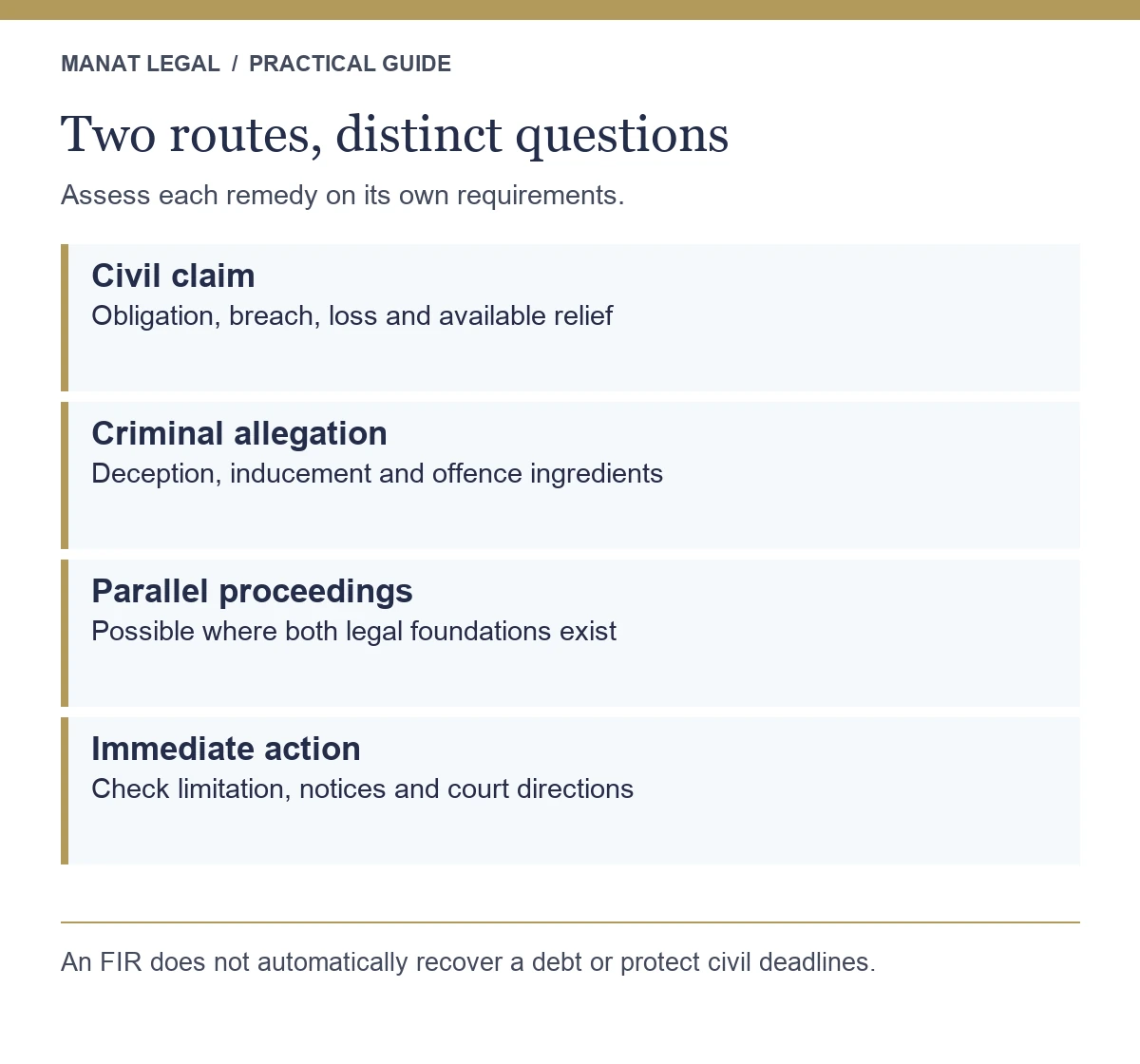
A civil suit or a contractually available arbitration may address recovery, damages, performance or other civil relief. The correct route depends on the agreement, jurisdiction, limitation and the relief sought. A legal notice can clarify a demand but does not decide whether a criminal offence exists.
A criminal complaint for non payment needs more than the unpaid amount if cheating is alleged. The complaint should set out the material facts supporting the offence. Criminal procedure should not be used as a debt-collection threat where the necessary ingredients are absent.
At the same time, civil and criminal remedies can coexist where the facts independently support both. An arbitration clause does not provide immunity from a genuine offence. Nor does a pending FIR automatically recover money or preserve every civil limitation period. Each proceeding needs its own legal assessment.
Keep the factual account consistent across notices, complaints, pleadings and settlement communications. If an earlier document described a delayed delivery and a later one alleges a knowingly false promise from the outset, be ready to explain the evidential basis for that difference. Do not change the facts merely to fit a preferred forum.
5. The next step depends on your role and the present stage
If you are considering a complaint, first organise the original representations and the resulting payment or action. Include facts that may weaken your position, such as contractual conditions, disclosed risks or your own outstanding obligations. An advocate cannot assess the dispute properly from favourable extracts alone.
If you have received a police notice or been named in an FIR, do not ignore it because you believe the issue is civil. Obtain the actual allegations and provisions, preserve records and seek advice on the notice, bail position and appropriate response. A civil defence and protection from arrest are separate matters.
Depending on the record and stage, counsel may assess whether a discharge application, a quashing petition or a defence at trial is appropriate. These routes have different tests and limits. A claim that the dispute is contractual does not by itself compel the High Court to end the case, especially where material facts require examination.
Keep settlement discussions lawful and accurately documented. Repayment or a private settlement does not automatically close an FIR or terminate every criminal proceeding. The offence, stage and applicable procedure determine what further order or process is required.
A practical comparison: two failed orders, different questions
Imagine two businesses each paying an advance for equipment. In the first transaction, the supplier identifies its manufacturer, shares genuine order confirmations and later reports a factory shutdown. In the second, the recipient allegedly uses fabricated stock records and a false warehouse address before taking the money. Both buyers may have an unpaid claim, but the second account raises a different question about the original representation.
The comparison is not a verdict. The first supplier’s documents may need verification; the second recipient may dispute fabrication or attribution. The exercise shows why cheating vs breach of contract should be assessed from the chronology and source documents, rather than from the amount lost or the intensity of later arguments.
A short case summary can separate what was promised, what was paid, what was delivered, what explanation was given and what evidence supports alleged deception. Note missing records openly. Do not manufacture a receipt, edit a conversation or pressure a witness to strengthen the account.
Documents to bring to the first legal review
Bring the full contract and amendments, pre-contract communications, payment records, invoices, delivery or acceptance records and all notices already exchanged. Include police papers and court orders if proceedings have begun. A one-page chronology will help connect the documents without replacing them.
For messages and emails, retain original files and relevant context. Our digital evidence preservation guide explains how to organise these records. If a complaint is appropriate, our separate FIR guide explains the reporting process.
- What precise representation induced the transaction?
- What evidence shows whether it was knowingly false at that time?
- Which contractual obligations remained unfulfilled on each side?
- What civil deadlines and police or court directions need attention now?
- What remedy is being sought, and which forum can grant it?
Frequently asked questions
Is failure to repay a loan always cheating?
No. Non-payment alone does not establish cheating. The original representations, inducement, intention and other statutory ingredients must be assessed. Separate recovery rights may still exist.
Does a written agreement prevent a criminal case?
No. A written agreement does not immunise conduct that independently satisfies a criminal offence. Equally, breach of a written agreement is not automatically cheating.
Can I pursue recovery while a criminal complaint is pending?
Potentially, where the applicable civil and criminal requirements are independently met. Discuss jurisdiction, limitation, consistency of pleadings and the effect of existing proceedings before filing.
Does part payment prove there was no dishonest intention?
Not by itself. Part payment is one relevant circumstance. Its timing, purpose and the rest of the record need to be considered.
Can I ignore a police notice because the transaction is civil?
No. Seek advice promptly on the notice and your response. Your legal position should be raised through the proper process while complying with applicable lawful directions.
ManAT Legal’s criminal-law team and civil-law team in Bengaluru can assess the transaction and available remedies. This is general legal information; the proper course depends on the documents, dates and facts of the dispute.