
Medical Evidence in Assault Cases: 7 Essential Checks
Medical evidence can be important after an alleged assault, but families often expect one document to answer every question. A wound certificate may describe injuries. A discharge summary may explain treatment. Neither automatically establishes who caused the injury or whether the entire complaint is proved.
Start with appropriate medical care, then preserve the records produced in the course of that care. This guide explains seven checks for organising and understanding an injury report in assault cases. It is about the legal use of records, not diagnosing an injury or recommending treatment.
1. Obtain care and give an accurate history
Do not delay necessary medical attention while waiting to assemble a complaint or locate a witness. Explain the incident and symptoms truthfully to the treating professional. If you do not know the exact time, identity of an assailant or object involved, make the uncertainty clear rather than guessing.
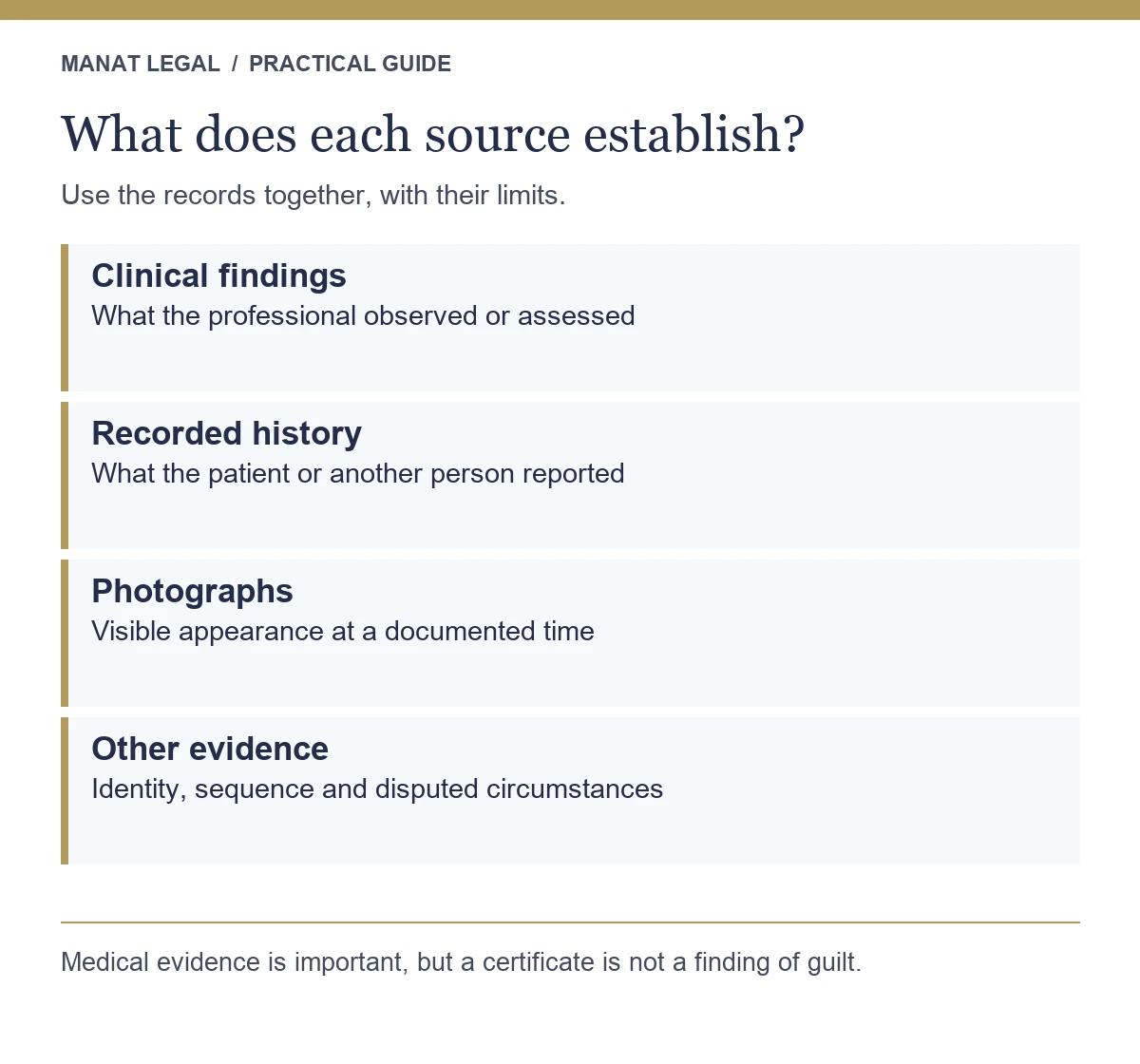
The history recorded by a clinician and the findings observed on examination are different parts of the record. A patient’s account of being struck explains why they attended; the clinical findings describe what was observed. Medical evidence should be read with that distinction in mind.
Keep the date and time of each visit, the hospital or clinic, the treating professional where recorded and the documents supplied. If someone else accompanied the patient, note that person’s role. Do not ask a clinician to add a fact they did not observe or to use a more serious description for litigation purposes.
2. Collect the record set, not just one certificate
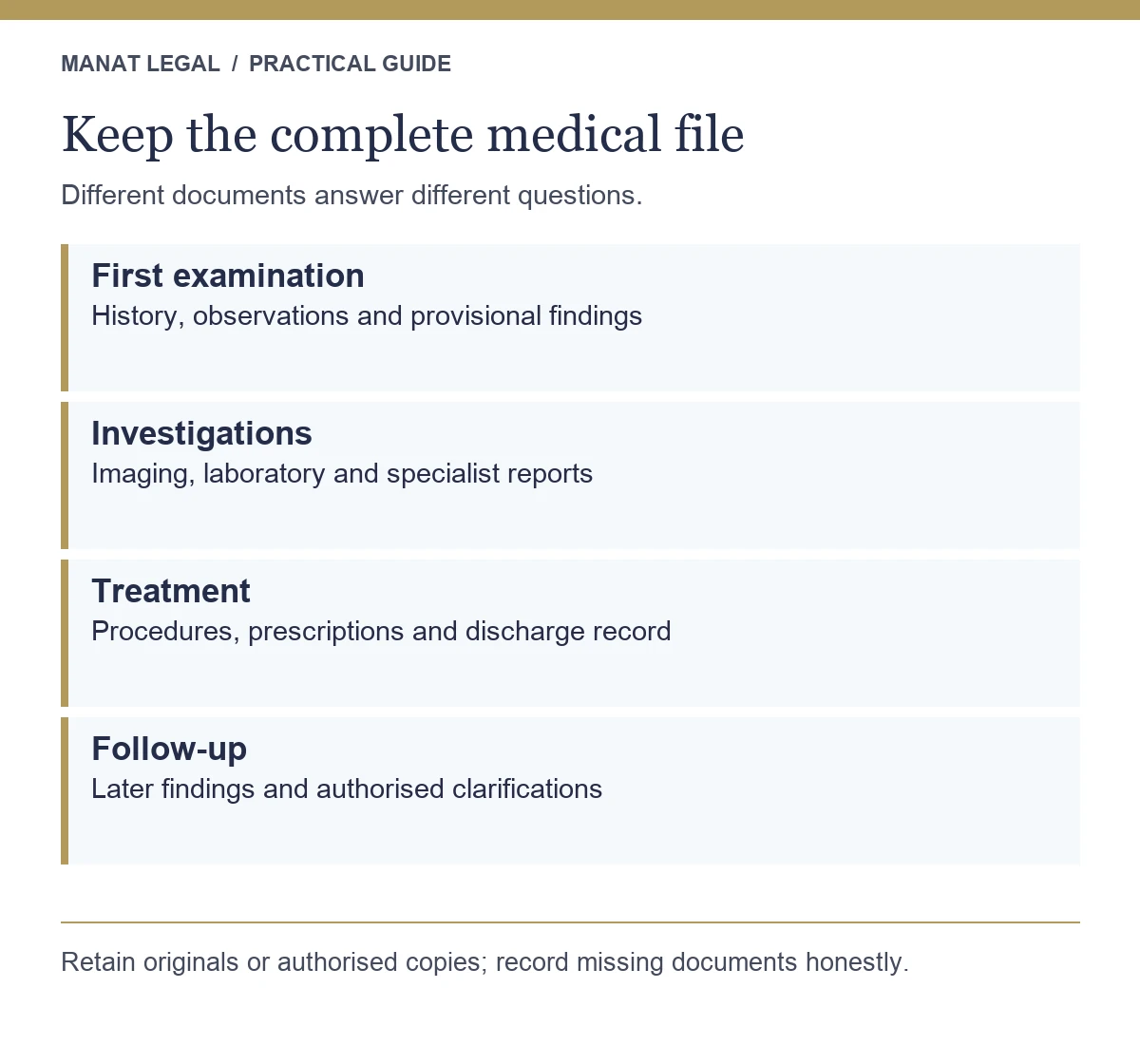
A medico legal report or wound certificate may be important, but it is often only one part of the relevant material. Emergency notes, examination findings, imaging reports, specialist consultations, operative notes, discharge papers and follow-up records may explain how the assessment developed.
Hospital terminology and document formats vary. Ask what records exist and use the hospital’s lawful process for obtaining copies. Do not assume that a bill, prescription and wound certificate are interchangeable, or that the absence of one particular title means no medical evidence exists.
Keep the originals or authorised copies as supplied. If you scan them, capture every page, including the reverse where it contains entries. Make a separate index rather than writing over clinical findings. Retain relevant receipts where expenses form part of an issue, while remembering that a bill does not by itself establish the cause of an injury.
If records are missing, note the request made, the date and any response. Your advocate can assess whether further records need to be obtained through the investigating officer or court. Do not manufacture a missing document from a remembered conversation.
3. Read the injury report in assault cases against a timeline
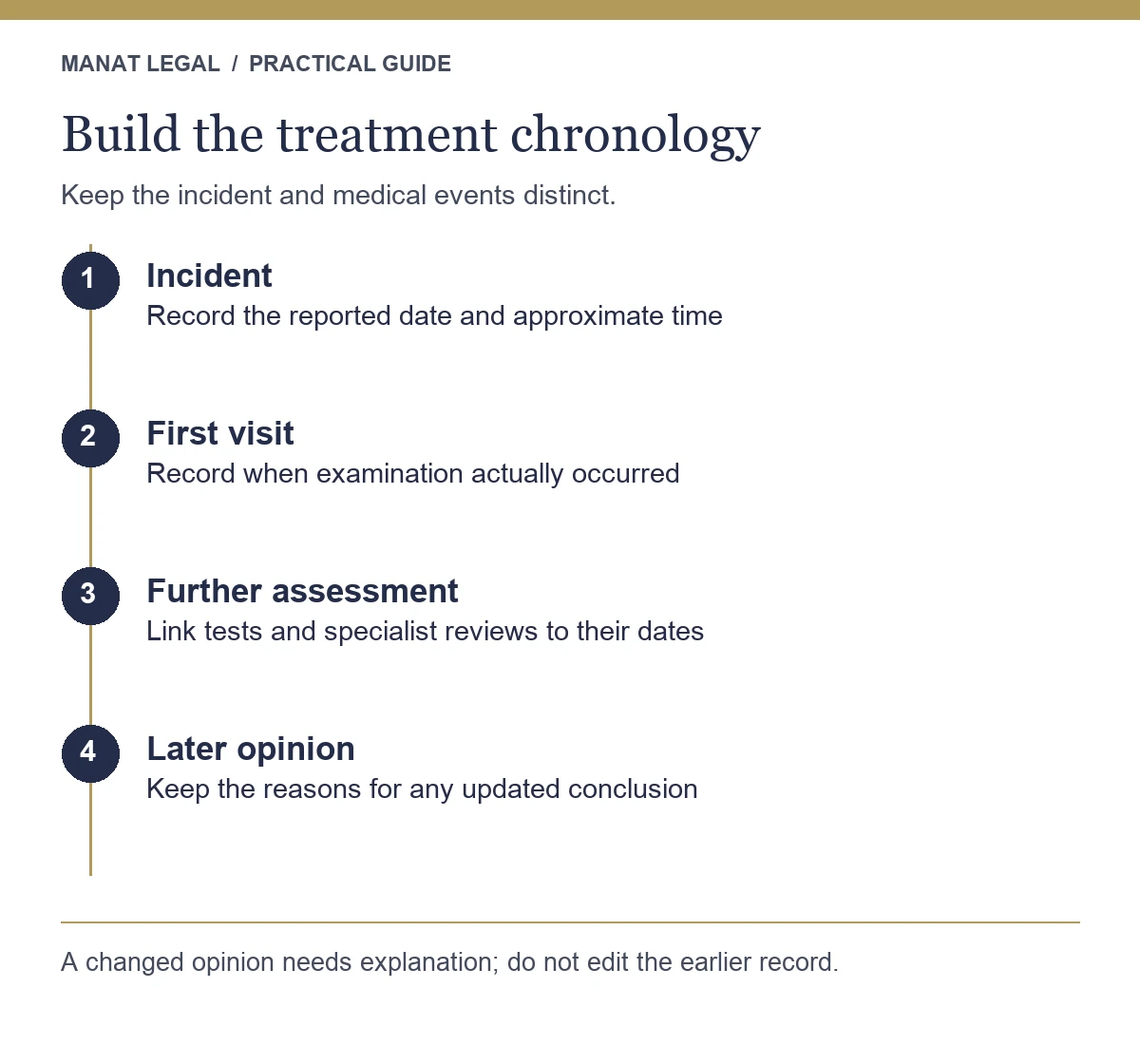
Place the alleged incident, first examination, imaging and later reviews in chronological order. An early note may record a provisional impression, while a later report adds information from a test or specialist. A change in the record needs explanation; it is not automatically proof of fabrication or of a more serious offence.
Record the gap between the incident and treatment accurately. A delay may require explanation, but no single interval automatically proves or disproves an assault allegation. The reasons, available findings and other evidence matter. Avoid adding a convenient explanation that the patient has not actually given.
If a document contains an apparent error in a name, date or side of the body, seek clarification through the issuing institution’s proper process. Keep the original and any correction or addendum together. Do not silently edit a scan to make it consistent with the complaint.
Medical evidence is easier to evaluate when the chronology includes relevant earlier conditions or later events that may affect interpretation. Share those facts with your advocate and clinician where appropriate. Leaving out an inconvenient record can create a larger dispute than the record itself.
4. Separate clinical findings from legal classification
The Bharatiya Nyaya Sanhita, 2023 distinguishes hurt and grievous hurt. Section 116 identifies the categories of grievous hurt, including specified permanent losses or impairments and fracture or dislocation of a bone or tooth. It also includes its stated life-endangering and duration-based categories.
A lay description such as ‘serious injury’ is not a substitute for checking the statutory definition. Equally, a small-looking injury should not be dismissed without the underlying medical assessment. The relevant findings, supporting reports and legal ingredients must be considered together.
Grievous hurt under BNS should not be assessed by copying an old IPC checklist without checking the current text and the date of the alleged offence. For example, section 116(h) uses fifteen days for its specified severe-pain or inability-to-follow-ordinary-pursuits category. The older IPC wording used a different period. The applicable substantive law must be identified before applying either.
The final legal issue can extend beyond injury classification to causation, intention, knowledge and the alleged means used. A medical label alone does not decide every element of the charged offence. Ask which conclusion is the clinician’s opinion and which remains for the court to determine.
5. Understand the limits of medical evidence
Medical evidence may support or test an account of injury, timing or possible mechanism. Its significance depends on the findings and the expert’s explanation. A record that an injury is consistent with a possibility is not necessarily an opinion that only that possibility could have caused it.
Section 39 of the Bharatiya Sakshya Adhiniyam, 2023 addresses expert opinion. The expert’s knowledge, reasons and supporting material matter. The court evaluates the opinion with the other evidence; a certificate is not a verdict.
An injury report does not ordinarily identify an assailant through the injury description alone. A name recorded in the history may come from the patient’s account. Witnesses, identification evidence, footage and other material can therefore remain important even where the injury itself is documented.
Avoid automatic conclusions in either direction. Absence of an external mark does not dispose of every allegation involving hurt, force or a threat. Conversely, the existence of an injury does not prove that the named person caused it in the manner alleged. The precise issue must be examined.
6. Preserve photographs and electronic hospital records properly
Where photographs of injuries are lawfully taken, retain the original files and note who took them and when. Avoid filters, retouching or overlays on the only copy. Respect the injured person’s privacy and consent, and do not publish sensitive images online to support a complaint.
A photograph is not a substitute for professional assessment. It may provide context, while the clinician explains findings and the court considers the evidence. If you create a working annotation for discussion, keep it clearly separate from the original image.
Electronic hospital records, emailed reports and digital images may raise source and certification questions under the applicable evidence law. Preserve the files as received and the accompanying communication. A screenshot of a report can omit identifying information or part of the document.
Our digital evidence preservation guide explains how to retain sources, context and a handling record. Do not access another person’s medical account or request records by pretending to be the patient.
7. Prepare focused questions for legal review
Bring the complete medical file, the complaint or FIR, police notices and the available incident chronology. Identify the exact point in dispute: the existence of injury, its nature, timing, possible cause, treatment history or the connection to a particular person. ‘The report is wrong’ is too broad to guide a useful review.
If an expert opinion needs clarification, counsel can assess the appropriate procedural step. Questions should address the basis of the conclusion, the records reviewed and the limits of the opinion. Do not contact a witness or clinician to pressure them into changing their account.
In a hypothetical gate-side altercation, a later imaging report might identify an injury not apparent in an early note. That does not by itself settle how it occurred. The chronology, clinical explanation and other incident evidence must be read together. This is why preserving the whole file matters more than selecting the page that appears most favourable.
Where both sides have injuries, disclose and organise the records for both accounts that are lawfully available to you. The legal significance of injuries on an accused person is fact-specific. They should neither be concealed nor treated as automatic proof of private defence.
- Which observations were made directly, and which details came from the history?
- Is the opinion provisional, final or dependent on another report?
- What supports the claimed timing and possible mechanism?
- Which statutory injury category is relevant, under the applicable law?
- What other evidence is needed to address identity and causation?
Frequently asked questions
Does a wound certificate prove who attacked the patient?
Not by itself. It may document injuries and recorded history. Identity and responsibility must be assessed using the relevant evidence, including the source of any name appearing in the history.
Is a prescription the same as a medico legal report?
No. Different records serve different purposes. Preserve all relevant documents and ask what examination, injury and treatment records are available from the institution.
Can an error in a report be corrected?
Seek clarification or correction through the issuing institution’s proper process. Keep the original and the authorised correction together. Do not alter the document yourself.
Does a delay in treatment automatically defeat the complaint?
No universal rule follows from delay alone. Its explanation and effect on the available evidence require assessment in the particular case.
Should I upload injury photographs to social media?
Avoid public circulation of sensitive medical material. Preserve the original files and share relevant material through an appropriate legal or investigative channel, with attention to the person’s privacy.
ManAT Legal’s criminal-law team in Bengaluru can review how medical evidence relates to the allegations and procedural stage. This is general legal information. Clinical assessment and treatment should be addressed by an appropriately qualified medical professional.