

Counter Complaints in India: 6 Essential Questions
Counter complaints can make a single neighbourhood, business or family dispute feel like two separate battles. One person reports an assault, the other gives a different account, and members of each group may be complainants in one proceeding and accused in another. Filing first does not, by itself, establish whose account is true.
The practical task is to keep the two proceedings organised while preserving the full sequence of the incident. This guide answers six questions about cross cases in criminal law, including why a counter FIR does not cancel the first FIR and why evidence cannot simply be carried from one trial into the other.
1. What are counter complaints and cross-cases?
The expressions commonly describe competing accounts from opposing sides about the same incident or transaction. A complaint may lead to an FIR, investigation or a court proceeding, depending on the allegations and applicable procedure. Not every complaint made after another complaint is necessarily a genuine cross-case.
Compare the event, time, location, people involved and alleged acts. A separate dispute between the same people on another day may need different treatment. Your advocate should identify the connection from the facts and records, not merely from the use of the word ‘counter’ in a heading.
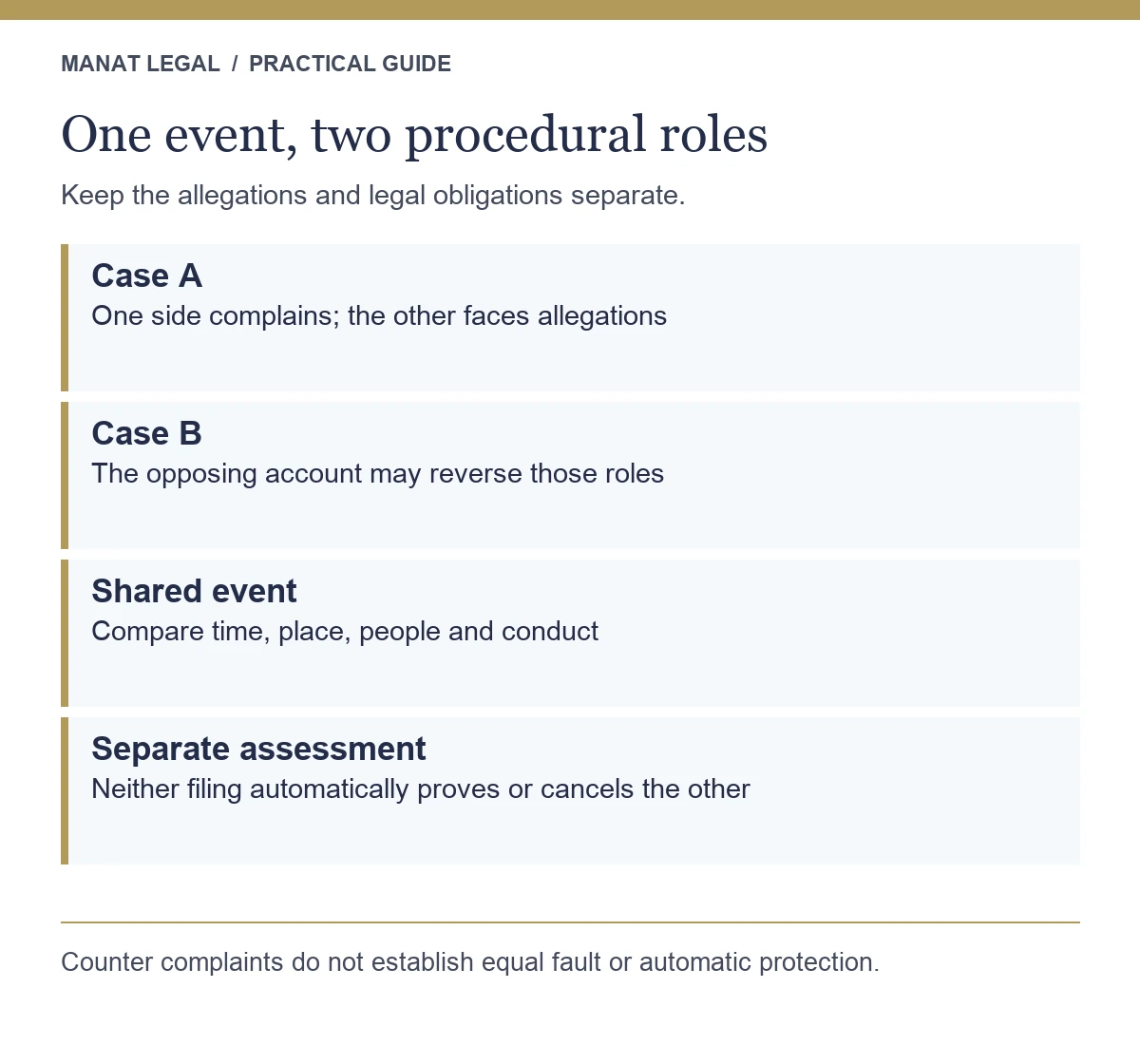
Counter complaints do not establish equal fault. One account may be supported, both may disclose offences, or a particular allegation may not be proved. Each person’s acts and the evidence require examination. Avoid assuming that the existence of two versions means the truth must be halfway between them.
Also distinguish a counter-version from a repeated complaint by the same side seeking another FIR about the same occurrence. The legal questions about multiple FIRs are different. A complaint’s timing and label do not answer its maintainability by themselves.
2. Does a counter FIR protect me from the first case?
No. A counter FIR does not automatically cancel the first FIR, suspend an investigation or provide bail. If you are an accused person in one proceeding, its notices, court dates and conditions still require attention even while you are a complainant in the other.
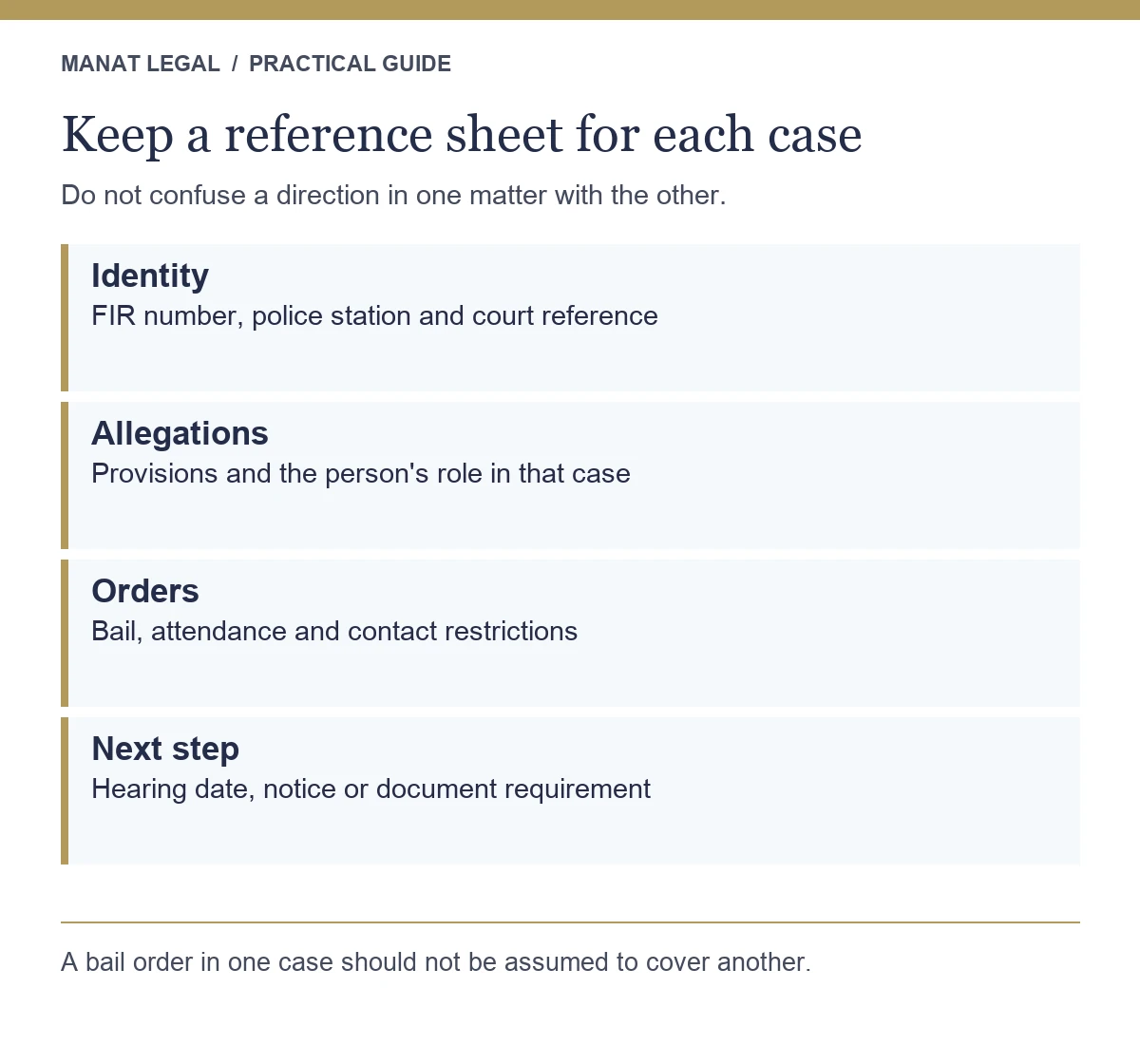
Assess each proceeding separately. Record the FIR number, police station, offences, investigating officer, court and next date. A bail order in one case should not be assumed to protect a person in another. Read the actual order and explain both proceedings to counsel.
If your account describes an offence, present it truthfully with the supporting material available. Do not create a retaliatory allegation merely to gain negotiating leverage. Adding names without a factual basis can undermine the complaint and create further legal exposure.
For the general reporting route, see our guide to filing an FIR in India. If the complaint has not been registered or acted on, retain the acknowledgment and discuss the appropriate statutory escalation or Magistrate process with your advocate.
3. How should cross complaint evidence be organised?
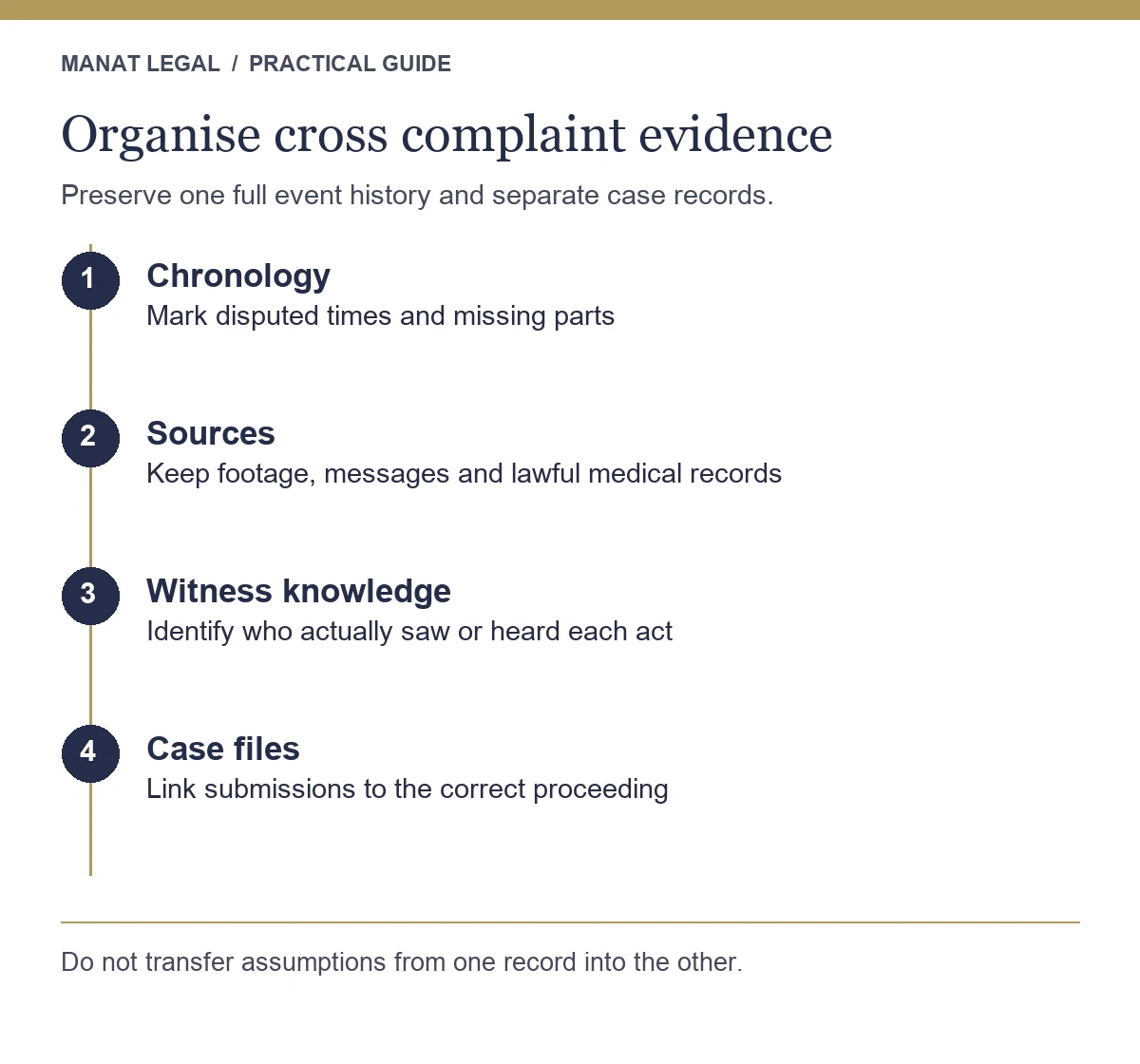
Start with one event chronology and two clearly labelled case files. The chronology records the sequence as you know it, with uncertain or disputed points marked. Each case file then contains that proceeding’s complaint, FIR, notices, orders and documents supplied. This prevents a notice in one matter from being mistaken for a direction in the other.
Cross complaint evidence may include CCTV, messages, call records, medical documents, scene photographs and witnesses with different vantage points. Preserve material that does not favour your account as well as material that does. A complete source can be more informative than a short clip circulated by either side.
Record which witness directly saw which act. Someone arriving after a confrontation may know about injuries or later statements without having seen how it began. Do not combine those different forms of knowledge into a claim that everyone witnessed the entire incident.
Medical records on both sides may be relevant, but obtain and use only records lawfully available to you. Injuries do not automatically establish who was the aggressor or whether private defence was justified. The sequence, circumstances and applicable legal tests must be examined.
Our digital evidence guide explains how to retain sources and handling details. Never delete inconvenient messages, recreate a conversation or coordinate witness accounts to make the two files appear consistent.
4. How are cross cases investigated and tried?
The investigating authorities need to consider the competing accounts and relevant material fairly. Give your advocate the reference numbers for both cases and identify evidence that may otherwise be overlooked. The existence of a counter complaint should be disclosed accurately, not used as a substitute for answering the allegation against you.
The case and counter case procedure is also important at trial. The Supreme Court’s established approach in Nathi Lal contemplates the same judge trying genuine cross-cases one after the other, with separate evidence and separate judgments. The objective is an orderly assessment without importing unproved material from one record into the other.
The Supreme Court discussed that approach in its 8 October 2021 judgment, distinguishing cross-cases from other questions about joint trials. Its 9 January 2025 judgment also referred to the ordinary need for the same judge or court to deal with interconnected cross-cases.
That does not mean two FIRs simply merge into one trial or that a document filed in one case automatically becomes evidence in the other. Jurisdiction, the offences, procedural stage and appropriate orders still matter. Bring the connection to counsel’s attention early so that the correct application can be considered.
Do not assume a different trial arrangement automatically invalidates every later decision. Any challenge requires examination of the governing law, procedural history and relevant prejudice. A general statement about cross-cases cannot replace a review of the actual record.
5. Does a settlement in one case end both?
A settlement must be assessed against each proceeding and its offences. The parties may agree on a factual or financial arrangement, but that agreement does not automatically dispose of every FIR, bail condition or court case. Some offences may be compoundable under the applicable procedure; other requests require a different legal basis and court consideration.
Make sure any proposed arrangement identifies the correct case numbers and parties. An undertaking in one matter may have consequences elsewhere, and a person cannot casually promise that the State will stop a prosecution. Ask which orders would actually be needed and which issues remain outside the parties’ control.
Never use threats, repeated calls or intermediaries to pressure the other side into withdrawing a complaint. Keep communications lawful and comply with restrictions on contact. The fact that settlement is being discussed does not authorise breach of a bail condition or interference with witnesses.
In the 9 January 2025 decision linked above, the Supreme Court considered the particular history and settlement circumstances of the cross-cases before it. It should not be read as a general rule that an outcome or concession in one proceeding automatically determines the other.
6. What should you do when both proceedings are active?
Maintain a single calendar that clearly labels the case associated with each date. Keep separate copies of notices, attendance records and court orders. Confirm whether a particular direction applies to you as an accused person, complainant or witness; the same person can have different procedural roles in the two matters.
Tell your advocate about every earlier account you have given, including a complaint, medical history, affidavit or settlement communication. If an error needs correction, address it honestly through the appropriate process. Do not silently replace an earlier version with a more convenient one.
In a hypothetical parking dispute, the first complaint may allege a blow and the counter-version may allege an earlier threat and obstruction. Footage of the entrance may show only part of the event. The useful question is what each source can actually establish, not which side acquired an FIR number first.
Counter complaints often create practical confusion before they create a complex legal issue. A clear case-reference sheet, a full chronology and preserved source material give counsel a better starting point for assessing investigation, bail and trial coordination.
- Track each FIR and court case under its own reference.
- Read every order for the people, case and obligations it actually covers.
- Preserve relevant evidence without coaching witnesses or altering records.
- Disclose related complaints, notices and proceedings promptly.
- Check any proposed settlement separately against both cases.
Frequently asked questions
Does the first FIR carry more truth than the counter FIR?
Registration order alone does not decide credibility or guilt. The allegations, timing, explanations and evidence must be examined in each proceeding.
Can the same person be a complainant and an accused?
Yes, in opposing proceedings arising from competing accounts. Keep the roles and requirements of each case distinct, including notices, bail orders and court dates.
Are cross-cases automatically combined?
No. The established approach to genuine cross-cases involves coordinated handling with separate evidentiary records and judgments, subject to the proper procedural orders. It is not an automatic merger.
Can evidence in one case simply be relied on in the other?
Do not assume so. Material must be brought into the relevant proceeding through the applicable process. The same judge hearing both does not remove the need to prove each case on its own record.
Should I file a counter complaint just to secure a settlement?
No. A complaint should set out a truthful factual allegation supported by the material available. Do not invent or exaggerate allegations to create bargaining pressure.
For related counter complaints in Bengaluru, ManAT Legal’s criminal-law team can review both records and advise on the immediate procedural steps. This guide provides general legal information; the correct approach depends on whether the matters are genuinely connected and on their present stage.