

Criminal Appeal vs Revision: 6 Essential Differences
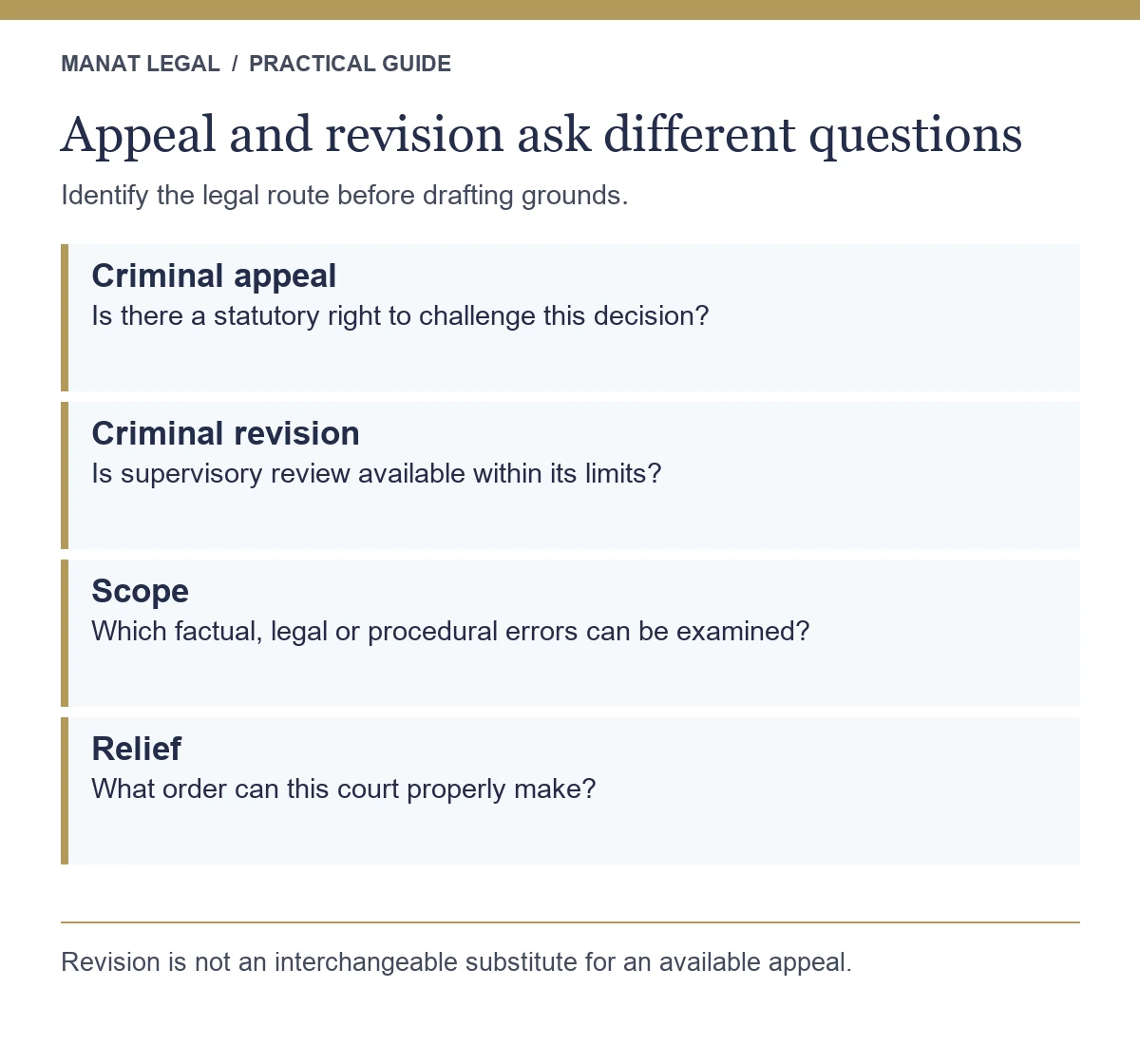
A criminal appeal and a revision are not interchangeable ways of asking a higher court to reconsider an order. Choosing the route requires reading the order, identifying the legal provision that permits a challenge and checking who is entitled to bring it. The fact that a decision seems wrong does not, by itself, answer those questions.
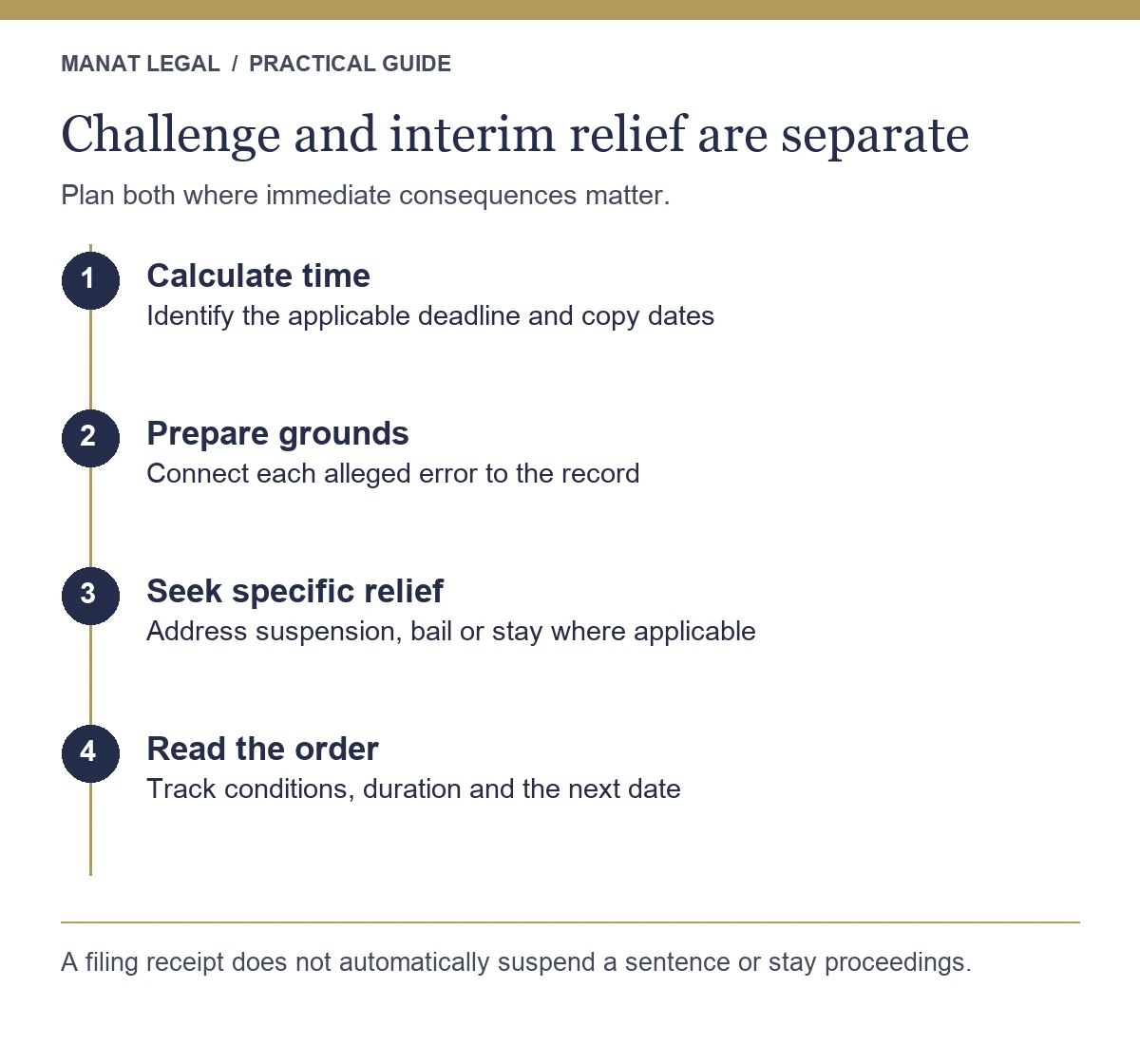
This guide explains six differences that matter under the Bharatiya Nagarik Suraksha Sanhita, 2023 (BNSS). It also separates the challenge to an order from any urgent request for bail, suspension or a stay. A filing receipt alone does not provide that interim protection.
1. A criminal appeal needs a statutory right
Section 413 BNSS states the starting rule: an appeal from a criminal court judgment or order must be provided by the BNSS or another applicable law. A criminal appeal is therefore not available merely because a party would like a second hearing. The relevant provision, person entitled to appeal and forum must be identified.
The chapter contains different routes for convictions, acquittals, sentence-related challenges and specified orders. It also contains restrictions, including provisions concerning guilty pleas and certain petty cases. A conviction appeal, a victim’s appeal and a complainant’s challenge to an acquittal can involve different requirements.
Criminal revision is a supervisory jurisdiction directed at the correctness, legality or propriety of findings, sentences or orders and the regularity of proceedings, within the statutory limits. It is not simply an appeal with a different title when a party prefers another court.
Read the official BNSS provisions, particularly sections 413–435 on appeals and 438–445 on revision, alongside any special statute. Older proceedings may continue under the CrPC savings framework. The correct section numbers depend on that assessment.
2. The scope of review is different
An available criminal appeal can permit examination of factual and legal grounds within the governing appellate framework. The appellate court’s powers and the nature of the appeal determine what can be reconsidered. The grounds should identify errors in the judgment or sentence and connect them to the record.
Revision is generally narrower and supervisory. It is not an ordinary opportunity to retry the entire case or ask a second court to prefer your account of every witness. A revision petition should identify the legal, jurisdictional or procedural problem and explain why it warrants intervention within the revisional power.
That does not mean revision is limited to correcting typing mistakes. Section 438 expressly addresses correctness, legality, propriety and procedural regularity. The point is that the nature and limits of the jurisdiction matter; a broad assertion that the lower court was unfair is not a substitute for a specific ground.
For either route, distinguish an error in the decision from dissatisfaction with the result. A useful ground identifies the relevant finding, the record or legal rule said to have been mishandled, and the relief that the reviewing court can properly grant.
3. The right court depends on the order and the route
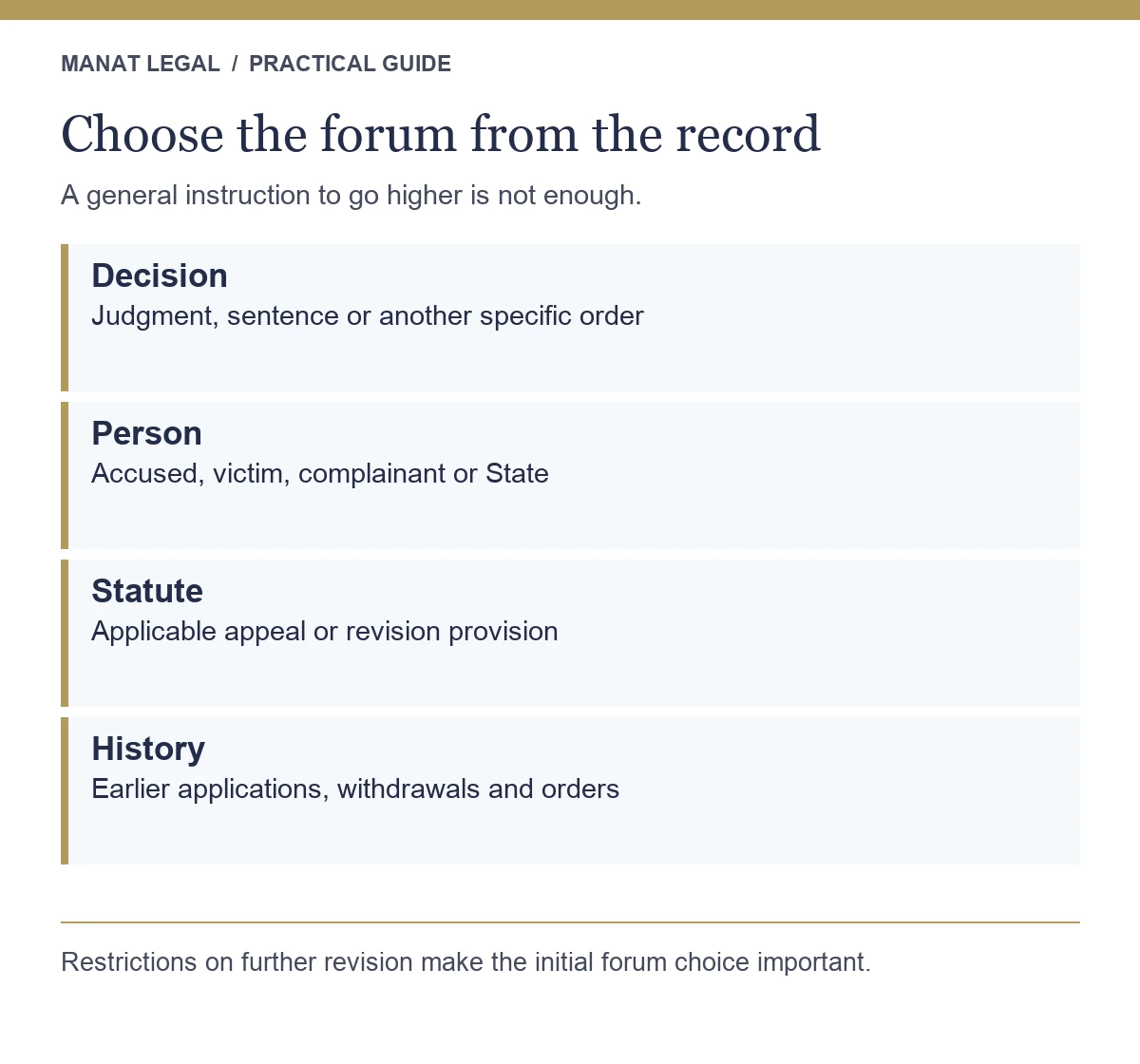
Section 415 addresses appeals from convictions and distinguishes, among other things, trials before Sessions courts and Magistrates, subject to its qualifications. Other provisions address acquittals and different classes of appeal. The identity of the trial court is important, but it is not the only fact needed to select the forum.
A victim, complainant, convicted person and the State do not necessarily proceed under the same provision. Leave or special-leave requirements may apply in particular routes. Explain your role and the exact order to counsel before deciding where to file.
Sections 438, 440 and 442 address revisional powers of the Sessions court and High Court. The availability of both levels for some matters does not create an unrestricted sequence of revisions. Section 438(3), together with the related provisions, restricts a further revision by the same person after choosing one of those forums.
Do not file parallel challenges without disclosing them or assume you can start again in the other forum if the first result is unfavourable. Tell your advocate about every earlier application, withdrawal and order. That history can affect maintainability and the relief available.
4. Some orders cannot be challenged by ordinary revision
Section 438(2) excludes revision against interlocutory orders. Whether a particular order is interlocutory, intermediate or otherwise amenable to challenge is a legal classification question. An order made before the final judgment is not automatically treated the same way as every other pre-trial order.
Another important limit appears in section 442(4): where an appeal lies and the party who could appeal has not done so, revision is not ordinarily available at that party’s instance under that provision. Revision should not be treated as a shortcut around an available criminal appeal.
Section 442(5) permits the High Court, in the specified circumstances, to treat a revision brought under an erroneous belief that no appeal lay as an appeal. That is a conditional judicial power, not a filing strategy or a guarantee that choosing the wrong remedy will be harmless.
The High Court’s inherent jurisdiction is a separate subject. Calling an application ‘quashing’ or invoking an inherent power does not automatically bypass statutory restrictions. Our guide to quashing of an FIR addresses a different context; the remedy for a particular court order still needs its own assessment.
5. Deadlines and interim relief need separate attention
The BNSS appeal procedure must be considered with the applicable limitation rules, special statute and court requirements. There is no single filing period that safely applies to every criminal appeal or revision. Record the date of the order, the copy application and receipt, and the relevant custody or compliance dates.
Ask counsel to calculate limitation from the correct provision and facts. If there is delay, preserve the true explanation and supporting documents. Do not assume delay will automatically be condoned, or wait for an informal assurance that the other party will not oppose the case.
Suspension of sentence pending an appeal is addressed in section 430 BNSS, with reasons and conditions under the provision. Bail or release pending the appeal is a related but distinct request. Filing the appeal does not itself suspend the sentence, and a suspension of sentence should not be confused with setting aside the conviction.
Where revision is maintainable, the revisional framework also contains powers concerning suspension and release in appropriate circumstances. The order actually made determines the protection. Keep track of its duration, conditions and the next hearing instead of treating a case number as a stay.
If there are employment, licensing, travel or other consequences of a conviction, identify them specifically. A request concerning the conviction itself is different from a request to suspend execution of the sentence. Do not assume one automatically resolves the other.
6. The available result is not identical
The powers available in a criminal appeal depend on its type and the governing provision, including section 427 BNSS. The appellate court may have options relating to findings, sentences or further proceedings as the statute permits. The petition should ask for relief that fits the actual appeal.
Revision has its own limits. Section 442(3) does not authorise the High Court to convert an acquittal into a conviction in revision. That is an important reason to identify the proper route when challenging an acquittal, rather than assuming all higher-court proceedings have the same possible outcome.
A remand or direction for further consideration is also different from a final finding in your favour. Read the operative part of the order to understand what the lower court must now do and which issues remain open. Do not describe a procedural success as an acquittal unless that is what the order actually provides.
Success cannot be predicted from the label ‘appeal’ or ‘revision’. The admissible record, governing test, specific error and available remedy determine the strength of a challenge. A focused assessment before filing is more useful than a promise that every adverse order can be reversed.
Prepare the file before choosing the remedy
Bring the complete judgment or order, sentence order if separate, relevant earlier orders, pleadings, deposition and exhibit references, and the current bail or custody record. Include details of any appeal or revision already filed by another party if known. A screenshot of the last page rarely gives enough context.
For example, a hypothetical person convicted after a trial may need advice on an available criminal appeal and a separate suspension-of-sentence request. A person objecting to a procedural order during an ongoing case needs an assessment of that order’s character and the applicable challenge route. The same ‘go to the High Court’ instruction does not answer both situations.
Write down the specific relief sought: reversal of conviction, challenge to sentence, correction of an unlawful order, remand, or interim protection. Ask which forum can grant it, what deadline applies and what remains enforceable while the challenge is pending.
- Exact order, date, court and procedural stage.
- Your role and the provision giving a right to challenge.
- Earlier challenges and the complete operative orders.
- Specific grounds supported by record references.
- Limitation calculation and any urgent interim-relief request.
Frequently asked questions
Can I choose revision instead of an available criminal appeal?
Do not assume so. Section 442(4) addresses the restriction where an appeal lies but the person entitled to appeal does not bring it. The correct remedy should be assessed before filing.
Can I file a second revision in the High Court after Sessions Court?
The BNSS contains restrictions on a further revision by the same person after choosing a revisional forum. Any possible further remedy requires separate legal assessment; it is not an automatic second revision.
Does filing an appeal stop the sentence?
No. Seek advice about suspension of sentence and any bail or release request. The court’s order, not the filing alone, determines the interim position.
Is every order before judgment interlocutory?
No simple timing rule answers that question. The nature and effect of the particular order must be examined when assessing the statutory bar on revision against interlocutory orders.
Can revision directly change an acquittal into a conviction?
Section 442(3) does not authorise that conversion by the High Court in revision. The proper challenge route and available relief must be identified from the applicable law.
For a criminal appeal or revision concerning a Bengaluru proceeding, ManAT Legal’s criminal-law team can review the order, record and urgent deadlines. This article provides general legal information; the correct remedy depends on the specific order, statutory route and procedural history.