

Criminal Intimidation and Assault: 6 Essential Checks
Criminal intimidation and assault allegations often arise from the same argument, but the law asks different questions about each. What was threatened? Was there a gesture suggesting immediate force? Did physical contact occur, and was anyone injured? A complaint becomes clearer when those events are described separately.
Whether you are reporting an incident or responding to an allegation, begin with safety and an accurate record. Do not try to settle the facts through another confrontation. These six checks explain how to organise the legal and evidentiary issues without assuming that an accusation is proved or that an angry exchange is always an offence.
1. Identify what is alleged as criminal intimidation
BNS section 351 addresses threats of injury to a person’s body, reputation or property, or to the person or reputation of someone in whom that person is interested. The required intention includes causing alarm or making the person do something they are not legally bound to do, or omit something they are entitled to do, to avoid the threat.
The words used and the surrounding circumstances therefore matter. Record the actual threat as accurately as you can, rather than writing only ‘he threatened me’. Identify who communicated it, to whom, by what means, when and in what context. If you are paraphrasing rather than quoting exactly, make that clear.
Not every rude message or heated disagreement establishes criminal intimidation. Equally, a threat does not become harmless merely because it was sent electronically or through another communication channel. The statutory ingredients and evidence must be examined.
The Bharatiya Nyaya Sanhita, 2023 distinguishes ordinary criminal intimidation, specified serious threats and anonymous or concealed-identity communications. The particular subsection affects the analysis. Older incidents may require consideration of IPC provisions and the applicable savings rules.
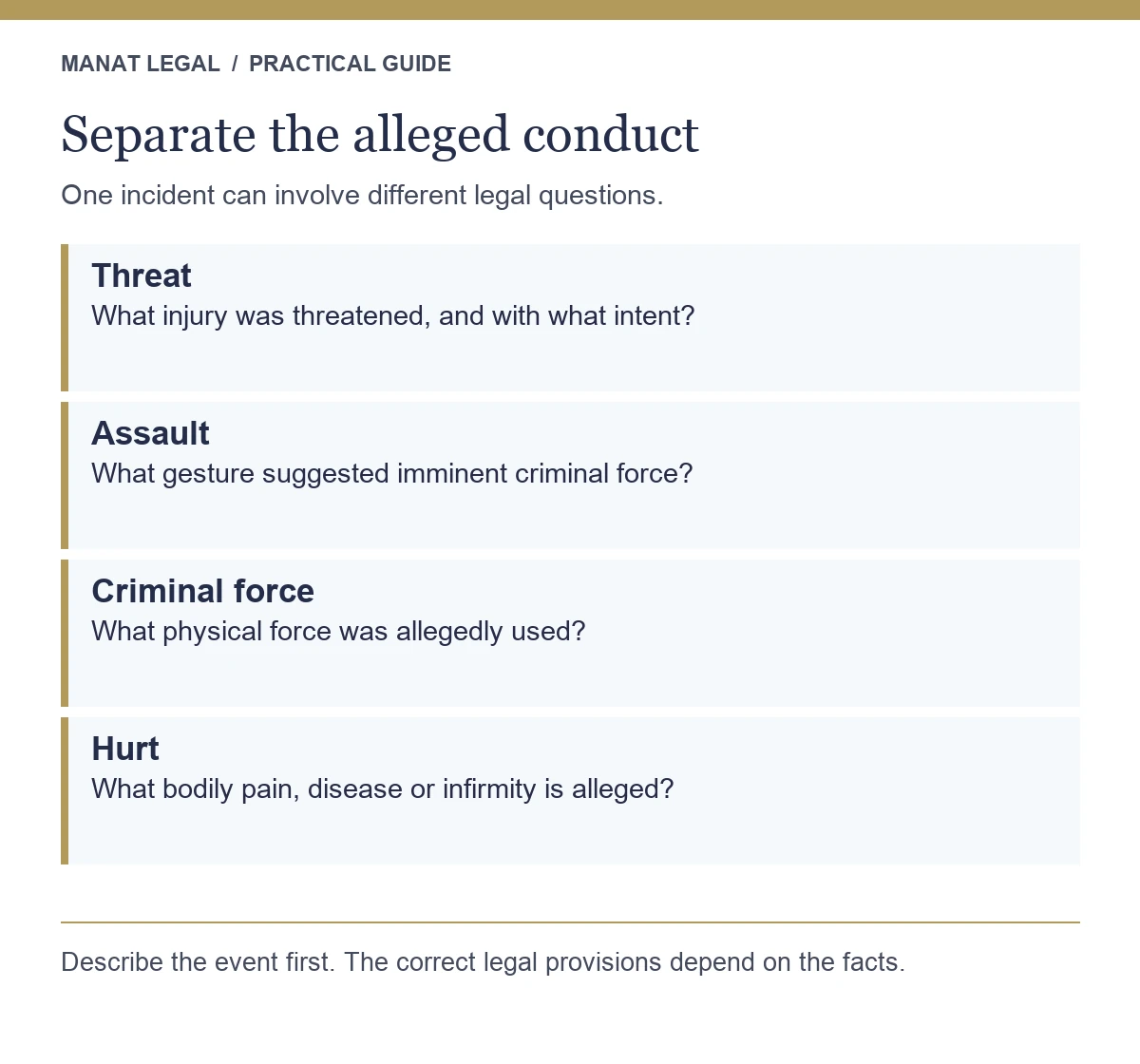
2. Separate assault, criminal force and hurt
In everyday speech, ‘assault’ often means a physical attack. Section 130 BNS uses a more specific definition involving a gesture or preparation intended, or known to be likely, to make someone present apprehend the imminent use of criminal force. Physical contact is not essential to that definition.
Mere words do not, by themselves, amount to assault under that provision, although words can give a gesture or preparation its meaning. Criminal force is addressed separately in section 129. Hurt and grievous hurt have their own provisions and ingredients. A complaint should describe what happened rather than rely on a broad label.
For example, an alleged raised fist accompanied by words and an alleged blow causing injury present different factual questions, even if both occur during one incident. State the sequence: approach, words, gestures, contact, injury and what happened next. Do not compress several people’s actions into ‘they all attacked’ if you can identify individual acts.
The precise offences, alleged weapon or means, injuries and any special enactment influence the procedure. Avoid blanket assumptions that every assault allegation is bailable or that every threat requires immediate arrest. Your advocate needs the actual FIR or notice and the current applicable classification.
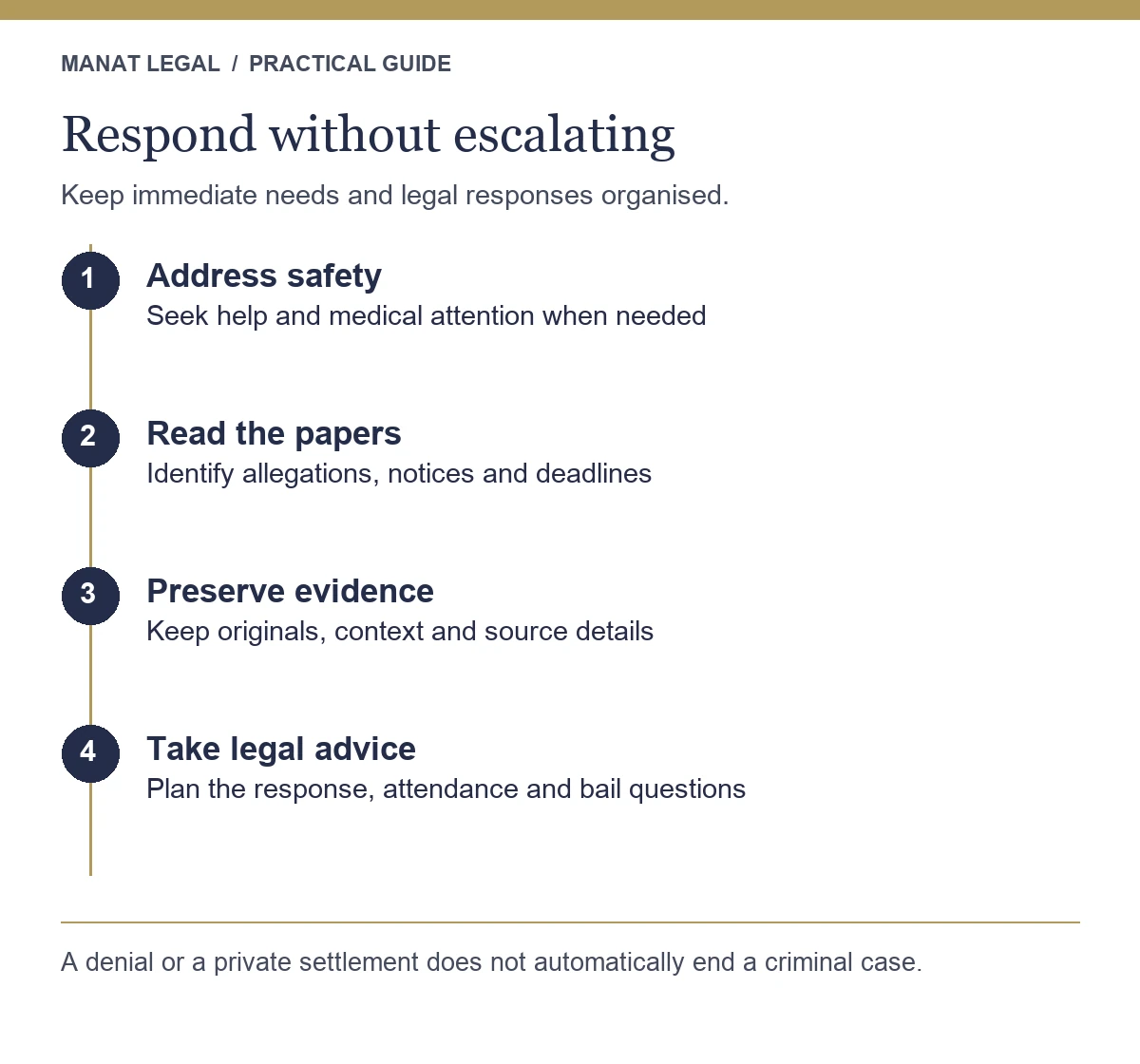
3. Put immediate safety and medical care first
If a threat appears immediate, move to a safer place and contact the local police or emergency services as appropriate. Do not arrange a private meeting to test whether the threat is serious. If someone is injured, obtain medical attention promptly; gathering evidence should not delay care.
Tell the treating professional what happened accurately and retain the records provided. Keep consultation notes, discharge papers, prescriptions and investigation reports together. Do not ask anyone to exaggerate an injury or record a history they did not receive.
An injury record can help explain the condition observed and the timing of examination. It does not automatically identify the person who caused the injury or settle every issue about the incident. Conversely, the absence of a visible injury does not by itself dispose of an allegation involving a threat or apprehension of force.
If both parties were injured, disclose that fact to your advocate. Private defence and other explanations need a factual foundation; they should not be added as standard phrases after the event. Preserve the whole sequence and seek case-specific advice.
4. Preserve threat complaint evidence with its context
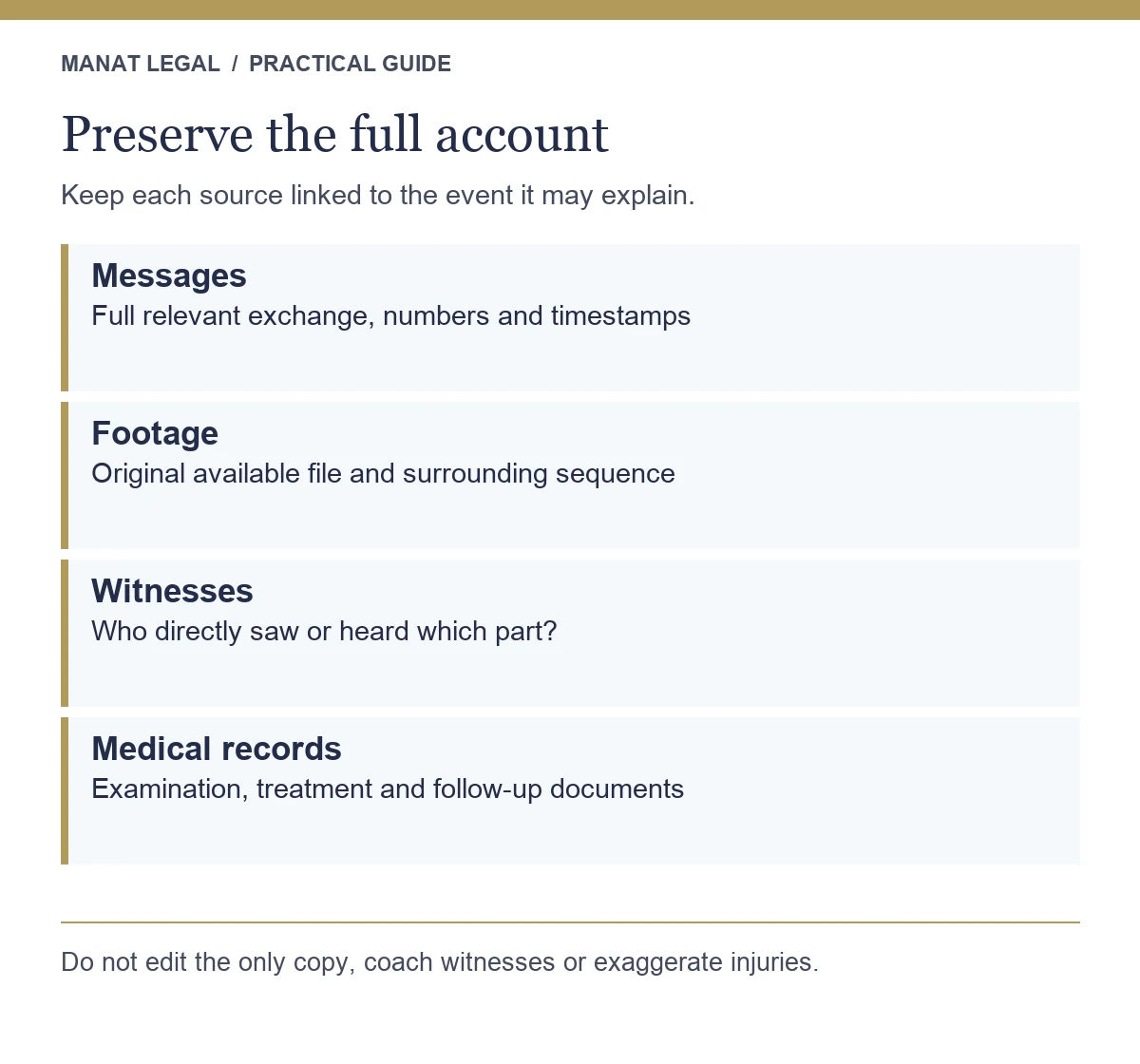
Threat complaint evidence may include messages, voice notes, call history, CCTV, photographs and accounts from people who directly heard or saw the incident. Preserve the source and relevant surrounding material. A short extract can be misleading if it omits who was present, what was said immediately before it or whether the recording is complete.
For digital material, keep the original device or file where possible, note the account or number and avoid editing the only copy. Do not circulate private recordings to build public pressure. Our digital evidence preservation guide explains source records, handling and certificate preparation.
Make a dated note of your own recollection while it is fresh. Distinguish what you personally observed from what another person told you. Ask witnesses to preserve their own records; do not coach them, prepare a common script or pressure them to support your version.
If the allegation concerns criminal intimidation, record any demand linked to the threat, such as withdrawing a complaint or surrendering a legal right. Also preserve context that may bear on intention. Evidence should help a decision-maker understand the event, rather than simply repeat a conclusion that somebody intended to cause alarm.
5. Respond to a notice without contacting the other side
When responding to an assault complaint, obtain the document actually served and identify the police station, case reference, provisions and attendance requirement. A phone summary from a relative is not enough. Send the complete notice and earlier correspondence to your advocate promptly.
Do not ignore a lawful notice, delete messages or ask the complainant to withdraw the allegation through threats or pressure. A response should deal with the specific facts: where you were, who was present, what records exist and which allegations you dispute. If a date or detail is uncertain, say so instead of inventing precision.
Assess bail and attendance requirements separately from the defence on the merits. The fact that you deny the allegation does not itself provide protection from arrest. Our guide to anticipatory bail under BNSS explains that distinct route where applicable.
Avoid posting your defence online, naming witnesses or sharing the other party’s personal information. Public exchanges can create fresh disputes and interfere with an orderly investigation. Preserve communications and use the appropriate legal channel for the response.
6. Keep complaint, defence and settlement issues distinct
A person reporting criminal intimidation should provide concrete facts and relevant records, including the particular words, conduct and surrounding circumstances. A person disputing the allegation should address those same particulars. Neither side benefits from unsupported labels or a narrative that changes with each document.
If you were also threatened or injured, discuss whether a separate factual complaint is appropriate. A counter-complaint is not a device to erase the first complaint or force a compromise. Disclose the other proceeding and maintain an accurate chronology of both accounts.
A private apology, repayment or agreement does not automatically end criminal proceedings. Compounding, quashing and other forms of disposal involve different legal requirements. Before making commitments, ask what is legally possible for the precise offences and stage, and whether an order is required.
The Supreme Court’s 16 April 2025 judgment, discussing the earlier IPC provisions, emphasises that the required intention for criminal intimidation must be supported by material. The practical lesson is to prepare the evidence of the alleged threat and its purpose, rather than assuming that an accusation or denial alone resolves the issue.
A useful file for the first consultation
Bring the complaint or FIR if available, every notice or order, a one-page chronology, relevant medical records and an index of digital evidence. Identify immediate concerns separately: a current threat, an attendance date, an approaching hearing or a source of evidence about to be lost.
Consider a hypothetical neighbourhood dispute in which one person alleges a threatening message and a later push at the gate. The message thread, gate footage, witnesses and medical record answer different questions. Organising them by event helps avoid treating the earlier argument as proof of every later allegation.
For reporting steps, see our guide to filing an FIR in India. Keep the account complete and avoid exaggerating legal terminology to make it sound more serious.
- Exact words or an honestly labelled recollection of the threat.
- Separate details of gestures, contact and injuries.
- Original available recordings and the people who control them.
- All notices, complaint references and related proceedings.
- Any immediate safety concern or deadline requiring action.
Frequently asked questions
Is every angry message criminal intimidation?
No. The content, context and required intention must be assessed under the applicable provision. Preserve the full exchange rather than relying on an isolated phrase.
Can an assault allegation exist without an injury?
Yes. The statutory definition of assault can concern apprehension of imminent criminal force from a gesture or preparation. Hurt and physical injury involve separate legal questions.
Does the complainant have to show visible fear?
The required intention and circumstances matter. Do not assume that the absence of an outward reaction automatically defeats an allegation. Equally, a claim of fear does not replace proof of the offence’s ingredients.
Should I contact the complainant to explain my side?
Seek advice first, especially where an investigation or court order is involved. Do not pressure the complainant or witnesses. A documented response through the proper channel is usually more useful than another disputed conversation.
Will an apology automatically close the case?
No. The effect of an apology or settlement depends on the offences, stage and applicable procedure. A separate court order or lawful process may be needed.
For advice on criminal intimidation or assault allegations in Bengaluru, ManAT Legal’s criminal-law team can review the records and immediate procedural needs. This article offers general legal information; it does not determine whether a particular allegation is true or legally established.