

Bail Conditions: 7 Essential Checks After Release
Bail conditions can be easy to overlook once a family has finally secured release. The immediate crisis feels over, work needs attention and the next hearing may seem far away. Yet the written order may require police reporting, limits on travel or other steps that begin straight away.
A useful first task is to turn the order into a short calendar and checklist. This guide explains seven checks for people on bail in Bengaluru and elsewhere in India. The conditions in your actual order, and any later order changing them, remain the starting point.
1. Read the complete bail order before making plans
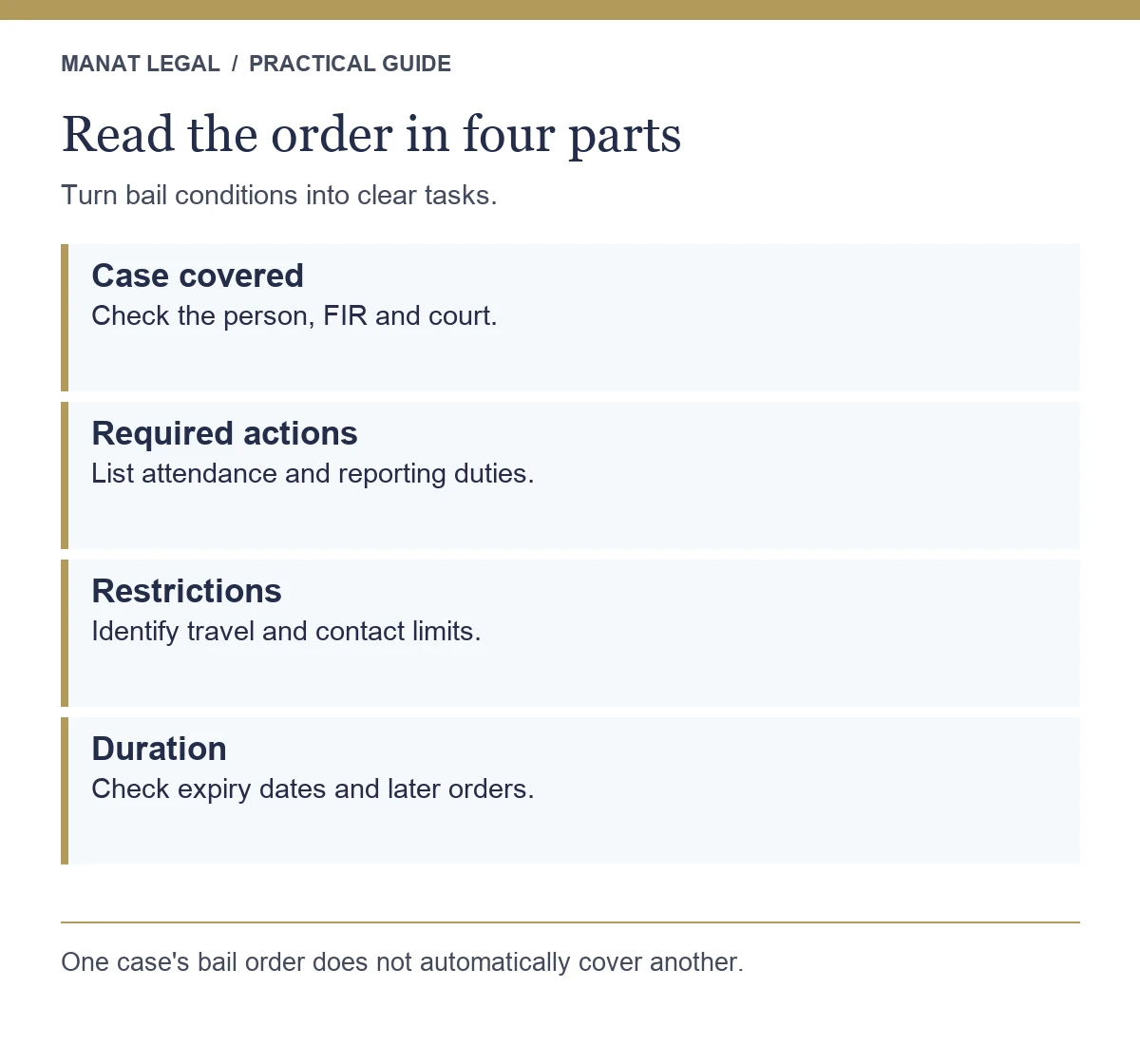
Obtain a readable copy of the signed order and keep it with the case reference. Read the operative directions, not just the sentence saying bail is granted. Check the accused person’s name, FIR number, court, offences and whether the order concerns anticipatory bail, regular bail or temporary relief. An order in one case should not be assumed to cover another.
Make a separate note of every deadline or recurring obligation. A direction to appear before the investigating officer once a week is different from a requirement to attend when called. Similarly, permission to leave a district and permission to leave India are different questions. If a phrase is unclear, ask your advocate to explain its practical effect.
The BNSS provisions on bail, including sections 480, 482 and 483, provide the statutory framework. Older proceedings may remain governed by the CrPC under the savings provision in section 531. Do not replace the section in your order simply because a newer number appears online.
2. Put attendance and reporting dates in one calendar
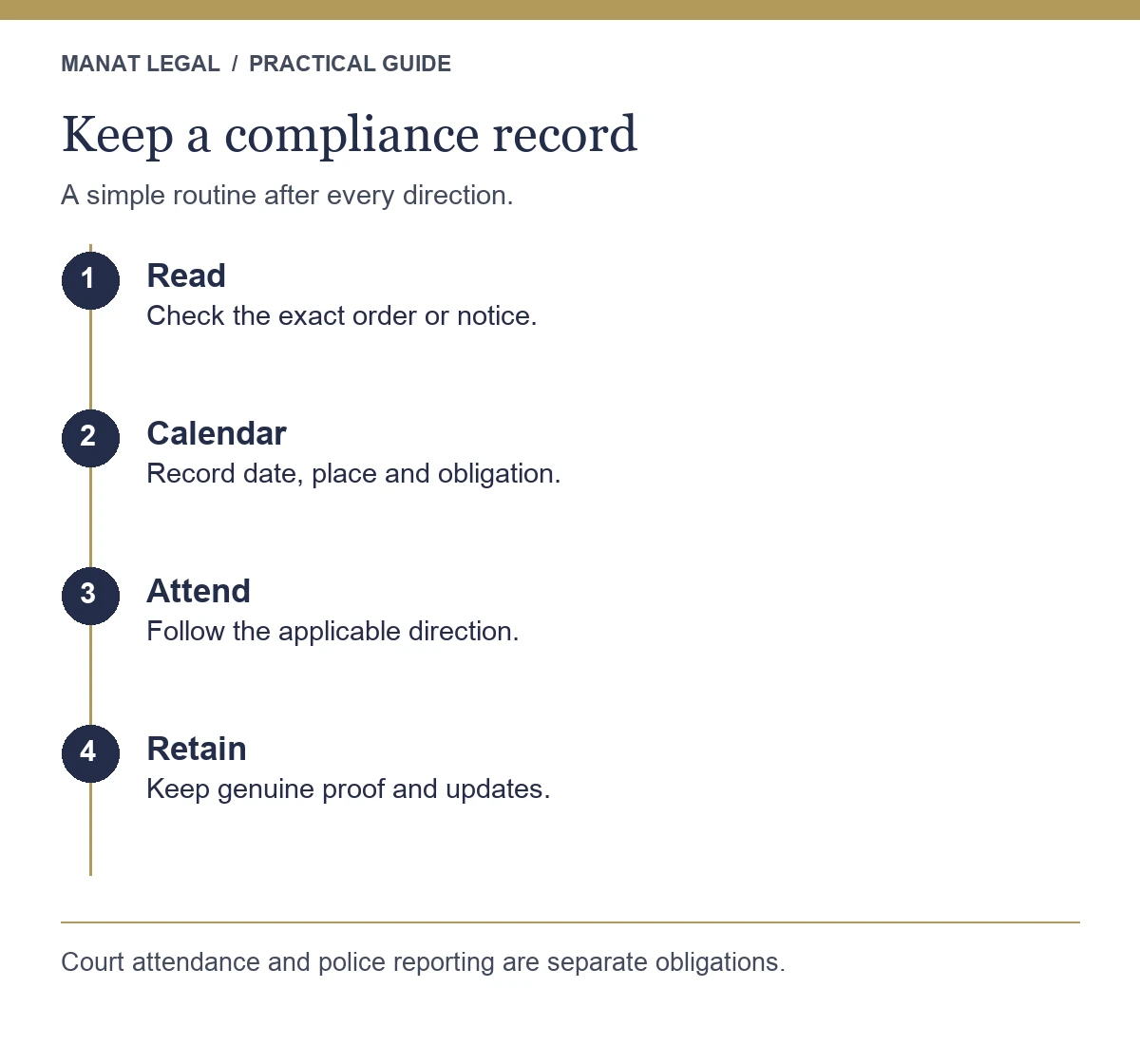
Record the next court date, any police reporting dates, the relevant location and the person who will confirm changes. Share this practical calendar with a trusted family member if useful. Keep the source order attached so that a reminder can be checked against the actual direction.
Court attendance and police reporting are separate obligations. Attending one does not necessarily satisfy the other. Do not assume that your advocate’s appearance excuses your personal attendance; an exemption must have the appropriate legal basis and, where needed, an order. Confirm the position before missing a hearing.
When complying with police reporting, retain a lawful acknowledgment or other contemporaneous record where available. Note the date, time and officer’s details accurately. Do not manufacture attendance proof or ask anyone to sign retrospectively. A simple, truthful record is more useful than a polished account created after a problem arises.
3. Keep contact with witnesses within lawful boundaries
Bail conditions commonly address interference with witnesses and evidence. Under section 480(3), relevant orders include restrictions on inducements, threats, promises and tampering. A restriction can cover indirect contact too. Sending a relative to persuade a witness may create the same concern as contacting that person yourself.
This matters in family, neighbourhood and workplace disputes, where avoiding contact can be difficult. Tell counsel about shared premises, employment relationships or unavoidable practical arrangements. Obtain advice on a lawful communication route instead of assuming ordinary social contact is harmless in every situation.
Do not discuss proposed testimony in a group chat, ask someone to delete messages or offer a benefit for changing an account. If a settlement is being considered, have it handled through an appropriate legal process. Settlement discussions do not suspend bail conditions, and a complainant’s willingness to talk does not itself amend a court order.
4. Check travel restrictions before booking
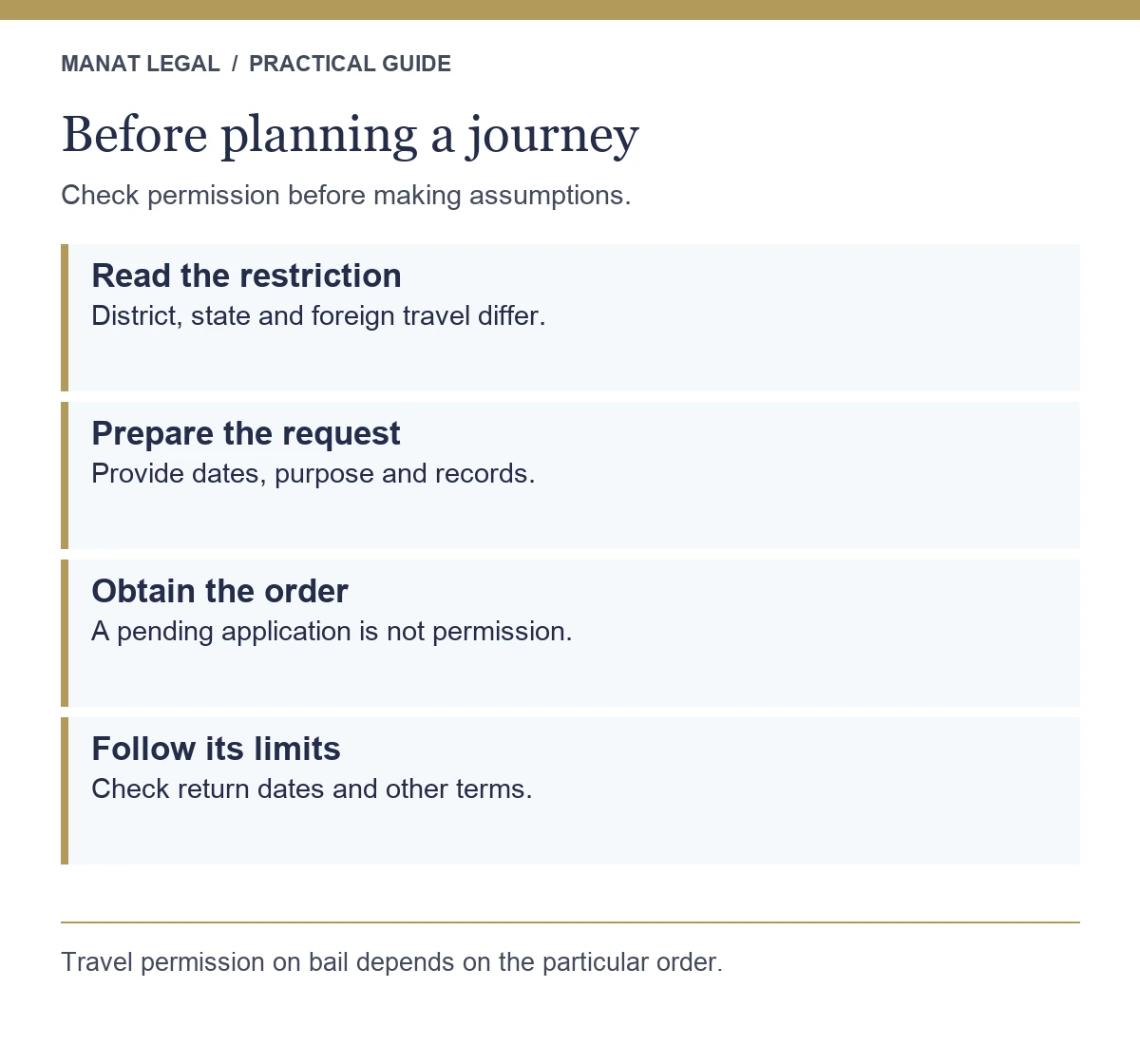
Travel permission on bail depends on the order and the legal circumstances. Some orders restrict foreign travel, require surrender of a passport or impose limits on leaving a particular area. Others contain different requirements. Read the geographical wording carefully and check every active case affecting you.
If permission is needed, give counsel the proposed dates, destination, purpose, itinerary and supporting records early. An employer’s letter, medical appointment or family event invitation may help explain the request. The court decides whether permission should be granted and on what terms; a ticket or visa does not replace that decision.
Where prior permission is required, a pending application is not permission to travel. Allow time for the hearing and any further documents. If circumstances change after permission is granted, check whether the change falls within the order. Avoid treating a permission for one journey as open-ended approval for later trips.
5. Understand the bail bond and surety obligations
The bail bond and surety paperwork should be kept with the release order. Under section 485 BNSS, the bond addresses attendance and includes conditions imposed for release. A surety is taking on an obligation; the role should not be treated as a formality undertaken without understanding the documents.
Check names, addresses, amounts and other particulars for accuracy. Preserve copies of documents accepted by the court and tell counsel if a surety dies, withdraws or becomes unavailable. The appropriate response may involve a replacement or further court directions. Do not silently assume the original arrangement remains sufficient.
If a bond amount or condition creates a genuine practical difficulty, raise it through counsel. Section 484 requires regard to the circumstances and says the bond amount should not be excessive; it also provides for reduction by the High Court or Court of Session. That is a route to seek an order, not permission to ignore the amount already fixed. Our bail documents checklist explains what families can organise.
6. Ask to modify bail conditions when circumstances change
A new job, a relocation or a medical problem may make an existing direction difficult to follow. To modify bail conditions, identify the exact clause, the proposed replacement and the evidence supporting the request. Your advocate should identify the court with power to grant the relief in the particular case.
A focused request is easier to assess than a general statement that the conditions are inconvenient. For example, explain how a reporting time conflicts with a documented work shift and propose a workable alternative. Include your compliance history honestly, including any lapse that needs to be explained.
Until the competent court changes the order, continue to comply as far as legally required. An informal conversation with an officer or an assurance from the other side should not be treated as a substitute for the necessary judicial direction. Keep the later order alongside the original so there is no confusion about which terms now operate.
7. Respond promptly if a breach is alleged
If you miss a date or receive notice of a bail cancellation request, contact counsel promptly. Collect the order, notice, attendance records and the genuine reason for the problem. A medical emergency, for example, should be supported by the available contemporaneous records, without exaggerating what they establish.
Bail cancellation is a legal decision, not an automatic consequence of every allegation. Equally, it is unsafe to assume that a small lapse will be ignored. Sections 480(5) and 483(3) contain powers relating to arrest and custody after release on bail. The applicable legal test, alleged conduct and procedural history need examination.
For a hypothetical example, a person who has changed address may continue receiving reminders from an old contact while missing official communications. Keeping counsel informed and following any address-update requirement can prevent this practical problem. A routine review of bail conditions after each hearing is often more useful than trying to reconstruct several months of events later.
- Keep the original order and every modification together.
- Track court attendance and police reporting separately.
- Retain genuine compliance records.
- Seek required travel permission before departure.
- Raise practical difficulties before they become missed obligations.
Frequently asked questions
Does getting bail mean the criminal case is over?
No. Bail concerns release from custody subject to the applicable legal framework. Investigation or trial may continue, and court directions still require attention.
Can I travel abroad while on bail?
Check the wording of every relevant order, passport-related restrictions and the applicable law. Where previous court permission is required, obtain it before travelling.
Can the complainant waive my bail conditions?
A private agreement does not itself amend a court’s order. Ask counsel whether a formal application and further order are needed.
What if I cannot attend police reporting because I am ill?
Inform your advocate promptly, preserve genuine medical records and seek the appropriate direction. Do not assume illness automatically excuses attendance or create retrospective proof.
Do bail conditions end when the chargesheet is filed?
Do not assume so. Their duration and any later changes must be checked against the order and procedural stage. Filing a chargesheet alone does not justify disregarding existing directions.
If you need help interpreting bail conditions in Bengaluru, ManAT Legal’s criminal-law team can review the order and the next procedural steps. This is general legal information; advice on compliance or modification requires the actual case documents.