

Enforcing a Civil Court Decree in Karnataka: A Post-Decree Checklist
Reviewed by Aiyappa B.T., Advocate, ManAT Legal
An execution of civil decree Karnataka checklist begins with a practical point: winning a civil suit does not always produce payment, possession or compliance automatically. If the judgment debtor does not obey the decree, the decree-holder may need proceedings under Sections 36–74 and Order XXI of the Code of Civil Procedure, 1908, read with applicable Karnataka court rules.
Execution of civil decree Karnataka procedure is not a second trial of the entire suit. The executing court ordinarily enforces the decree as drawn and deals with questions concerning execution, discharge or satisfaction within the CPC framework. The first practical task is to read the operative decree, not only the judgment’s reasoning.
Start with the signed decree and current order record
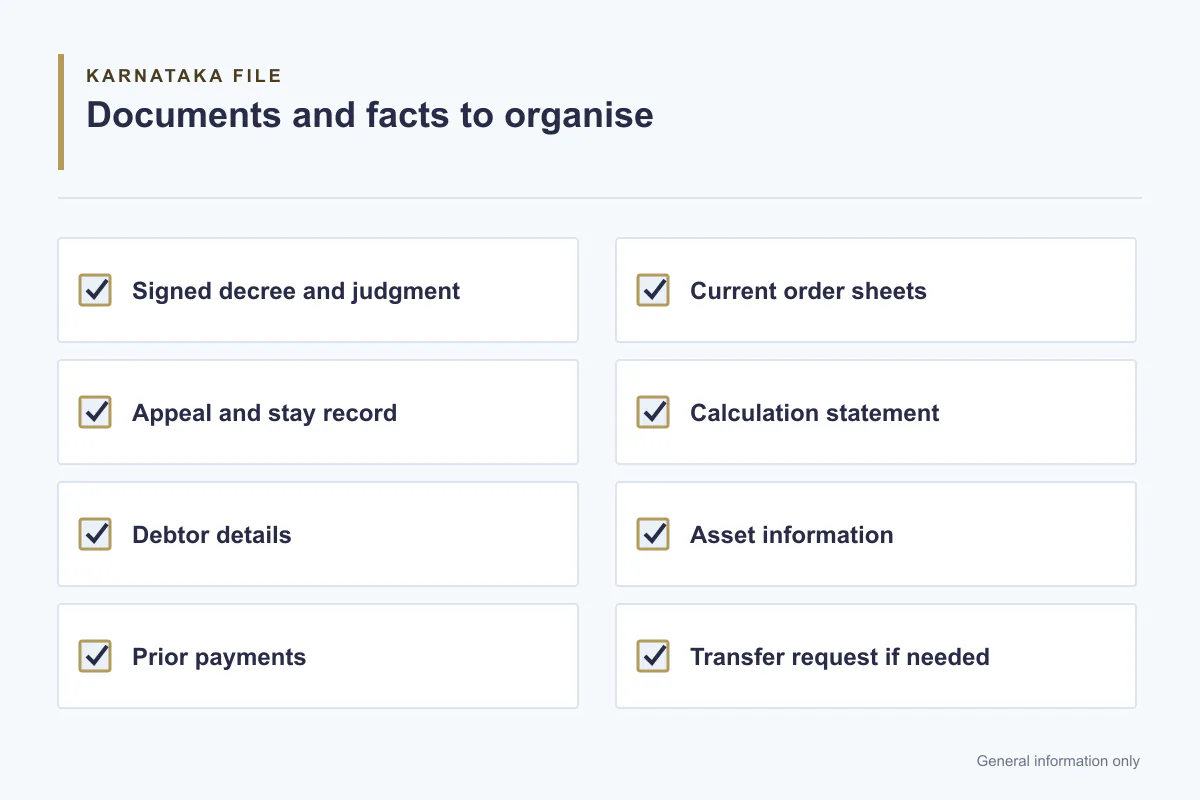
Collect:
- judgment and formally drawn decree;
- certified copies where required;
- appellate, review, stay or modification orders;
- date on which the decree became enforceable;
- calculation of principal, interest, costs and payments;
- schedule of property or exact act ordered;
- details of parties and legal representatives; and
- every earlier execution application and result.
The judgment explains why the court decided the case; the decree records the enforceable relief. If the decree is ambiguous, conditional or not drawn in accordance with the judgment, appropriate correction/clarification may be required rather than asking the executing court to rewrite the merits.
Does an appeal stop execution of civil decree Karnataka proceedings?
An appeal does not automatically operate as a stay merely because it has been filed. The operative appellate or trial-court orders must be checked. If stay has been granted, read its scope, conditions, duration and security terms carefully.
Do not rely on a party’s statement that “the matter is in appeal.” Obtain the case number and signed orders and confirm current status.
Execution of civil decree Karnataka: which court can act?
Section 38 CPC states that a decree may be executed by the court that passed it or by the court to which it is sent for execution. Sections 39–46 and Order XXI address transfer and related procedure.
Transfer may be relevant when, for example, the judgment debtor resides, carries on business or has property within another competent court’s jurisdiction, subject to the statutory conditions.
The Karnataka Civil Rules of Practice, 1967 add state practice. Rule 106 states that an application to transfer a decree for execution is made by a verified execution petition in Form 13, with facts supporting Section 39 and Order XXI Rules 4 and 5. It also addresses notice where Order XXI Rule 22 requires it and process fee after transfer is allowed.
Court selection should be checked against:
- the court that passed the decree;
- statutory competence and pecuniary limits;
- judgment debtor’s residence/business;
- location and nature of property;
- prior transfer certificates or execution proceedings; and
- local filing/e-court requirements.
Execution of civil decree Karnataka: what goes into the application?
Order XXI Rules 10 and 11 govern applications for execution. A written application generally requires the particulars identified in Rule 11(2), including the suit, parties, decree date, appeal information, payments/adjustments, previous execution applications, amount or relief due, person against whom execution is sought, and mode of court assistance requested.
Prepare a clear schedule rather than a narrative demand:
| Item | Details to verify |
|---|---|
| Decree | Court, case number, date and relief |
| Appeal/stay | Case, order date, current operation and conditions |
| Amount | Principal, decree interest, costs, credits and balance |
| Prior execution | Number, court, date and result |
| Judgment debtor | Current identity, address and legal status |
| Property/assets | Description, location, ownership evidence and encumbrances |
| Mode sought | Delivery, attachment/sale, receiver, Rule 32 step or other lawful mode |
| Documents | Decree, orders, calculations, searches and supporting records |
The application should request a mode that matches the decree. A money decree, possession decree and injunction decree are not enforced in the same way.
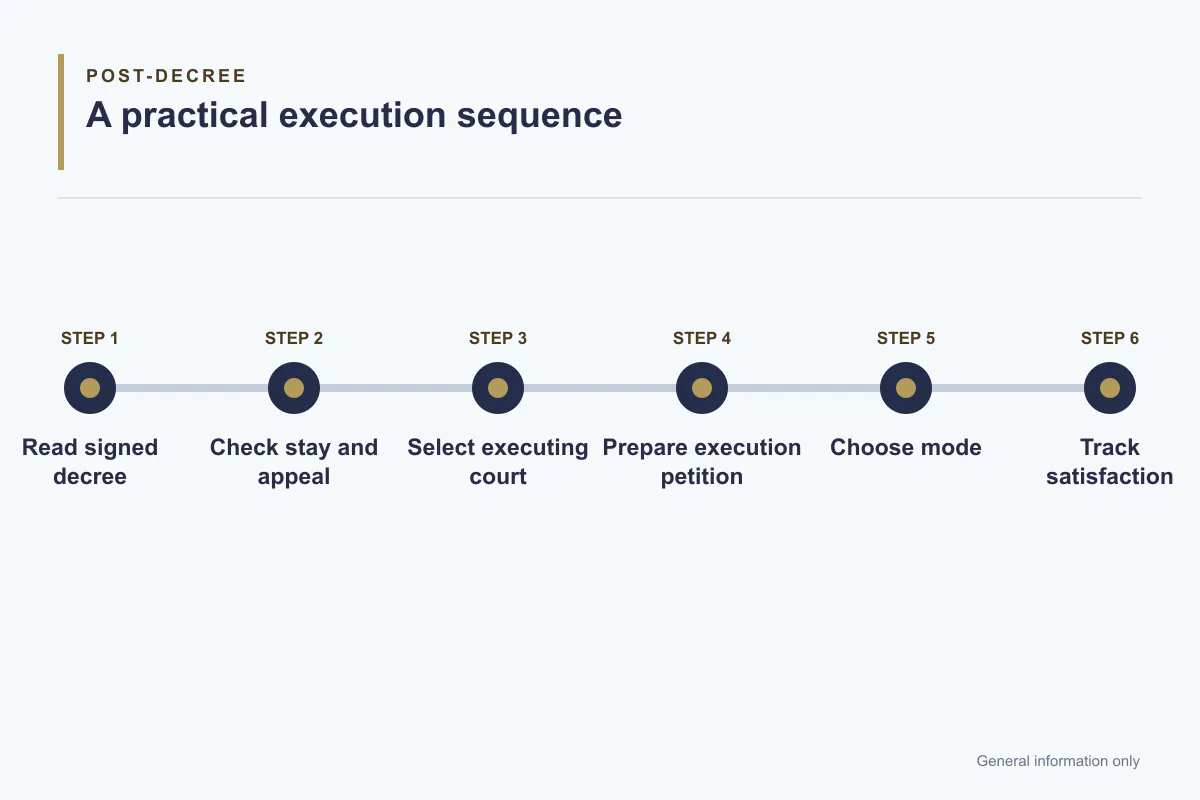
Modes of execution under Section 51
Subject to the CPC’s conditions and limitations, Section 51 recognises execution:
- by delivery of specifically decreed property;
- by attachment and sale, or sale without attachment, of property;
- by arrest and detention where legally permissible;
- by appointment of a receiver; or
- in another manner required by the relief.
For a money decree, detention is subject to the proviso to Section 51, notice/opportunity and recorded judicial satisfaction on the specified grounds. It is not a routine substitute for identifying attachable assets.
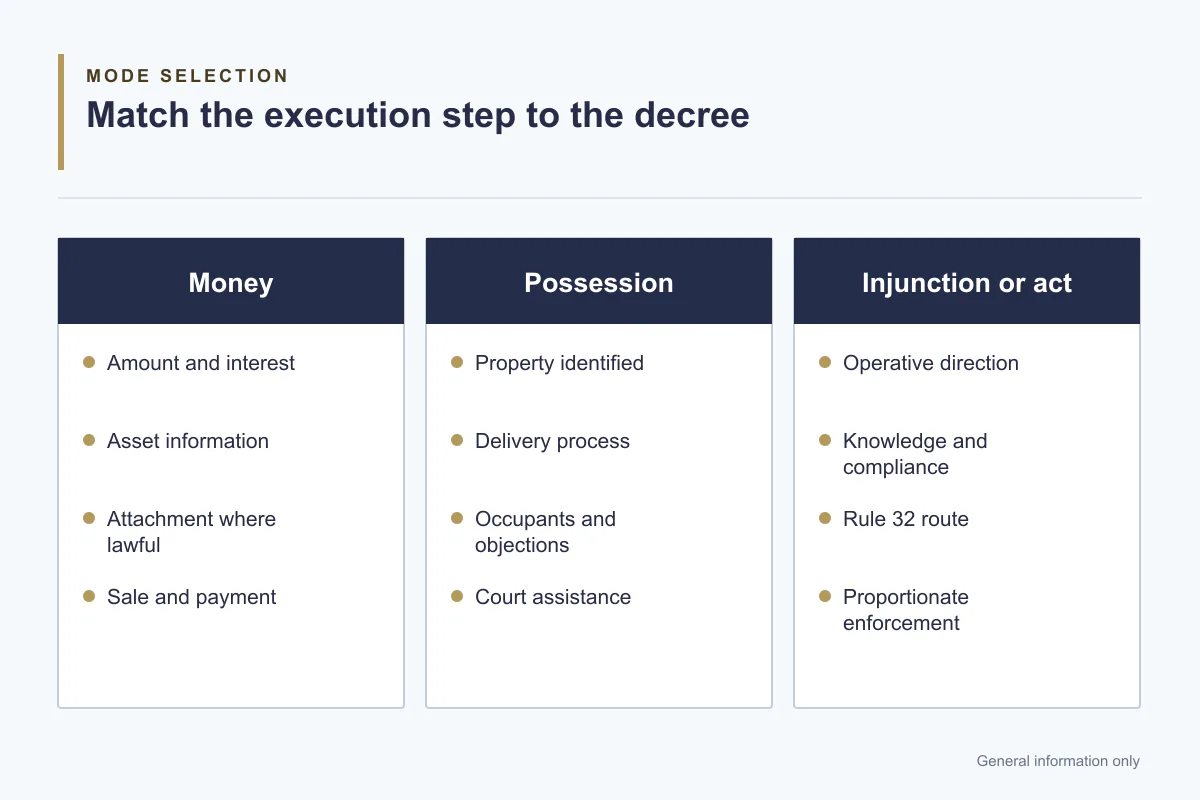
Execution of civil decree Karnataka: enforcing a money decree
Order XXI Rule 30 permits execution of a money decree by detention, attachment and sale of property, or both, subject to the Code. The practical questions are:
- What exact amount remains due under the decree?
- Which assets legally belong to the judgment debtor?
- Which assets are attachable, and what exemptions apply?
- Is the proposed process proportionate and likely to realise value?
Calculate the decree amount transparently
Show:
- principal awarded;
- pre-suit, pendente lite and future interest exactly as decreed;
- decree costs;
- post-decree payments or adjustments;
- the date up to which interest is calculated; and
- the resulting balance.
Do not import an interest rate or compounding method not granted by the decree.
Identify assets lawfully
Possible records may include company filings, land/property records, vehicle records, contractual receivables and bank information lawfully available. Ownership, encumbrance and exemptions must be verified.
Order XXI Rule 41 provides mechanisms for examination and disclosure concerning a judgment debtor’s property in the circumstances stated by the rule. It can be important where the decree-holder lacks reliable asset information.
Attachment and sale
Section 60 and Order XXI contain rules on property liable to attachment and sale and exemptions. Different procedures apply to movable property, debts, shares, salary, bank accounts and immovable property.
For immovable property, accurate description, ownership and encumbrance material are essential. Order XXI Rules 54 and following address attachment and sale procedure. Attachment is not ownership transfer; sale requires the prescribed proclamation, notice and court process.
For debts owed to the judgment debtor, garnishee procedure may be considered under Order XXI. The identity of the garnishee, debt, maturity and competing claims require evidence.
Delivery of movable or immovable property
Order XXI contains distinct provisions for delivery of specific movable property and possession of immovable property. The decree schedule must identify the property sufficiently. Boundaries, occupants, tenants, subsequent purchasers or third-party claims can affect the procedure.
If resistance or obstruction occurs, Order XXI Rules 97–103 provide a framework for adjudicating relevant questions. A third party’s right, title or interest cannot be dismissed merely because it appears at execution, but execution should not automatically become a fresh suit either.
Enforcing an injunction or specific-performance decree
Order XXI Rule 32 addresses decrees for specific performance, restitution of conjugal rights and injunctions through the mechanisms and conditions stated there. The operative obligation, opportunity to obey and alleged wilful failure must be established.
For a permanent injunction, Article 136 contains a specific proviso concerning limitation. The correct execution mode depends on whether the decree orders restraint, a positive act or another specific relief.
Do not assume police assistance or contempt is the first or automatic route. The decree, rule, conduct and court directions must be examined.
Partition decree boundary
Partition litigation may involve a preliminary decree declaring shares, further proceedings for actual division and a final decree. Karnataka practice treats final-decree procedure as a continuation requiring its own careful steps.
This execution guide does not replace ManAT Legal’s article on partition disputes in Karnataka. Before seeking delivery, confirm that the decree is at the enforceable stage and that property has been finally allotted or otherwise directed.
Payment or adjustment after decree
Order XXI Rules 1 and 2 regulate payment under a decree and certification/recording of out-of-court payments or adjustments. Informal payment should be documented and brought on record in the prescribed manner.
The decree-holder should not claim sums already paid. The judgment debtor should not assume a private adjustment will automatically be recognised without compliance.
When is notice under Order XXI Rule 22 relevant?
Rule 22 requires notice in specified cases, including applications made after the period stated in the rule or against a legal representative, subject to its terms and exceptions. Notice is not required in every execution application.
The application should identify deaths, succession, assignment, delay and prior execution proceedings early so the court can apply the correct procedure.
What objections can be raised?
Section 47 directs questions between the parties or their representatives relating to execution, discharge or satisfaction to the executing court. Common issues include:
- decree already satisfied or adjusted;
- amount incorrectly calculated;
- property does not belong to the judgment debtor;
- property is exempt from attachment;
- lack of jurisdiction or invalid transfer;
- decree not yet enforceable or stayed;
- execution against the wrong person or beyond legal-representative liability;
- limitation; and
- proposed execution going beyond the decree.
The executing court ordinarily cannot go behind or vary the decree. The Supreme Court reiterated the limited execution focus in Rahul S Shah v Jinendra Kumar Gandhi, while directing courts toward effective and timely execution.
Execution of civil decree Karnataka: what is the limitation period?
Article 136 of the Limitation Act, 1963 generally prescribes twelve years for execution of a decree or order of a civil court other than a decree granting a mandatory injunction, beginning when the decree or order becomes enforceable or, for a decree directing payment/delivery at a certain date or recurring periods, when default occurs in respect of which execution is sought. Its proviso states that an application for enforcement of a decree granting a perpetual injunction is not subject to a period of limitation.
This summary is not a calculation for a particular decree. Mandatory injunctions, instalments, appellate modification, enforceability conditions and prior proceedings can change the analysis. Delay also creates practical asset and evidence problems even when an application is within the outer period.
Execution of civil decree Karnataka: 12-point preparation checklist
- Obtain the judgment, signed decree and all later orders.
- Confirm enforceability and current stay status.
- Calculate the unsatisfied relief exactly.
- Identify the executing court and whether transfer is needed.
- If transferring, verify Karnataka Rule 106 and Form 13 requirements.
- Select a CPC mode matching the decree type.
- Gather lawful asset/property and ownership material.
- Disclose prior execution and all payments/adjustments.
- Anticipate Rule 22 notice, Section 47 issues and third-party objections.
- Calculate Article 136 limitation from the correct enforceability/default event.
- Check current court fee, process fee, affidavit, copy and e-filing practice.
- Track every warrant, attachment, proclamation, sale, delivery and compliance order.
Execution of civil decree Karnataka: common mistakes
- Filing from the judgment summary rather than the drawn decree.
- Assuming appeal equals stay.
- Choosing a court only because the debtor has an office there.
- Requesting arrest routinely for a money decree.
- Attaching property without verifying ownership or exemption.
- Claiming interest or amounts beyond the decree.
- Omitting post-decree payments or earlier execution cases.
- Treating a preliminary partition decree as ready for possession execution.
- Ignoring third-party resistance procedure.
- Waiting until the limitation deadline to identify assets.
Frequently asked questions
Does a decree automatically transfer money or property?
Not always. Voluntary compliance may occur, but otherwise the decree-holder may need execution steps matched to the relief.
Can execution be filed where the debtor’s assets are located?
The CPC transfer and executing-court provisions must be followed. Asset location is relevant but does not eliminate the formal transfer/competence analysis.
Can the executing court reconsider who should have won the suit?
Ordinarily it cannot go behind the decree. It can decide execution, discharge and satisfaction questions and other matters assigned to it by Order XXI.
Is every decree enforceable for twelve years?
No universal statement is safe. Article 136 has text, starting rules and exceptions, including different treatment for mandatory and perpetual injunctions. The exact decree and later orders control.
Can a bank account be attached?
Attachment of a debt held by a bank may be possible through the applicable Order XXI procedure, but ownership, account character, exemptions, competing claims and precise court directions must be established.
Related ManAT Resources
- Civil litigation lawyers in Bangalore
- How to file a money recovery suit in India
- Partition disputes in Karnataka
- Debt recovery and debt-related matters
This execution of civil decree Karnataka guide is general information, not legal advice. Execution strategy depends on the decree, appellate record, parties, property, assets, objections, limitation and current Karnataka court practice.