
Police Search and Seizure: 7 Essential Checks
Police search and seizure can interrupt an ordinary morning at home or bring an office to a standstill. The first questions are practical: who is conducting the search, what authority are they relying on, and how will the items taken away be recorded? A calm record of those details is more useful than an argument about a rule remembered from television.
Indian procedure allows searches through different legal routes. A warrant is important where one is being executed, but it is not required for every lawful police search. This guide explains seven checks under the Bharatiya Nagarik Suraksha Sanhita, 2023 (BNSS), with particular attention to records you should preserve.
1. Identify the basis for police search and seizure
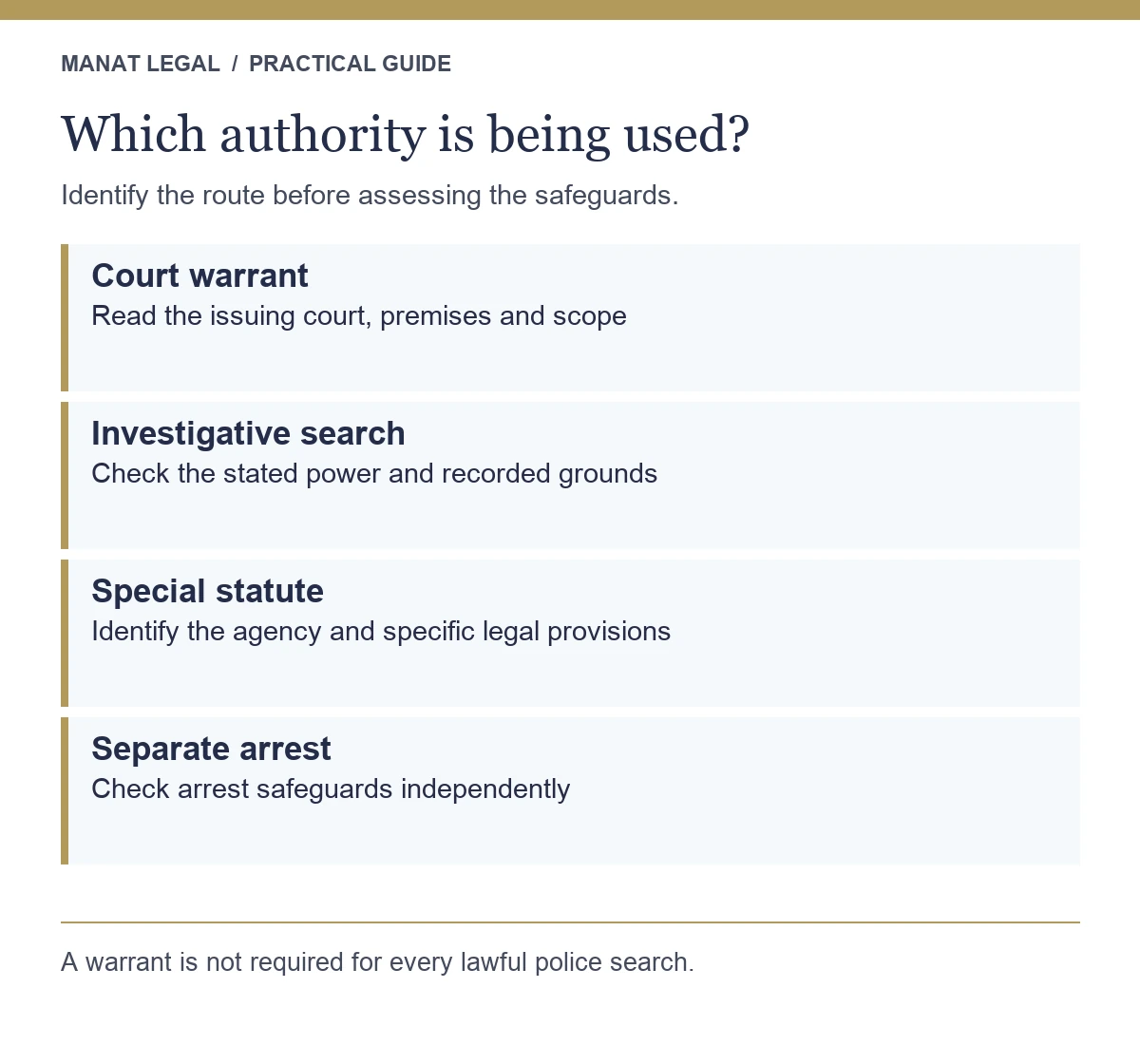
Ask for the officers’ identities, police station, case reference and the legal basis of the search. Where a warrant is being executed, ask to see it and note the issuing court, premises and stated scope. If you are not the occupier or person in charge, identify the person who can explain the premises and ownership of items.
Section 96 of the official BNSS text addresses circumstances in which a court may issue a search warrant. A warrant may limit the search to a particular place or part of a place. That detail matters; do not reduce the document to its heading alone.
Section 185 provides a separate investigative search power where its conditions are met, including recorded grounds and the issue of obtaining necessary material without undue delay. Search without warrant in India is therefore not automatically unlawful. Equally, the absence of a warrant does not remove the statutory conditions and safeguards.
Special statutes can prescribe different powers or additional safeguards. Older proceedings may also involve the Code of Criminal Procedure under the BNSS savings provision. Tell your advocate the actual offences and agency involved so that the correct framework can be checked.
2. Cooperate with lawful directions and record concerns
Do not obstruct the officers, conceal articles, delete files or ask someone elsewhere to remove material. Contact your advocate promptly and provide the case reference and the authority shown or stated. Do not assume the search must stop until your advocate arrives.
You can raise a concern about an incorrect address, an item belonging to someone else or a document you do not understand. State the concern accurately and ask that it be recorded. A factual note of what happened is generally more useful for later legal review than an escalating confrontation at the premises.
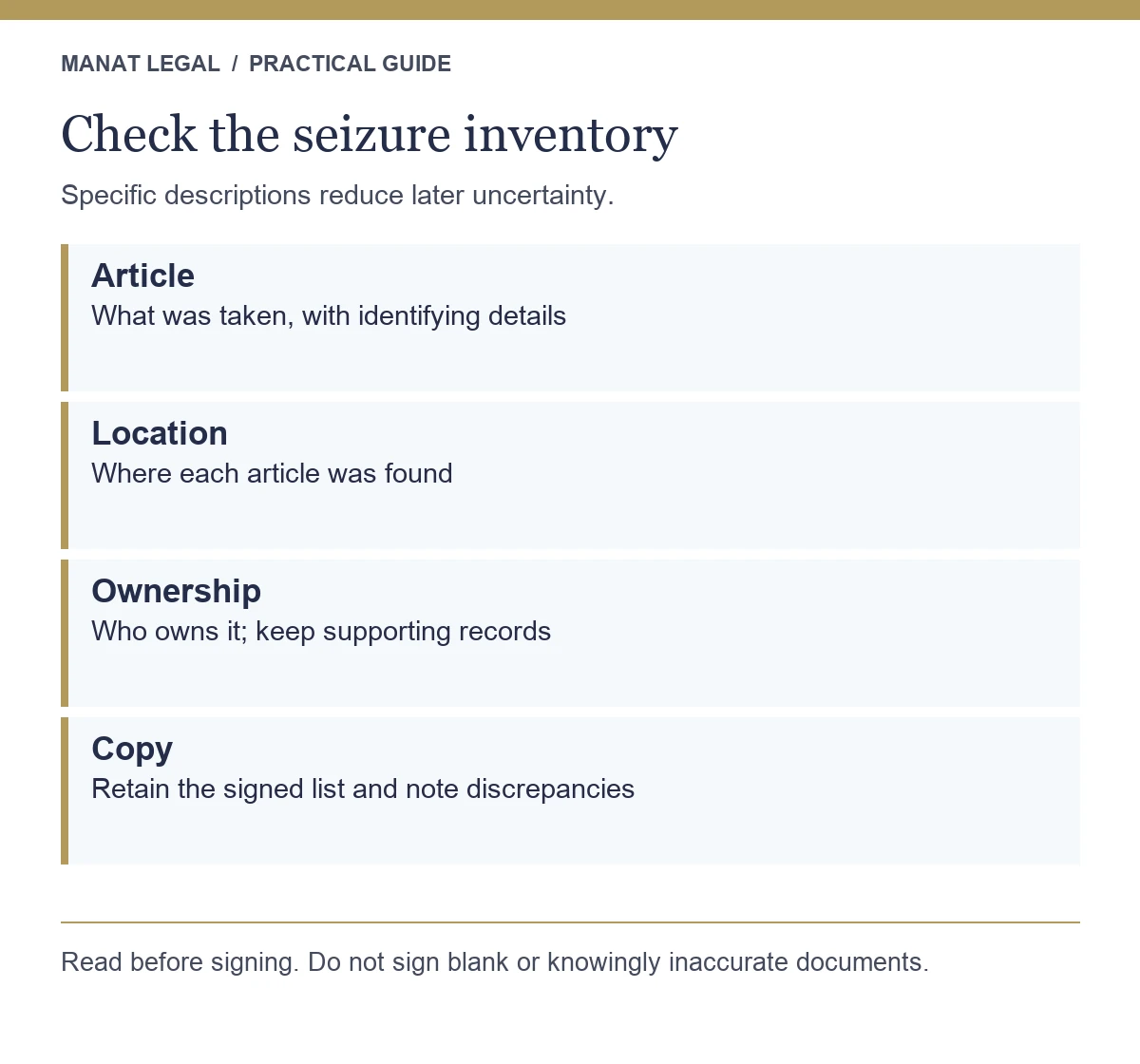
Avoid signing blank papers or an account you know is inaccurate. Read documents presented to you, ask what your signature acknowledges and request correction of factual errors. If you cannot read the language used, say so and seek an explanation. Different documents serve different purposes; a seizure list is not the same thing as a witness statement.
A search of premises and an arrest are also different acts. If someone is arrested, the grounds, information to relatives and other arrest safeguards require separate attention. Do not infer that everyone present has been arrested merely because officers are searching the premises.
3. Know the witness and presence safeguards
Section 103 sets out general search safeguards, including calling two or more independent and respectable witnesses. It provides for witnesses from another locality where suitable local inhabitants are unavailable or unwilling. The statutory procedure should be checked against what actually occurred, rather than assuming that a familiar neighbour must always be the witness.
The section also provides for the occupant, or someone on the occupant’s behalf, to attend during the search and receive a copy of the signed list. Section 185 applies the general provisions so far as may be to searches under that section. Keep track of who was present and the times the search began and ended.
Where a woman is personally searched under section 103(3), the provision requires another woman to conduct that search with strict regard to decency. A personal search has its own legal context; do not treat a search of a cupboard and a search of a person as interchangeable.
If you believe a safeguard was not followed, record the specific event and who witnessed it. Do not assume that any alleged irregularity automatically ends the criminal case or makes all recovered material unusable. Its legal effect requires assessment in the proceeding.
4. Read the seizure mahazar and inventory carefully
A seizure mahazar or panchnama records the search or seizure process; the precise form and terminology can vary. Read the description of each article, where it was found and the identifiers used. The BNSS search procedure requires a list of things seized and the places where they were found in the circumstances covered by section 103.
For a device, useful identifiers include its make, model and serial number where available, together with accessories and storage media taken. For papers, a meaningful description or page count may prevent later confusion. Ask about unclear entries such as ‘one bundle’ or ‘one electronic item’ without altering the official record yourself.
Check whether the document distinguishes property found at the premises from property belonging to its occupant. A work laptop may belong to an employer, and a shared office cabinet may contain several people’s records. Explain ownership accurately and preserve supporting invoices or asset records.
Request the copy to which you are entitled and keep it intact. If you receive an incomplete or illegible copy, note that promptly and ask for a usable copy through the appropriate channel. Do not rely only on a family member’s memory of what was removed.
5. Understand the recording duties during police search and seizure
Section 105 requires audio-video recording of the search or taking possession within its scope, including preparation of the seizure list and witness signatures. It also requires the police officer to forward the recording without delay to the specified Magistrate. Section 185 separately refers to audio-video recording of its searches.
These duties are not the same as a blanket right for an occupant to film every moment on a personal phone. If you wish to make your own record, ask how that can be done without obstruction or interference and take advice about any restriction. Never disrupt the process to obtain a clip for social media.
For a search under section 185, the provision requires the relevant written records to be sent to the nearest empowered Magistrate within forty-eight hours. The owner or occupier can apply to the Magistrate for a free copy of those records. That is a specific statutory route, not a promise that every investigation document must be handed over at the scene.
Preserve any lawful recording already available, together with the original file and context. Our guide to digital evidence preservation explains why edited clips and forwarded copies should not replace the source.
6. Deal carefully with seized phones and business records
When police search and seizure involves devices, record what was taken and the practical effect of losing access. Tell your advocate if the device contains privileged legal communications, third-party confidential material or records necessary for daily business. Those concerns should be raised through an appropriate legal request, rather than by deleting or remotely wiping information.
Requests involving passwords, access credentials and compelled disclosure can raise distinct legal questions. There is no useful universal answer based only on the fact that a phone has been seized. Explain the exact request, your role in the investigation and any order shown to your advocate promptly.
If you need copies of business records or access to essential data, identify the specific material and why it is needed. An application can then address the investigation’s requirements and appropriate safeguards. Do not assume ownership gives you an immediate right to reconnect to, reset or retrieve the device yourself.
Keep a separate record of operational disruption, such as payroll records needed or statutory filing dates approaching. Be specific: a documented need for identified records is more helpful than a general demand that every item be returned immediately.
7. Review the record and seek the correct follow-up order
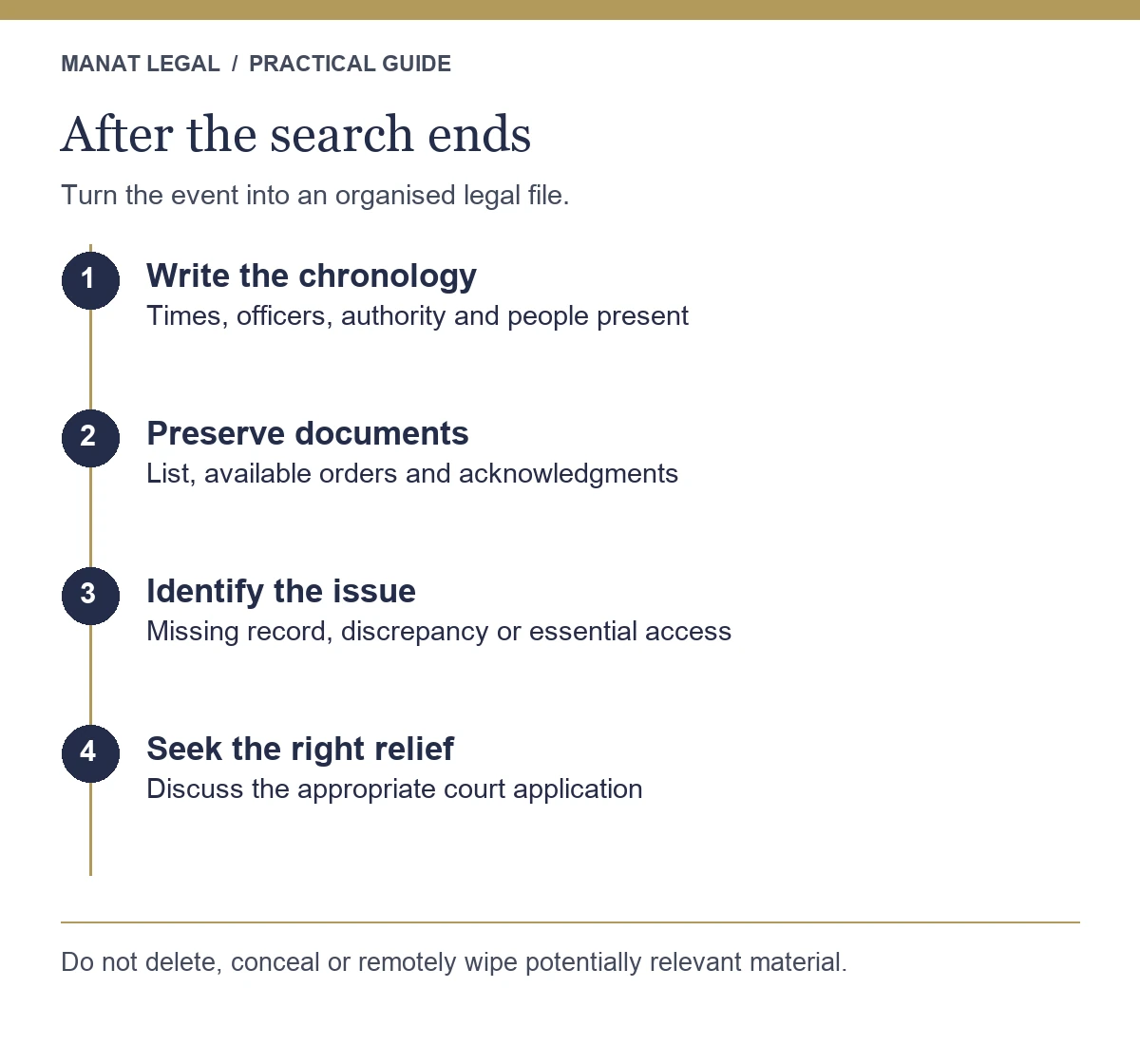
After police search and seizure, prepare a chronology while the details are fresh. Include the officers, case number, authority relied on, persons present, documents supplied and any specific discrepancy. Keep photographs or other material only if lawfully obtained, and distinguish personal observations from what someone later told you.
Return of seized property is a separate procedural question. The appropriate court may consider custody or disposal of property under the applicable BNSS provisions, including sections 497 and 503 where relevant. The route depends on how the property was seized, whether it is before a court and the needs of the investigation or trial.
Collect proof of ownership and explain why interim custody, a copy or another limited arrangement is sought. Conditions may be imposed to preserve the property or ensure it can be produced again. No fixed return date can be promised simply because an invoice is available.
For example, if a shared office laptop is taken, the immediate task is to identify it correctly, record the employer’s ownership and explain any essential business-data need. That is different from asserting that the seizure is invalid merely because the employee using it is not its owner. The facts and the legal basis must be considered together.
- Keep the warrant or other available authority, seizure list and acknowledgments together.
- Record any discrepancy in dates, items, ownership or signatures.
- Identify the specific relief needed: copy, access, interim custody or another order.
- Continue complying with notices and court directions while the request is considered.
Frequently asked questions
Can the police search without a warrant?
Yes, a warrant is not required for every lawful search. Section 185 BNSS is one investigative route, subject to its conditions and safeguards. Special statutes may also apply. The exact authority and facts should be checked.
Does a search mean I have been arrested?
No. Searching premises, seizing an article and arresting a person are distinct actions. If you are told you are under arrest, obtain advice on the separate grounds and safeguards relevant to that arrest.
Should I sign a blank seizure document?
Do not sign a blank document. Read the record, ask what your signature acknowledges and request correction of factual inaccuracies. If the language or document is unclear, say so and seek advice.
Will a missing witness automatically invalidate the case?
An alleged procedural breach needs to be examined against the applicable law and the actual evidence. Do not assume it automatically nullifies the investigation, requires return of every article or guarantees acquittal.
Can seized property be returned before the trial ends?
An appropriate custody or return application may be possible, depending on the property and proceeding. The court considers the applicable provisions and may impose conditions. Return is not automatic and no universal timetable applies.
For advice on police search and seizure involving your home or business in Bengaluru, ManAT Legal’s criminal-law team can review the available records and the appropriate next application. This article is general legal information, not a substitute for advice on the specific search and governing statute.