

Specific Performance of an Agreement to Sell Property in India
Reviewed by Ann Finiya Pereira, Advocate, ManAT Legal
When a seller refuses to register sale deed, the buyer does not automatically become owner merely because an agreement to sell exists. A suit for specific performance agreement to sell asks the civil court to enforce the contractual promise, subject to the Specific Relief Act, 1963, limitation, proof of the claimant’s performance and readiness, correct parties and the proper property forum. Immediate priorities are to preserve the agreement, payment trail, due-date events, communications and title position.
Agreement to sell and sale deed are not the same

An agreement to sell generally records a future obligation to transfer property on agreed terms. It does not by itself create the completed conveyance that a registered sale deed ordinarily effects. The agreement, its certainty, applicable stamp and registration consequences, and the parties’ subsequent conduct all require examination.
That distinction explains why a specific performance agreement to sell claim seeks enforcement of a promise rather than a declaration that the agreement itself transferred title. Property verification remains a separate task and may reveal title, authority or encumbrance issues affecting relief.
|
Question |
Agreement to sell |
Registered sale deed |
|---|---|---|
|
Main legal function |
Records a contractual promise for a future transfer |
Completes the conveyance subject to applicable law |
|
Typical evidence |
Terms, signatures, consideration, conditions and due date |
Executed instrument, registration record and title chain |
|
If the transaction breaks down |
Contractual remedies may be assessed |
Title and post-transfer remedies require separate analysis |
When specific performance of an agreement to sell may be sought
After the 2018 amendment, Section 10 of the Specific Relief Act states that specific performance shall be enforced subject to Sections 11(2), 14 and 16. The remedy is therefore governed by statutory conditions and bars rather than a free-floating discretion. Relief still depends on a valid, enforceable and sufficiently certain contract, the claimant’s compliance, limitation, parties and the pleaded case.
If the seller refuses to register sale deed, the response should not be reduced to sending repeated notices. Counsel should determine whether the agreed completion date or condition has occurred, whether the claimant can perform the remaining obligations, whether third-party dealing is threatened and what final and interim prayers are legally available.
What the claimant must prove
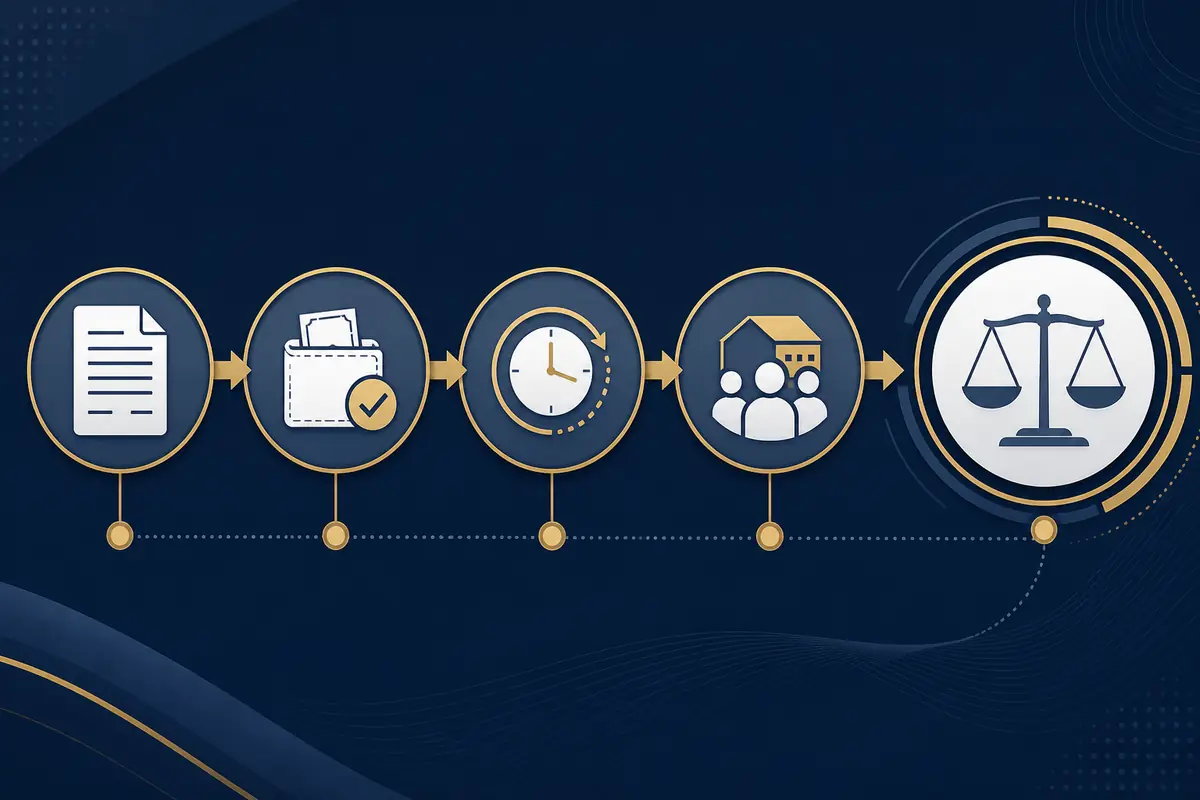
The court examines the contract and the claimant’s conduct together. A successful specific performance agreement to sell case normally requires more than proving signatures. The pleaded obligations, money trail, chronology and continuing capacity should support each other from contract through decree.
Valid and sufficiently certain contract
The property, parties, consideration and essential obligations must be identifiable. Conditions precedent, permissions, title-clearance duties, payment stages and the completion mechanism should be read as a whole. Ambiguity, lack of authority, illegality or a contract falling within Section 14 can prevent enforcement.
Performance and buyer readiness and willingness
Section 16(c) bars relief to a claimant who fails to prove performance of, or continuous readiness and willingness to perform, essential terms. Buyer readiness and willingness has two connected dimensions: capacity to perform, including financial capacity when money is due, and conduct demonstrating a genuine intention to complete.
The Supreme Court reiterated in 2025 and 2026 that there is no mechanical formula. Bank records, available finance, attendance at the Sub-Registrar where relevant, notices, offers of performance and compliance with court directions may matter. Actual tender or deposit is not invariably required unless directed, but assertion alone is not proof.
Breach and continuing ability to perform
Identify exactly what the opposing party failed to do and whether the claimant remained capable of doing what the contract required. Where both sides had outstanding obligations, the sequence and dependency of those promises are critical. A later inability to comply with a decree condition can also undermine claimed continuous willingness.
Time limit and when the right to sue arises
Article 54 of the Limitation Act generally provides three years for a suit for specific performance: from the date fixed for performance, or, if no date is fixed, when the plaintiff has notice that performance is refused. The time limit after sale agreement breach is therefore fact-sensitive. A later reminder does not necessarily restart limitation.
Dates linked to permissions, title clearance, payment, possession or registration may change when performance became due. Delay can also affect interim relief and factual credibility even if the suit is within the formal time limit after sale agreement breach. Prepare a dated chart before issuing or responding to a final notice.
Which court and which parties?
Forum and party analysis should be completed before filing. Relief respecting immovable property is ordinarily tied to the property’s location, but the precise prayers and CPC rules matter. Pecuniary limits, commercial-court questions and local amendments must also be checked.
Court jurisdiction for property suit
Section 16 CPC generally directs suits for recovery of, or determination of rights or interests in, immovable property to the court where the property is situated, subject to its proviso and other jurisdictional rules. Court jurisdiction for property suit cannot safely be inferred only from where the agreement was signed or where one defendant lives.
Subsequent purchaser and necessary parties
Section 19 of the Specific Relief Act addresses enforcement against parties and certain persons claiming under them by subsequent title, while protecting a transferee for value who paid in good faith without notice. Search current property records. A subsequent purchaser, co-owner, principal, agent or legal representative may be necessary depending on title and relief.
Evidence to preserve before filing

- Original agreement and every annexure, amendment or receipt.
- Proof of earnest money, instalments and available balance consideration.
- Title documents, encumbrance information and authority to sell.
- Notices, replies, complete message threads and delivery proof.
- Evidence of attending or preparing to attend registration where relevant.
- Loan sanction, bank statements or other lawful proof of financial capacity.
- A chronology of conditions, due dates, defaults and later transfers.
- Current identity and address details for every proposed party.
Preserve originals and context rather than isolated screenshots. The evidence should demonstrate both breach and buyer readiness and willingness, not merely one side of the transaction.
Interim protection against third-party rights
If the property may be sold, encumbered, developed or materially altered, interim relief may be considered under Order XXXIX CPC and other applicable powers. The applicant must address a prima facie case, balance of convenience and irreparable injury. An injunction is not automatic simply because a suit is filed.
The main contractual remedy must remain distinct from temporary injunction principles. A narrowly framed interim prayer should preserve the subject matter without granting the final relief in advance.
Alternative or additional relief
The plaint should be designed around the current statute, because some relief must be expressly claimed. The facts may support compensation, refund or possession-related relief in addition to or instead of specific performance.
Refund, compensation and possession-related prayers
Sections 21 and 22 address compensation and certain additional relief, including possession, partition or refund of earnest money where applicable. Plead the legal and factual basis and quantify money claims responsibly. Do not assume that failure of the main remedy automatically produces every alternative prayer.
Substituted performance and statutory bars
Section 20 allows substituted performance after the prescribed notice process, but a party who obtains substituted performance cannot then claim specific performance. Section 14 excludes specified contracts, including those involving continuous duties the court cannot supervise and contracts dependent on personal qualifications. The remedy election should precede irreversible steps.
What happens after a decree?
A decree may direct execution of the sale deed, payment or deposit of balance consideration and consequential steps within stated time. Non-compliance can generate further applications and may affect the decree’s benefit. Registration, possession and third-party issues do not always resolve themselves with the judgment.
The post-decree stage is addressed separately in ManAT Legal’s guide to enforcing a civil decree in Karnataka. The decree terms and execution court’s powers control the next steps.
Common mistakes
- Treating the agreement as if it already transferred title.
- Waiting because negotiations continue without protecting the limitation calculation.
- Pleading willingness without documents showing financial and practical capacity.
- Ignoring the seller’s own unfulfilled conditions or title obligations.
- Filing in a convenient but incorrect forum.
- Omitting a subsequent purchaser or necessary title holder.
- Seeking only final relief while a genuine alienation risk develops.
- Obtaining substituted performance without understanding the statutory election.
Frequently asked questions
These answers clarify common issues that arise after an agreement to sell is breached. The contract, title documents, payment record, parties, limitation facts and local court requirements still need individual review before selecting relief or starting proceedings.
Does every agreement to sell support specific performance?
No. The contract, certainty, statutory bars, claimant’s conduct, limitation, parties and property forum all matter. A court will not enforce an invalid or legally non-enforceable bargain merely because it is in writing.
Must the buyer deposit the full balance before filing?
Not automatically. Section 16 explains that actual tender or court deposit is unnecessary unless directed. The buyer must nevertheless prove continuous readiness and willingness according to the contract, which can require credible financial evidence.
What if the property has been sold to someone else?
The transfer, purchaser’s good faith, payment of value and notice of the earlier contract require examination under Section 19 and property law. The later purchaser may need to be joined; the outcome is fact-specific.
Is a legal notice mandatory before suit?
Not universally for every private dispute, though the contract or facts may make a notice important. A carefully prepared notice can record performance, refusal and the remedy sought, but it cannot repair an expired limitation period or missing evidence.
Related ManAT Resources
- Property dispute advice in Bangalore
- Verify title and transaction records
- Temporary injunction principles
- Enforcing a civil decree in Karnataka
A specific performance agreement to sell claim should be prepared as an evidence-led enforcement case, not a routine registration request. This guide is general information and does not replace advice on the agreement, title, limitation, forum and relief.