

What is Mediation in Divorce: Process, Benefits & Timeline
Mediation in Divorce is a private, structured conversation where a neutral mediator helps spouses settle issues like child custody, maintenance, and property without a judge deciding for them. It is faster, less stressful, and often cheaper than a full court fight. In India, a mediated settlement can be made legally enforceable, and many Family Courts encourage it at the very start of a case. If both sides are willing to talk, mediation can turn a conflict into a clear, written agreement you can file in court.
What is Mediation in Divorce?
Mediation in Divorce is a voluntary process. A trained, neutral professional helps you and your spouse reach a practical settlement. The mediator does not take sides, give legal advice, or force a result. You stay in control of the outcome. The focus is on workable solutions for parenting, time with children, school choices, monthly support, division of assets and debts, and next steps for filing your divorce.
Why families choose it
- Control: You design the outcome instead of a judge.
- Speed: Most matters conclude in months, not years.
- Privacy: Discussions stay confidential.
- Lower stress: A calm room beats a crowded courtroom.
- Better co‑parenting: The tone is collaborative, not hostile.
If your situation involves safety risks or severe power imbalance, we adapt the process (separate rooms, online sessions, or lawyer‑assisted “shuttle” mediation). If mediation cannot keep you safe, litigation remains open to you.
How does mediation work in divorce? (Step‑by‑step)
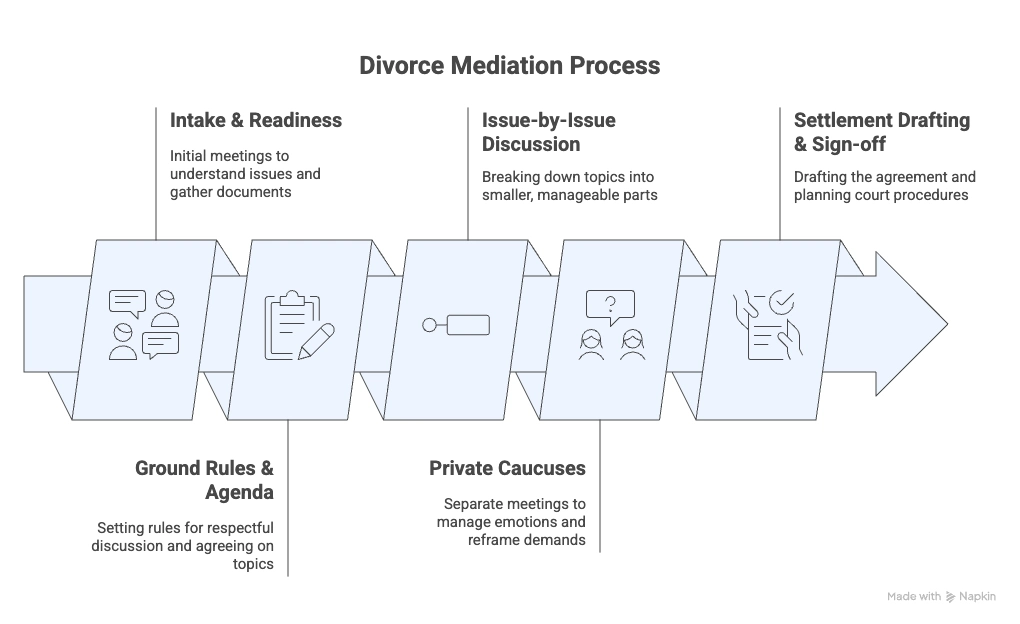
These are the practical steps of Mediation in Divorce, from intake and ground rules to focused discussions, private caucuses, and a signed settlement. Use this roadmap to see how each session builds momentum toward a workable, court‑ready agreement.u003cbru003eu003cbru003eBelow is the typical flow at ManAt Legal. Formats vary by case, but the core path is simple and predictable.
u003cstrongu003e1) Intake u0026amp; readinessu003c/strongu003e

We meet each spouse (together or separately) to understand issues, urgency, and safety needs. You get a checklist: ID proofs, marriage certificate, children’s details, assets/liabilities, income proofs, and key concerns.
u003cstrongu003e2) Ground rules u0026amp; agendau003c/strongu003e

At the first joint session, the mediator sets ground rules for respectful hearing, no interruptions, confidentiality, and a focus on solutions. You agree on an agenda: parenting, money, home, and timelines.
u003cstrongu003e3) Issue‑by‑issue discussionu003c/strongu003e

We break big topics into small ones. For parenting, we map school hours, holidays, birthdays, travel consent, and decision‑making. For finances, we review incomes, living costs, and a clear maintenance plan. For assets, we list what exists and how to divide or sell them.
u003cstrongu003e4) Private caucuses (if needed)u003c/strongu003e

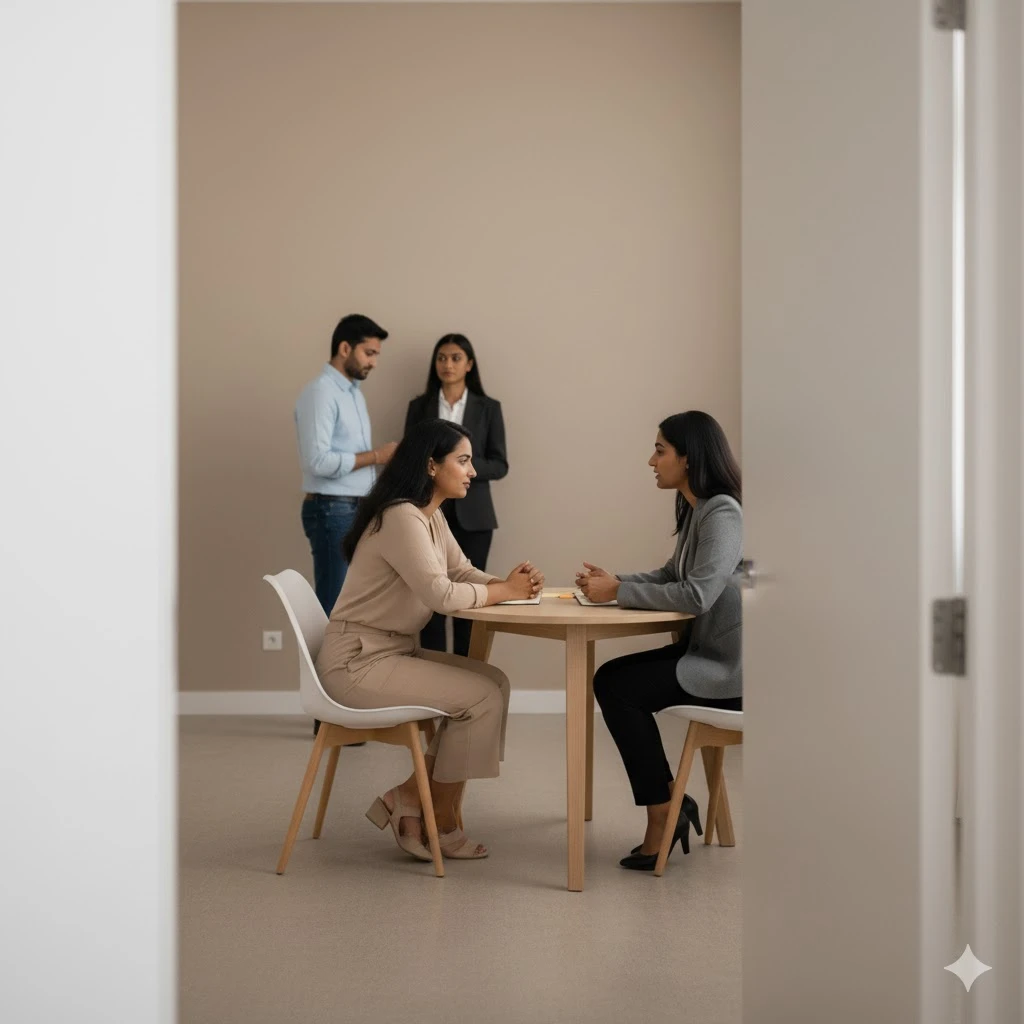
If emotions run high, the mediator may speak to each spouse separately. This makes space for reality‑testing offers and reframing demands.
u003cstrongu003e5) Settlement drafting u0026amp; sign‑offu003c/strongu003e
Once you reach a broad agreement, we draft a u003cstrongu003eMediated Settlement Agreement (MSA)u003c/strongu003e. You review it with your lawyer. After sign‑off, we plan the court route, often a u003cstrongu003emutual consent divorceu003c/strongu003e with your MSA attached, or placing terms on record in a pending case.
Benefits of divorce mediation (beyond peace of mind)
These benefits show why many families prefer mediation: quicker resolution, lower costs, privacy, enforceable outcomes, and durable parenting plans without the stress of adversarial hearings or uncertain court timelines.
- Time certainty: Mediation typically concludes within a defined timeframe. You are not trapped in years of hearings.
- Cost control: Fewer court dates mean lower legal spend.
- Confidentiality: Settlement offers and talks remain off‑record.
- Enforceability: Once recorded properly, your settlement carries legal weight.
- Future‑proofing: Parenting plans include review dates and a process to handle future changes.
- Voice for both sides: Each spouse is heard; solutions last longer.
Legal framework in India (in plain language)
- Family Courts encourage settlement: Under Indian law, Family Courts try for conciliation at the start (see Section 9 of the Family Courts Act, 1984). You will often be sent to a mediation centre early in the case.
- Clear timelines: As a practical guidepost, mediation is designed to wrap up in about 120 days (extendable by 60 days) when run through recognized institutions (see Section 18 of the Mediation Act, 2023). That gives you momentum without rushing.
- Online mediation is valid: If you cannot travel or prefer privacy, sessions can run on secure video platforms. Online mediation and the agreements made there are recognized in law (see Section 30 online mediation of the Mediation Act, 2023).
- Your agreement can be enforced: When documented and filed correctly, a Mediated Settlement Agreement can be enforced like a court order (see Section 27 enforcement of the Mediation Act, 2023). In mutual consent divorces, courts can also waive the usual cooling‑off period when conditions are met, see Amardeep Singh v. Harveen Kaur (2017) 8 SCC 746.
*Courts may also refer parties to mediation under Section 89 of the Code of Civil Procedure; the Supreme Court clarified this in Afcons Infrastructure Ltd. v. Cherian Varkey (2010).
(These points are kept simple here. In your consultation, we explain the exact sections, paperwork, and the court route that fits your facts.)
Mediation in Divorce: A Working Timeline
Every family is different, but this is a common path:
- Week 1–2: Intake calls, document checklist, scheduling
- Week 3–8: 2–4 mediation sessions of 60–120 minutes each (more if complex assets)
- Week 9–10: Draft settlement, lawyer review, edits, final sign‑off
- Week 11+: Court filing. If you proceed with a mutual consent divorce, the next hearing(s) depend on the court calendar and whether the cooling‑off period is waived. If the waiver fits your case, many couples finish within a few months. If not, expect additional months before the final decree.
What to bring to your first session
Bring basic IDs, financial proofs, and a clear list of priorities so sessions stay focused and productive; knowing your non‑negotiables and flex points helps the mediator craft faster, practical solutions.
- Government ID, marriage certificate
- Children’s birth certificates (if any), school details
- Latest 6–12 months’ bank statements and payslips
- List of assets (home, car, gold, investments) and loans
- Rent agreements, insurance, income tax returns (if available)
- A calm mindset and a list of what you can compromise on
Pro tip: Decide your must‑haves vs. nice‑to‑haves. Mediation moves fastest when both sides know their bottom lines.
When mediation may not be ideal

Choose a different route or a modified, lawyer‑led format if:
- There is ongoing domestic violence or a serious safety risk
- One party hides assets or refuses to share financials
- One party cannot participate in good faith
- Urgent court orders are needed (e.g., immediate protection)
We can still protect you. In high‑conflict cases, we use shuttle sessions, strict information exchange, or proceed directly with litigation while keeping mediation as a parallel option.
Practical outcomes you can expect
These are the tangible deliverables you walk away with: clear parenting plans, maintenance terms, property division timelines, debt closure steps, and privacy clauses drafted in court‑ready language so judges can adopt them without ambiguity.
- Parenting plan with school/holiday schedules, travel consent, and decision rights
- Maintenance/alimony amount, mode, and step‑up/step‑down triggers
- Property division with clear timelines to sell/transfer hand over
- Debt closure plan and indemnities
- Non‑disparagement & privacy clauses
If the agreement covers all issues and both spouses agree to end the marriage, we usually file for a mutual consent divorce and attach the settlement. Where only some issues settle, the court records those terms and decides the rest.
Further reading & next steps
Explore concise guides that deepen the key decision-making process, custody, and finances so you can move from understanding to action with confidence.
- Understand the full divorce process in Bangalore, timelines, documents, and local practice.
- If parenting is central, read our plain‑English guide on child custody in India.
- For money questions, see maintenance and alimony in divorce.
FAQs
u003cstrongu003eWhat happens in mediation in divorce?u003c/strongu003e
You and your spouse meet a neutral mediator for guided talks. You share documents, explore options, and test practical solutions. If you reach an agreement, it is written into a u003cstrongu003eMediated Settlement Agreementu003c/strongu003e. With your lawyers, you can file it in court, often as part of a mutual consent divorce petition.
u003cstrongu003eWhat are the disadvantages of mediation in divorce?u003c/strongu003e
Mediation needs u003cstrongu003ewillingnessu003c/strongu003e and u003cstrongu003efair disclosureu003c/strongu003e. If one spouse hides assets, refuses to engage, or there is abuse, mediation may stall or be unsafe. In such cases, we switch to lawyer‑assisted formats, stronger interim orders, or litigation.
u003cstrongu003eWhat are the 5 steps of mediation?u003c/strongu003e
1) u003cstrongu003eIntake u0026amp; readinessu003c/strongu003e u003cbru003e2) u003cstrongu003eGround rules u0026amp; agendau003c/strongu003e u003cbru003e3) u003cstrongu003eIssue‑by‑issue discussionu003c/strongu003e u003cbru003e4) u003cstrongu003ePrivate caucusesu003c/strongu003e (if needed) u003cbru003e5) u003cstrongu003eSettlement drafting u0026amp; court planu003c/strongu003e.
u003cstrongu003eHow long after mediation is a divorce final in India?u003c/strongu003e
If you proceed by u003cstrongu003emutual consentu003c/strongu003e and the court u003cstrongu003ewaives the cooling‑off periodu003c/strongu003e, many couples finish within a few months (subject to court dates). Without a waiver, the cooling‑off window adds time. Either way, mediation shortens the overall journey by settling issues before you step into court.
Mediation in Divorce: tips to succeed
A few simple habits make mediation smoother: come prepared, stay child‑focused, write offers clearly, and take breaks when needed. These tips help you reach a durable, court‑ready settlement faster.
- Come prepared with documents and realistic budgets
- Focus on interests (child well‑being, stability), not only positions
- Keep offers simple and written
- Use breaks when emotions spike
- Aim for “good‑enough and durable,” not “perfect”
Conclusion
We combine a steady mediation culture with strong courtroom experience. That balance helps you settle fast and protect your rights if talks fail. Our team runs both in‑person and online sessions, uses clear checklists, and drafts airtight settlements tailored to Bengaluru courts.
If you are anxious about long cases, rising costs, or the emotional toll of litigation, mediation offers relief. Book a confidential consult with our divorce lawyers team to map your issues, pick the right format (online or in‑person), and leave with a clear next step.