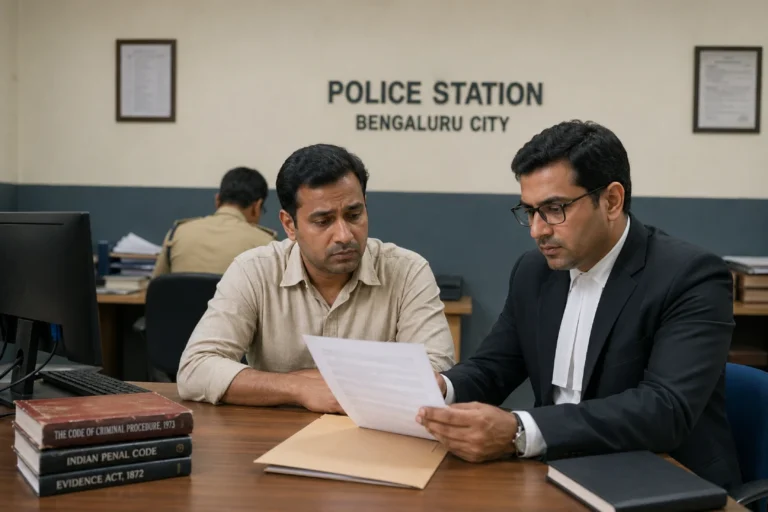

Police Statements: 6 Essential Rights and Precautions
Police statements often begin with an ordinary request: tell us what happened. A witness may then worry about using the wrong word, remembering a time incorrectly or being asked to sign a document. The most useful preparation is an accurate account of what you actually know, together with an understanding of the kind of document being recorded.
This guide explains six points about witness examination under the Bharatiya Nagarik Suraksha Sanhita, 2023 (BNSS). It distinguishes police statements from an FIR, other signed paperwork and a statement before a Magistrate. It does not suggest a rehearsed answer or a way to conceal facts.
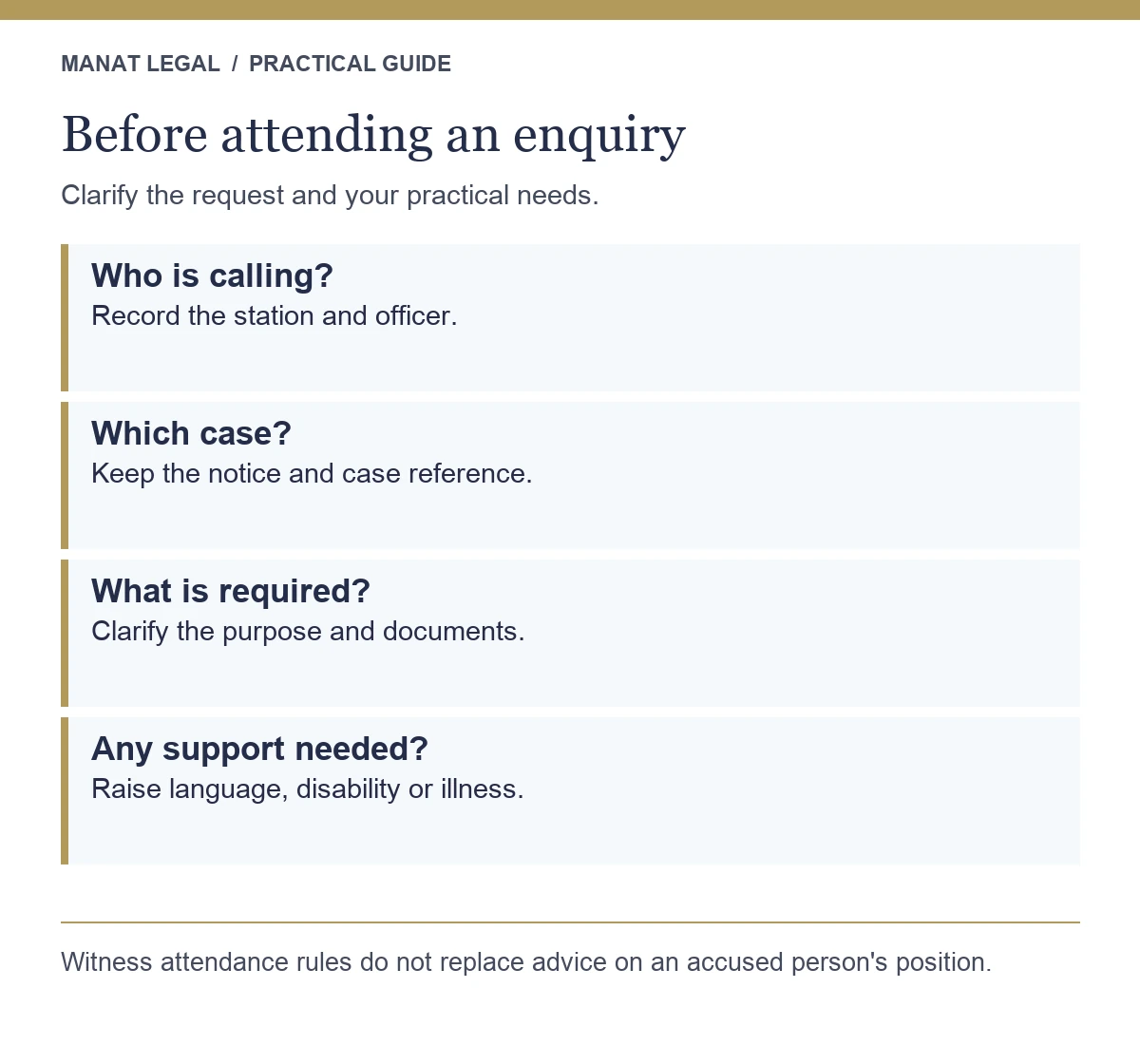
1. Establish why you have been asked to attend
Ask for the police station, officer’s name, case reference and purpose of the request. A person may be approached as a complainant, a witness or someone whose own conduct is under investigation. Do not infer your position solely from an informal description used on the telephone. Preserve the notice or written communication and show it to your advocate if there is uncertainty.
Section 179 BNSS addresses a written order requiring attendance of a person acquainted with the case within the stated territorial limits. It protects specified people from being required to attend anywhere other than their residence, including women, males below fifteen or above sixty, persons with mental or physical disability and persons with acute illness. The provision also permits voluntary attendance at the station by such a person.
These rules should be read in their specific witness-attendance context. They are not a general exemption from every lawful criminal process. Explain any relevant age, illness or disability accurately and ask for the correct arrangement. Our police enquiry guide covers the initial practical steps when an officer contacts you.
Avoid simply ignoring a request because it arrived informally. Clarify what is required and whether a written notice has been issued. If you suspect that you may be accused, obtain advice on that position rather than relying on a witness-focused article.
2. Give facts, and separate them from assumptions
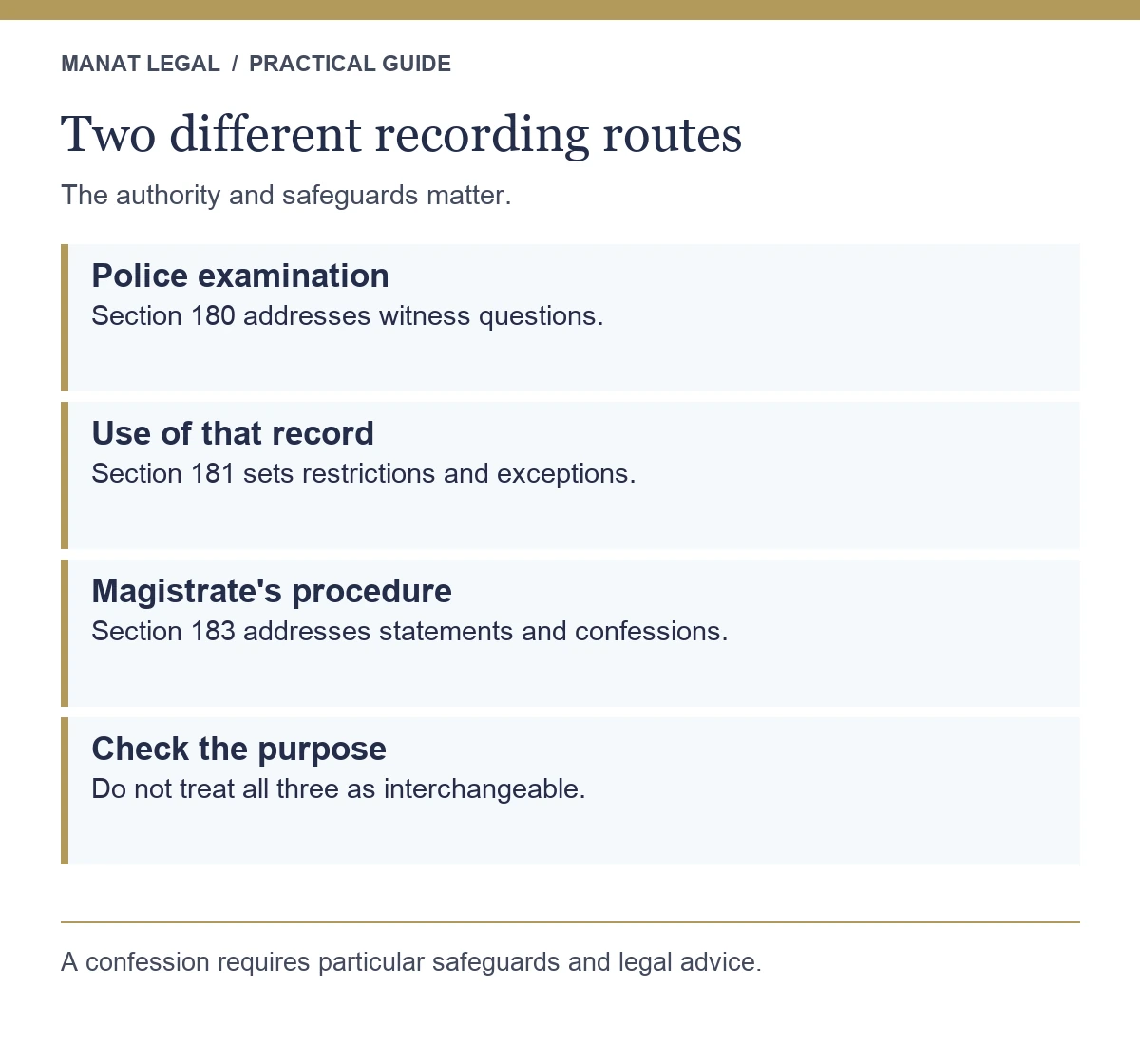
BNSS section 180 permits oral examination of a person supposed to know the facts and circumstances of the case. It requires truthful answers to relevant questions, subject to the protection for answers tending to expose that person to a criminal charge, penalty or forfeiture. This is a specific legal protection; it is not a licence to give false information.
Before attending, distinguish three things: what you saw or heard yourself, what somebody later told you, and what you inferred. If you reached the scene after an incident, say that. If you cannot identify the speaker, vehicle or exact time, explain the uncertainty. A witness statement to police should not acquire details merely because they fit another person’s account.
A private chronology can help organise your recollection, but do not memorise a script or coordinate accounts with other witnesses. Preserve original messages, photographs and records that may help establish dates. If a record refreshes your memory, be clear about that rather than suggesting you independently remembered every detail.
For example, hearing a crash and then seeing a person leave is different from seeing that person cause the crash. Both observations may matter, but combining them into an assertion about an act you did not see can distort the investigation. Accuracy includes describing the limits of your knowledge.
3. Understand when police statements should not be signed
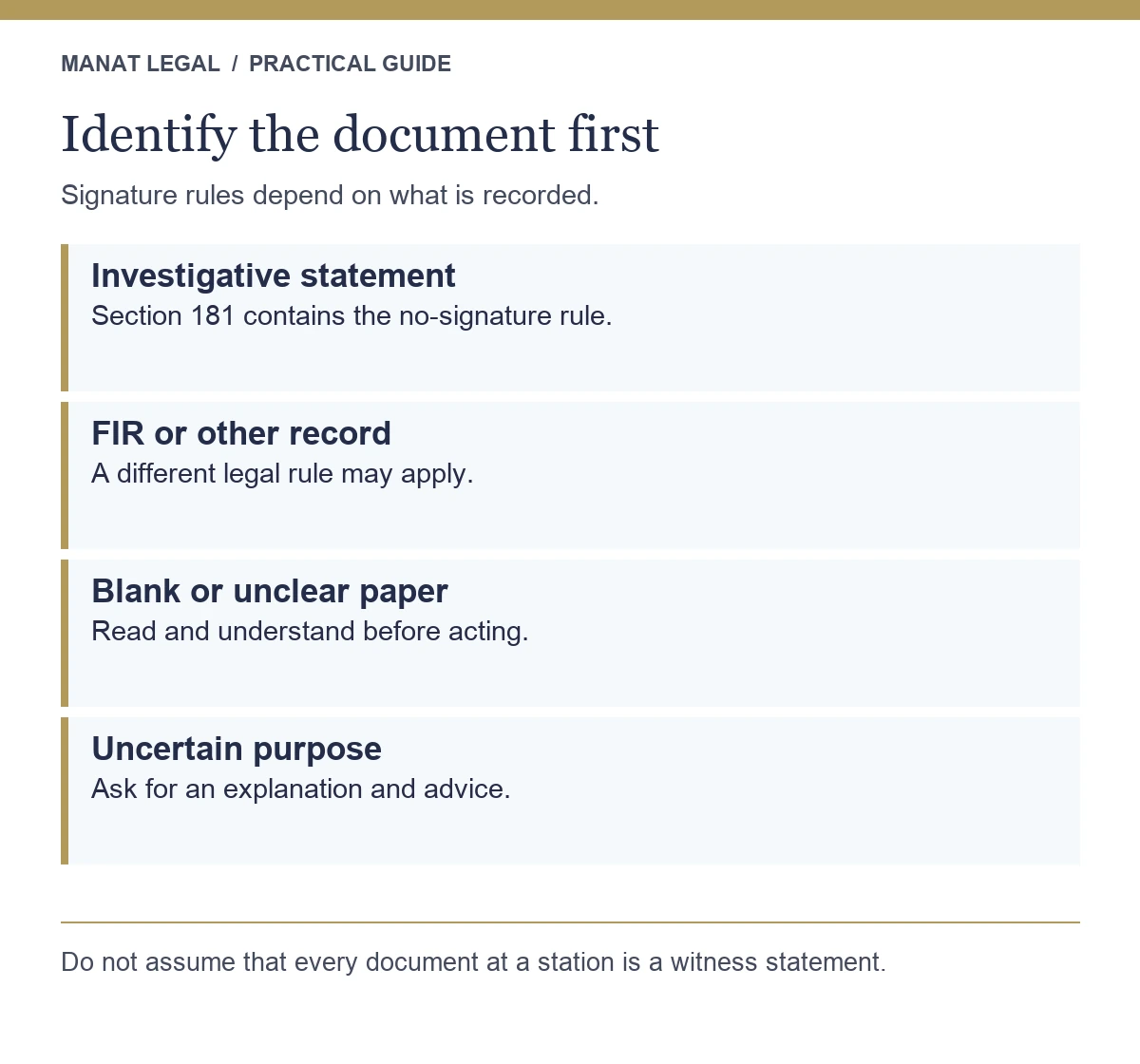
BNSS section 181 says that a statement made to a police officer during an investigation under the relevant chapter, if reduced to writing, is not to be signed by its maker. That rule applies to the specified investigative statement. It does not mean that every document presented at a police station is legally unsigned.
An FIR recorded under section 173, a seizure-related document, an acknowledgment and a bond serve different purposes. Ask what the document is, read it carefully and seek an explanation in a language you understand. Do not sign a blank page or a document whose contents or purpose you have not understood.
If a document appears to be an investigative witness statement but a signature is requested, calmly raise the distinction and seek legal advice. Do not turn the rule into a confrontation or destroy the document. Keep an accurate note of the issue and the explanation provided.
The official BNSS text published through NCRB sets out sections 173, 179, 180 and 181. Older references to sections 161 and 162 CrPC concern the earlier framework. Which procedural law governs an existing case requires attention to the savings provision and its history.
4. Know how the record may matter later
Police statements are not ordinarily a substitute for a witness giving evidence at trial. Section 181 restricts their use and provides, among other things, a procedure for using a duly proved part to contradict a prosecution witness. The prosecution requires the court’s permission for its use in the manner stated there.
This does not make the earlier record irrelevant. A significant omission may, depending on its context, amount to a contradiction. If you later remember an important detail, tell counsel or the investigating officer through a proper process and explain why it was missing. Do not assume you can silently improve an earlier version without questions arising.
The statute also preserves particular exceptions, including the identified evidence-law provisions concerning certain statements by deceased persons and information leading to discovery. Whether a particular statement is admissible is a legal question about its content and circumstances. A blanket claim that nothing said to police can ever be used is inaccurate.
Keep your own records truthful and secure. Never edit a message history, recreate a document or ask another person to change an account to avoid an apparent inconsistency. The digital evidence preservation guide explains why retaining original sources matters.
5. Distinguish a statement before a Magistrate
A statement before a Magistrate under section 183 is a separate procedure from police examination under section 180. The section addresses both statements and confessions, with safeguards and specific requirements. The fact that both processes are described informally as giving a statement does not make their legal consequences identical.
Before recording a confession, the Magistrate must explain that the person is not bound to confess and that the confession may be used as evidence against them. The Magistrate must be satisfied that it is voluntary. The statute provides a different recording and signature process for such a confession.
If you are asked to appear for this purpose, establish what is proposed and obtain advice. Do not rely on a promise that a confession is merely routine paperwork or will automatically secure release. A person who is unwilling to confess should say so; counsel can explain the specific safeguards and consequences.
The BNSS also contains particular procedures for specified victims and witnesses, including assistance where disability affects communication. Tell the relevant authority about a genuine need for an interpreter, special educator or other prescribed support. Do not assume that a family member’s informal translation will always satisfy the legal process.
6. Raise errors, pressure or communication difficulties promptly
If a question is unclear, ask for it to be explained. If you do not remember, say so accurately. Distinguish inability to recall from a positive statement that something did not happen. These are different answers, and a hurried conversation can blur the distinction.
Where you believe a record misstates what you said, raise the issue promptly through an appropriate documented channel after taking advice. Identify the disputed words or facts and the correction sought. Do not fabricate a fresh account or backdate a clarification. Preserve any acknowledgment of the concern.
If you experience threats, coercion or inappropriate pressure, tell your advocate and consider the appropriate complaint or court remedy. The relevant response depends on your status, the circumstances and the available record. Legal assistance is particularly important where answers may implicate you personally.
After the interaction, record the basic administrative details while they are fresh: date, place, officer, reference and documents handed over. Keep originals secure and follow any lawful further direction. Police statements are most useful to an investigation when each person’s account remains their own, with its uncertainties openly identified.
- Carry the notice or case reference and relevant identification.
- Separate direct observation, later information and inference.
- Identify each document before considering a signature.
- Ask for clarification or appropriate communication support.
- Preserve original records and report concerns truthfully.
Frequently asked questions
Must every document at a police station remain unsigned?
No. The section 181 rule concerns the specified statement made during investigation. Other documents, including an FIR, can have different signature requirements.
Can police statements be recorded electronically?
Section 180 permits recording by audio-video electronic means. The method does not remove the need for an accurate record or the applicable legal safeguards.
Should witnesses discuss their answers together?
Do not coordinate accounts or agree on facts you do not independently know. Each witness should describe their own knowledge and identify uncertainty honestly.
What if an answer may incriminate me?
Section 180(2) contains a protection concerning answers tending to expose the person to a criminal charge, penalty or forfeiture. Seek legal advice on its application; do not substitute a false answer.
Is a Magistrate’s statement the same as a police statement?
No. Section 183 provides a distinct process, including safeguards for confessions and requirements for specified statements. Its purpose and consequences should be understood separately.
For advice about police statements or a notice in Bengaluru, ManAT Legal’s criminal-law team can examine the documents and your procedural position. This article provides general legal information, not a script for answering questions in a particular investigation.