

Difference Between FIR and Complaint in India
People often use the words FIR and police complaint interchangeably. You may hear someone say, I filed a complaint at the police station, when what they actually mean is that an FIR was registered. In law, however, these are not always the same thing.
Understanding the difference between FIR and complaint matters because each can lead to a different legal process. Whether the police can immediately investigate, whether an FIR must be registered and what remedies are available if the police do not act will depend largely on the nature of the alleged offence.
Under the current law, these procedures are mainly governed by the Bharatiya Nagarik Suraksha Sanhita, 2023 (BNSS), which came into force on 1 July 2024 and replaced the Code of Criminal Procedure, 1973 for new criminal proceedings.

What Is an FIR?
FIR stands for First Information Report.
In simple terms, an FIR is the formal record made by the police when they receive information about the commission of a cognizable offence.
Section 173 of the BNSS deals with information relating to cognizable offences.
A cognizable offence is generally an offence for which the police have the legal authority to investigate and, subject to the conditions prescribed by law, arrest without first obtaining a warrant.
Examples can include serious offences such as theft, robbery, certain forms of assault, kidnapping and other offences classified as cognizable under the applicable criminal law.
Information about a cognizable offence does not necessarily have to come from the victim personally. It may be provided by another person who has knowledge of the incident.
Under Section 173 BNSS, information may be given orally or through electronic communication. If information is given orally, the police officer must reduce it to writing and read it back to the informant. The person giving the information is then required to sign it.
Where information is sent electronically, the BNSS requires it to be signed by the informant within the prescribed period.
The purpose of an FIR is not to decide whether the accused is guilty. It is the starting point of the formal investigation into an alleged cognizable offence.
What Is a Police Complaint?
A police complaint is a broader concept.

In everyday use, a police complaint simply means giving information to the police about an incident, offence, threat, dispute or suspected illegal activity and asking them to take appropriate action.
A complaint to a police station may be made in writing, orally or through an available electronic reporting system, depending on the circumstances.
However, there is an important legal distinction.
The BNSS separately defines the word complaint in Section 2(1)(h). In that legal definition, a complaint generally refers to an allegation made orally or in writing to a Magistrate, with a view to the Magistrate taking action under the law.
Therefore, a complaint submitted at a police station and a complaint before a Magistrate are not necessarily the same thing.
This distinction is often overlooked.
Most importantly, filing a written complaint at a police station does not automatically mean that an FIR has been registered.
The police have to examine the nature of the allegations and determine the procedure required under the BNSS.
Difference Between FIR and Complaint

The FIR and complaint difference becomes easier to understand when the two are compared directly.
| Point | FIR | Police Complaint |
| Meaning | Formal record of information relating to a cognizable offence | Information or grievance submitted to the police |
| Authority | Police officer in charge of the police station | Usually the police; a statutory complaint under BNSS may also be made before a Magistrate |
| Nature of offence | Primarily relates to cognizable offences | May relate to cognizable, non-cognizable or other allegations |
| Legal provision | Section 173 BNSS | Depends on the nature of the complaint; Section 174 deals with non-cognizable information |
| Registration | Formally registered as an FIR | Does not automatically become an FIR |
| Investigation | Police may investigate according to the BNSS | Depends on whether the police have legal authority to investigate |
| Format | Recorded according to the statutory procedure | May initially be written, oral or electronic |
| Legal effect | Starts the formal criminal investigation process | May lead to an FIR, enquiry, non-cognizable procedure or other lawful action |
| Next step | Investigation and eventual police report | Depends on the nature of the allegations |
The simplest way to understand complaint vs FIR is this: a complaint is information given to the police, while an FIR is the formal registration of information relating to a cognizable offence.
How to File an FIR
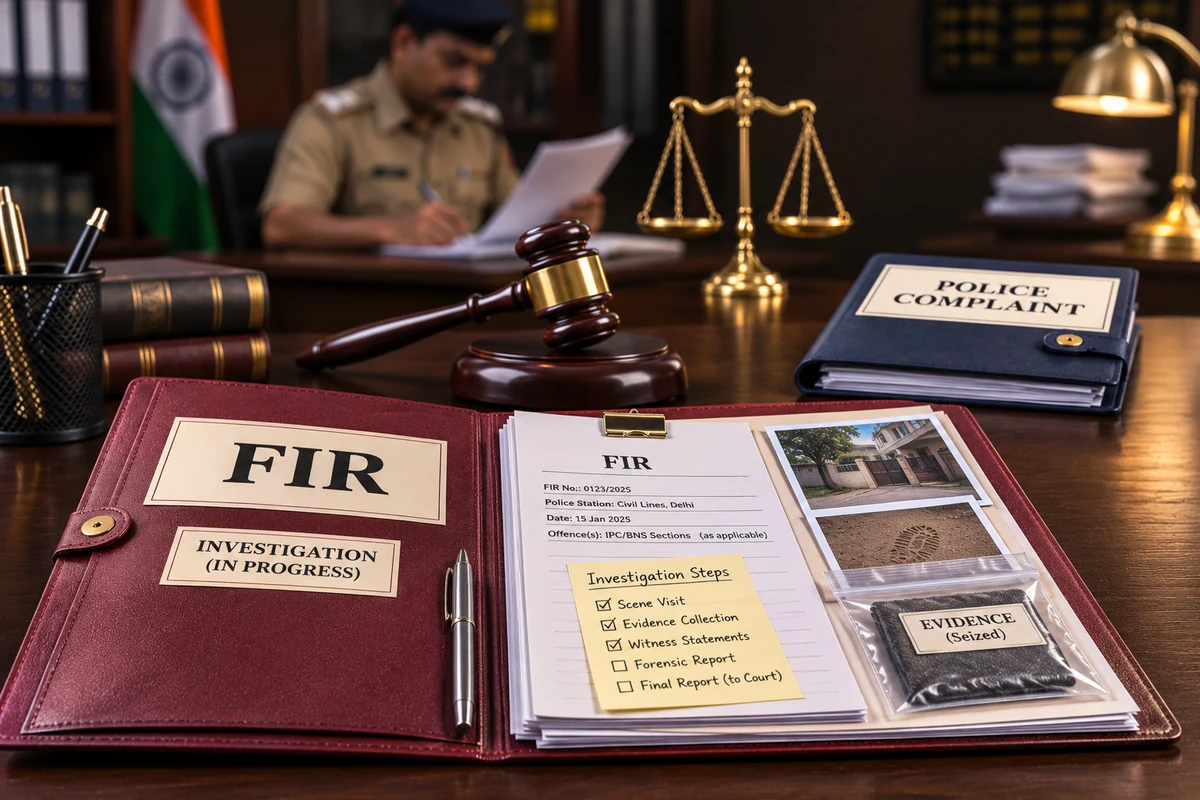
If the facts disclose a cognizable offence, the person can approach the police and provide the relevant information.
The usual FIR registration process works as follows.Outline restrictions on sharing company data with third parties.
1. Approach a police station
You may approach the police station and explain what has happened.
Section 173 BNSS states that information relating to a cognizable offence may be given irrespective of the area where the offence occurred. This supports the practice commonly known as a Zero FIR, where a police station can initially record information even if another police station ultimately has territorial jurisdiction.
2. Explain the facts clearly
Provide the important facts in chronological order.
This may include:
- what happened;
- when and where it happened;
- who was involved, if known;
- names of witnesses, if any;
- documents, messages, photographs or other evidence available.
It is better to clearly state known facts rather than guess or exaggerate details.
3. Give oral, written or electronic information
Information may be given orally or through electronic communication in accordance with Section 173 BNSS.
If it is given orally, the police officer must reduce it to writing.
4. Check the recorded statement
The written information should be read over to the informant.
Before signing it, make sure that important facts have been correctly recorded.
5. Obtain a copy
The BNSS provides that a copy of the recorded information must be given free of cost to the informant or victim.
Keeping a copy is important for future reference.
6. Investigation begins
Once the FIR is registered, the police may begin investigation in accordance with the applicable provisions of the BNSS.
How to File a Police Complaint

The police complaint process is generally straightforward.
A written complaint should ideally contain the complainant’s details, a clear description of what happened, the date and location of the incident and details of the people involved, if known.
Relevant supporting material may also be attached.
For example, depending on the nature of the case, this could include:
- photographs;
- emails;
- messages;
- bank transaction records;
- agreements;
- medical records;
- CCTV information; or
- details of witnesses.
The complaint can be submitted to the appropriate police station or through any official reporting facility made available by the concerned police authority.
Always retain a copy and acknowledgement where possible.
What happens next depends on the allegations.
Can Police Refuse to Register an FIR?

This is one of the most common questions people have when approaching a police station.
The legal position is that where the information clearly discloses a cognizable offence, registration of an FIR is ordinarily required, subject to the procedure provided under the BNSS.
However, the BNSS also contains a specific provision for certain offences.
Under Section 173(3), where the alleged cognizable offence is punishable with imprisonment of three years or more but less than seven years, the officer in charge may, with prior permission from an officer not below the rank of Deputy Superintendent of Police, conduct a preliminary enquiry in appropriate cases.
The purpose of such an enquiry is to determine whether a prima facie case exists.
This means the answer to can police refuse to file an FIR depends on the facts and the statutory procedure applicable to the case.
If the officer in charge refuses to record information that discloses a cognizable offence, Section 173(4) BNSS provides a further remedy.
The aggrieved person may send the substance of the information in writing and by post to the concerned Superintendent of Police.
If the Superintendent of Police is satisfied that the information discloses a cognizable offence, the officer may investigate the matter personally or direct a subordinate officer to conduct the investigation.
Depending on the circumstances, approaching the competent Magistrate may also be available as a further legal remedy under the BNSS.
Can a Police Complaint Become an FIR?

Yes.
A person may initially submit a document titled Police Complaint, but the title given to the document is not what determines its legal effect.
The police have to examine the substance of the allegations.
If the facts disclosed in the complaint reveal the commission of a cognizable offence and the statutory requirements are satisfied, the complaint may result in an FIR being registered.
For example, a person may submit a written complaint describing allegations of cheating, assault or another criminal offence. If those allegations disclose a cognizable offence under the applicable law, the police may register an FIR based on that information.
So, can a complaint become an FIR? Yes, but every complaint will not necessarily result in FIR registration.
What Happens After Filing an FIR?
Registration of an FIR is only the beginning of the criminal investigation process.
After an FIR is registered, the investigating officer may take several steps depending on the nature of the case.
These can include visiting the place of occurrence, collecting documents, reviewing electronic records, examining witnesses and obtaining forensic or technical evidence.
Police may also record statements of persons who appear to have information relevant to the case.
An important point is that registration of an FIR does not automatically mean arrest.
Whether an arrest is justified depends on the nature of the offence, the facts of the case and the requirements laid down under the applicable law.
After the investigation is completed, the police submit the appropriate report before the Magistrate.
Where sufficient evidence is found, the police may file what is commonly referred to as a charge sheet. Where the investigation does not support prosecution, another form of final report may be filed according to law.
Section 193 BNSS also contains provisions relating to completion of investigation and the police report.
FIR vs Complaint Which One Should You File?
There is no single answer that applies to every situation.
Whether you should make a police complaint or whether the matter requires FIR registration depends mainly on the nature of the alleged offence.
Relevant factors include:
- whether the offence is cognizable or non-cognizable;
- the facts currently available;
- whether police investigation is required;
- whether the police or a Magistrate is being approached; and
- whether any previous complaint has already been made.
A person reporting an incident does not necessarily have to identify the exact legal provision before approaching the police.
What matters most is providing a truthful and clear account of what happened.
The police and, where necessary, the courts determine the appropriate legal classification and procedure.
When Should You Speak to a Criminal Lawyer?
Legal advice may be useful where the procedure becomes complicated or where the consequences of the allegations are serious.
For example, you may consider speaking to a criminal lawyer where:
- police refuse to register an FIR despite allegations of a cognizable offence;
- you have been named in an FIR that you believe contains false allegations;
- there is a risk of arrest;
- the allegations involve a serious criminal offence;
- you are unsure whether to approach the police or Magistrate;
- senior police authorities need to be approached; or
- proceedings before a criminal court have already started.
A lawyer can examine the facts and explain which remedy is legally available instead of relying only on the label given to the complaint.
For matters in Bangalore and Karnataka, ManAT Legal assists clients with FIR-related issues, criminal complaints, police proceedings and representation before the appropriate courts.
Frequently Asked Questions About the Difference Between FIR and Complaint
What is the difference between FIR and complaint?
An FIR is the formal recording of information relating to a cognizable offence under Section 173 BNSS. A police complaint is broader and refers to information or a grievance submitted to the police. Every complaint does not automatically become an FIR.
Is every police complaint an FIR?
No. A complaint can relate to a cognizable offence, non-cognizable offence or another grievance. An FIR is registered where the legal requirements for registration are satisfied.
Can police refuse to file an FIR?
Where information discloses a cognizable offence, FIR registration is ordinarily required, subject to the procedure and limited preliminary-enquiry framework provided under Section 173 BNSS. Remedies are available if the police fail to record qualifying information.
Can a complaint become an FIR?
Yes. If a police complaint contains information that discloses a cognizable offence, it can lead to registration of an FIR.
What happens after filing an FIR?
Police may investigate the allegations, collect evidence, examine witnesses and take other lawful investigative steps. Once the investigation is complete, an appropriate police report is submitted before the Magistrate.
Can an FIR be filed online?
Section 173 BNSS recognises information given through electronic communication. However, the required procedure must still be followed, including the statutory requirement relating to the informant’s signature. Online reporting facilities may vary between States and police authorities.
What is the difference between FIR and police complaint?
A police complaint is information submitted to the police asking for action. An FIR is a formal record relating to a cognizable offence that triggers the criminal investigation process under the BNSS.
Conclusion
The difference between FIR and complaint is not merely a matter of terminology. It can determine how the police deal with the information, whether an investigation begins immediately and what remedy may be available if no action is taken.
A police complaint may or may not result in an FIR. Where the allegations disclose a cognizable offence, Section 173 BNSS becomes particularly important. Where the offence is non-cognizable, a different procedure applies.
If you need assistance with an FIR, police complaint or criminal proceeding in Bangalore or Karnataka, contact ManAT Legal to understand the legal options available based on the facts of your case.