Digital Evidence Preservation: 7 Essential Steps
Digital evidence preservation often starts with a small, urgent problem: a building’s CCTV recorder is about to overwrite yesterday’s footage, a phone is being replaced, or a relevant conversation is scattered across screenshots. Waiting until a hearing is listed can make an otherwise useful record difficult to recover.
The aim is to preserve the original material, its context and an honest account of how it was obtained. A dramatic screenshot is not a substitute for those foundations. This guide explains practical steps for people dealing with criminal complaints in India, without assuming that every digital file will be accepted or prove the allegation.
1. Start digital evidence preservation with a source list
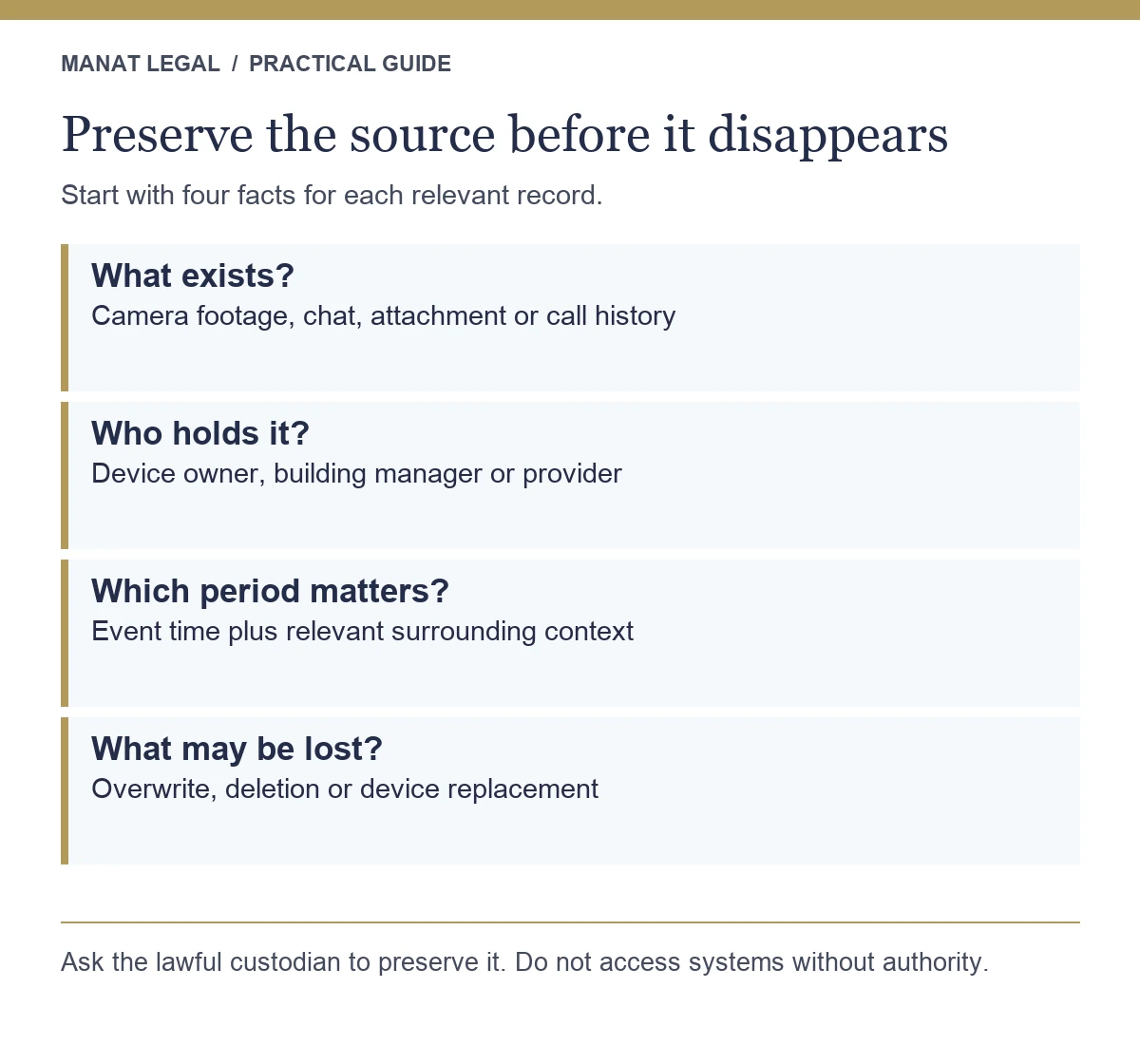
Write down what may exist, who controls it and how quickly it may disappear. Separate the phone in your possession from a workplace server, a shop’s camera system and records held by a telecom provider. Your ability to view something does not necessarily give you permission to extract the entire system.
Record the incident’s date, approximate time and location. Note whether the relevant camera or device displays the correct time. A recorder running twelve minutes slow can cause a genuine clip to appear inconsistent with a message timestamp unless that difference is documented.
Prioritise sources that routinely overwrite or expire. Ask the lawful custodian to preserve the relevant material promptly, preferably through a dated written request. A request is not a court order and does not guarantee cooperation; tell your advocate if an investigator or court process may be needed.
- Identify the device, account, camera or provider and its custodian.
- Describe the relevant date and time window, including useful context before and after the event.
- Record retention or overwrite concerns without guessing an exact deadline.
- Keep a copy of preservation requests, acknowledgments and refusals.
2. Preserve CCTV footage with the surrounding sequence
CCTV footage evidence is easier to assess when the sequence shows how people arrived, what occurred and what happened immediately afterwards. A ten-second clip may omit the event that explains it. Seek a reasonable surrounding window and relevant camera views, while avoiding unnecessary collection of other people’s private activity.
Ask the authorised operator to retain the original recording and export a usable copy. Some systems need a proprietary player or a particular export format. Keep that information with the file. Do not assume a phone recording of a monitor is equivalent to the original export, although it may still help identify a source that needs urgent preservation.
Make a contemporaneous note of who exported the footage, when, from which recorder and onto what storage. Record any known clock difference. If a police officer takes the recorder or storage device, retain the available receipt or seizure record and share it with your advocate. Do not interfere with a lawful seizure to create your own copy.
There is no single retention period that applies to every camera installation. Storage capacity, settings and the owner’s policy differ. Treat possible overwrite as a practical urgency, not as a universal legal deadline.
3. Keep WhatsApp chats as evidence in their full context
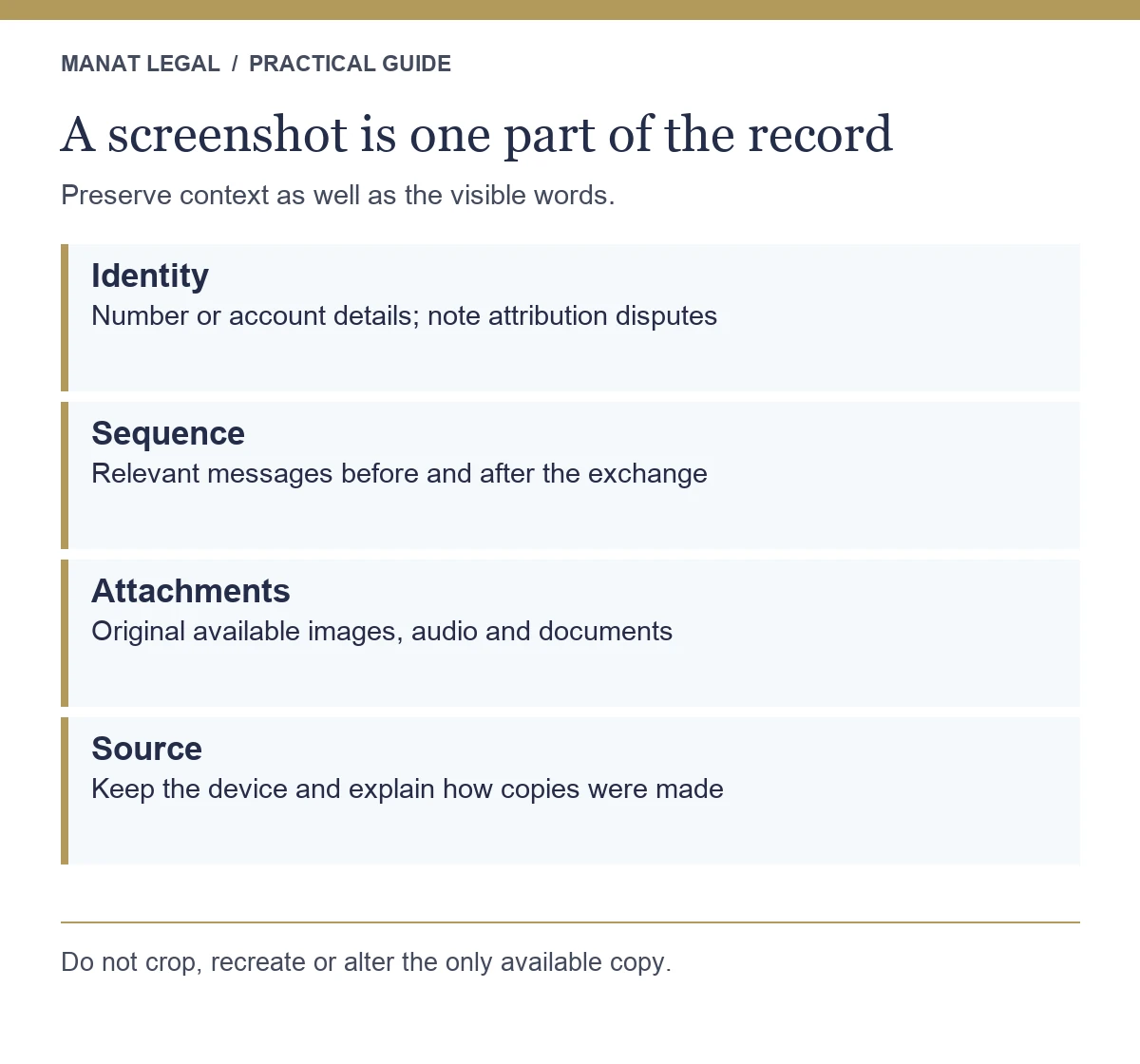
When using WhatsApp chats as evidence, preserve the relevant conversation on the original device where possible. Keep the number or account information, dates, attachments and enough surrounding messages to understand the exchange. A saved contact name alone does not establish who was actually communicating.
Screenshots can be useful working references, especially where a message may disappear. Avoid cropping away identifiers or timestamps. Keep an unedited version separately from any annotated working copy, and clearly label the annotation. Where an export is available and lawful, preserve it along with relevant media rather than assuming the text export contains every attachment.
Do not delete inconvenient messages, edit an exported text file, or recreate a conversation to make it clearer. If part of the thread has already been lost, say so. A truthful explanation of the gap is more useful than a reconstructed record presented as original.
A shared phone, forwarded message or disputed account requires particular care about attribution. The court may need other evidence connecting the communication to a person. Preservation protects the record; it does not by itself settle who authored it or whether its contents are true.
4. Understand what call records can and cannot show
Call records in criminal cases may help establish contact, timing or an investigative lead. A screenshot of your handset’s call history is different from records supplied by a service provider. Preserve your own relevant history, but do not describe it as a certified telecom record.
A call detail record does not ordinarily contain the audio of the conversation. Nor should a location inference from network records be treated as an exact account of where a person stood. Interpretation can require technical evidence and context.
Tell your advocate or the investigating officer which numbers, dates and time windows matter. Provider records should be sought through the appropriate lawful process. Do not buy unofficial records, use another person’s credentials or access an account without authority. If a recording already exists, explain how it was made and obtained so that privacy, legality and proof can be assessed.
5. Keep a simple, reliable record of handling
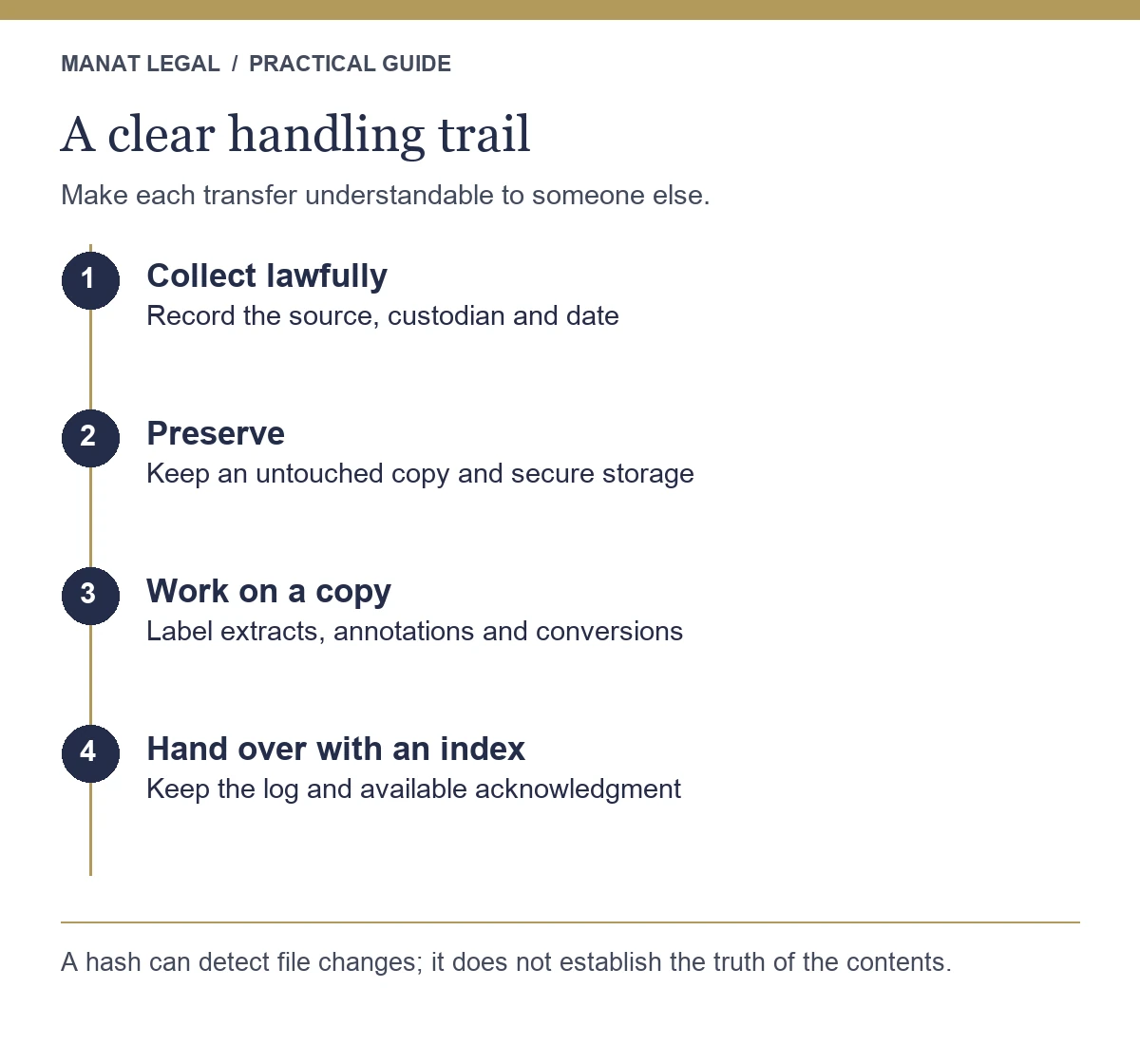
Digital evidence preservation includes documenting what happened to the material after collection. Keep an untouched preservation copy and use a separate working copy for review. Limit access to people who need it, protect the storage and avoid sending the only copy through a chain of messaging apps.
Maintain a short log: filename, source, date received, person who supplied it, storage location and each subsequent transfer. Record conversions, extractions or changes instead of concealing them. If an expert makes a forensic copy, retain the expert’s report and the details that identify that copy.
A cryptographic hash can help show whether a file has changed between two checks. It does not establish that the recorded event happened as alleged, that the account belonged to a particular person or that the original file was authentic when first obtained. Ask a qualified professional to handle forensic extraction where the device or allegation warrants it.
Do not experiment with recovery software on a potentially important original device. Recovery attempts, updates and routine use can change data. Seek advice about preserving the device safely; do not follow blanket instructions to reset it, disconnect it or change settings without understanding the circumstances.
6. Plan the electronic evidence certificate early
The Bharatiya Sakshya Adhiniyam, 2023 (BSA) addresses electronic and digital records in sections 61–63. Section 63 deals with the conditions for specified electronic outputs and the accompanying certificate. Its Schedule contains the certificate format, including the party and expert portions. The appropriate proof route depends on what is being produced and how it was created.
An electronic evidence certificate is not a generic declaration to sign after the source has disappeared. Identify who can explain the relevant device or system, the production process and the required particulars. Discuss the prescribed form and expert requirements with your advocate while the custodian and equipment are still accessible.
Older proceedings may continue under the Indian Evidence Act because of the BSA’s savings provision. You may therefore encounter the earlier section 65B terminology in genuine case papers. Do not simply relabel an old certificate as a section 63 certificate without checking which law applies.
Certification, relevance, authenticity, completeness and the weight of the evidence are related but different questions. A certificate does not automatically prove every allegation in a chat. Equally, do not assume all screenshots are inherently useless. The court assesses the material through the applicable rules and the evidence before it.
7. Hand over an organised, proportionate evidence pack
A useful pack lets the recipient connect each file to a specific event. Provide a brief chronology, an index of the files, the source-and-handling log and any preservation correspondence. Separate your account of events from what a recording actually shows. Mark uncertain dates and missing segments plainly.
For example, in a hypothetical apartment altercation, the lobby footage may show entry and exit while messages explain why the parties met. Neither source necessarily records the confrontation itself. Presenting that limitation accurately helps the investigation focus on missing evidence instead of overstating the available material.
Share relevant material through the channel agreed with your advocate or the investigating officer and retain an acknowledgment where available. Do not post evidence publicly to put pressure on the other party. Public circulation can expose private information, invite disputes about editing and complicate witness accounts.
For the reporting process, see our guide to filing an FIR in India. If the underlying allegation involves online offending, our cybercrime overview addresses that broader context. This article focuses on preserving and explaining the evidence itself.
- Keep the original or best available source and an identified working copy.
- Index files by date and event, without changing their substantive contents.
- Include source details, clock differences and known gaps.
- Ask what further records and certificate material must be obtained.
Frequently asked questions
Are screenshots enough to prove a WhatsApp conversation?
They may be useful, but sufficiency depends on the dispute, source, attribution and applicable proof requirements. Preserve the original device and conversation where possible, and discuss context and certification before relying only on screenshots.
Can I demand footage from a neighbouring shop?
You can ask the lawful custodian to preserve relevant footage. That does not give you an automatic right to take its recorder or access its system. If cooperation is refused, seek advice about the appropriate investigative or court process.
Does a call detail record include what was said?
A call detail record ordinarily records communication-related information rather than the conversation’s audio. Do not confuse a provider’s records with a recording or with the call-history screen on a phone.
Should I edit a video to highlight the important part?
Keep the original intact. A clearly labelled working extract may help explain relevance, but it should not replace or conceal the full available source. Record any extraction or conversion and discuss the format for submission.
What if messages or footage have already been lost?
Record what is missing and when you noticed it. Preserve the remaining material and tell your advocate promptly. Lawful recovery or another source may be possible, but recovery should not be promised and the gap should never be filled with invented material.
ManAT Legal’s criminal-law team in Bengaluru can assess the evidence available and the lawful steps for preserving or requesting additional records. This guide provides general legal information; the applicable evidentiary requirements depend on the proceeding and its facts.