

Anticipatory Bail Rejected? 7 Essential Next Steps
Having anticipatory bail rejected can leave a family with several urgent questions: can the police arrest now, can another court be approached, and is there time to organise the papers? Start with the signed order. A message saying ‘bail dismissed’ does not tell you whether any protection continues, why the court refused relief, or what directions must be followed.
The next step depends on the court that passed the order, the allegations, earlier applications and whether the person is still outside custody. This guide explains how to organise that decision. It does not promise a second application, a fixed period of protection or release on a particular date.
1. Anticipatory bail rejected: read the operative order first
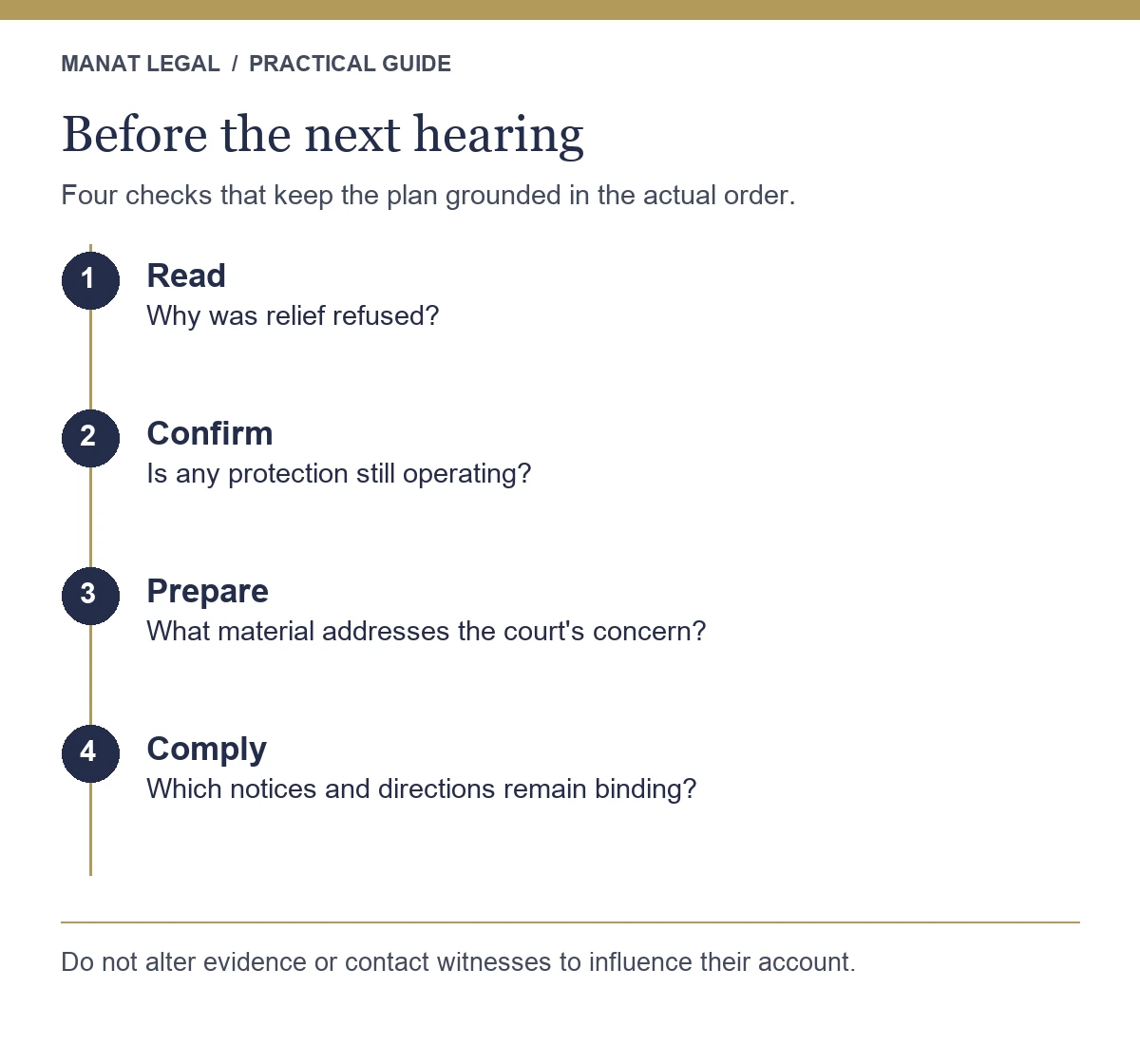
Obtain the complete order and read its final directions with your advocate. A dismissal on merits, withdrawal, disposal for a procedural reason and refusal of interim relief are different events. Do not treat them as interchangeable simply because none produced the protection you wanted.
Identify the case number, date, court, offences, reasons for refusal and any reference to an earlier order. If the court granted protection for a limited period, record the precise expiry and conditions. If it did not, do not assume an informal grace period exists while you arrange the next filing.
A bail refusal is not a conviction. Equally, the ability to seek another remedy is not itself protection from arrest. Keep these two points separate when making arrangements for work, travel or attending an investigation.
- Download or apply for the order and keep the complete PDF, not just a screenshot.
- Collect every earlier bail application and order, including withdrawn applications.
- Record the next police-attendance date and any court-directed deadline.
- Ask which protection, if any, is actually in force today.
2. Check the applicable law and the correct court
Section 482 of the Bharatiya Nagarik Suraksha Sanhita, 2023 (BNSS) addresses anticipatory bail. Section 483 concerns the special bail powers of the High Court and Court of Session. Older records may refer to sections 438 and 439 of the Code of Criminal Procedure. The BNSS repeal-and-savings provision means the applicable procedure must be checked against the case history; simply changing the section numbers on an old petition is not enough.
The statute also contains exclusions, and special enactments can change the availability or conditions of bail. Your lawyer needs the actual FIR provisions, not a broad description such as ‘business dispute’ or ‘family complaint’. Territorial jurisdiction and the investigation’s location also matter.
The official BNSS text is the starting point. For the original application process, see our separate guide to anticipatory bail under BNSS. This article deals with what follows a refusal.
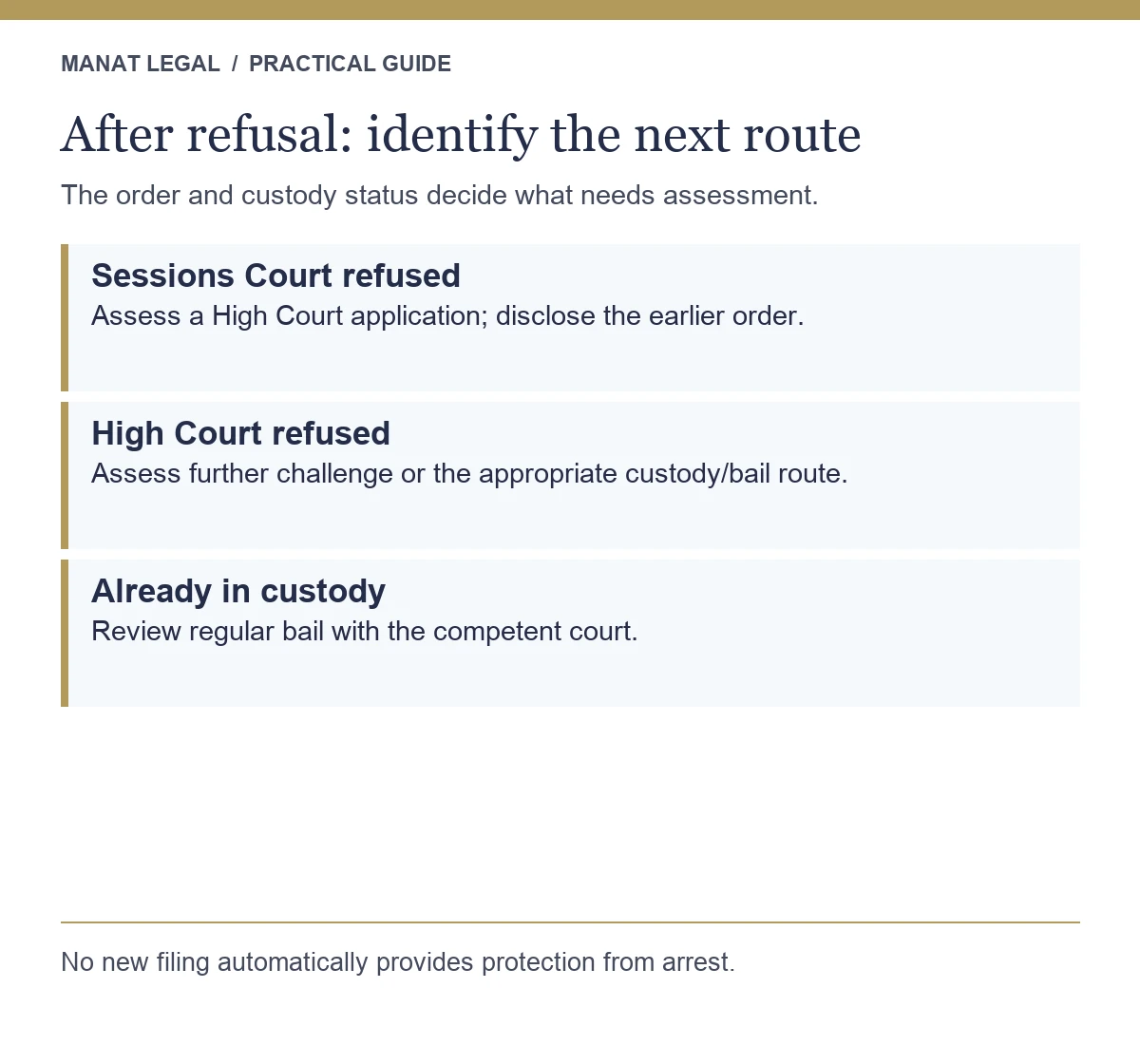
3. Consider High Court anticipatory bail after a Sessions Court refusal
If the Sessions Court has refused pre-arrest protection, an application before the jurisdictional High Court may be considered. It is not a routine appeal in which the same papers are submitted unchanged. The earlier refusal and the grounds recorded by that court must be disclosed and addressed.
Useful preparation means identifying the real issue. Was custodial interrogation considered necessary? Did the court record non-cooperation, a specific recovery, witness influence or an incomplete account of the transaction? A focused response supported by records is more useful than repeatedly describing the accusation as false.
High Court anticipatory bail remains discretionary. Filing, obtaining a diary number or securing a listing date does not automatically prevent arrest. If interim protection from arrest is needed, the application and the resulting order must deal with that request expressly.
4. If the High Court refused relief, assess the next remedy carefully
Where anticipatory bail has been refused by the High Court, counsel may assess whether a special leave petition before the Supreme Court is justified. Access to that jurisdiction does not mean the Court must entertain the petition or grant interim protection. The factual record, reasons in the impugned order and governing legal principles all matter.
Do not move between courts without disclosing previous proceedings. A withdrawal, undertaking or liberty recorded in an earlier order may affect the next application. An advocate advising on further proceedings needs the complete history, including pending applications elsewhere.
Sometimes the more appropriate plan is to address custody and seek regular bail before the competent court. That decision should be made with legal advice, taking account of the actual order and investigation. Avoid a generic instruction to ‘surrender immediately’ or ‘wait for the Supreme Court’; neither is safe for every case.
5. Distinguish a fresh application from repeating the same request
A second attempt is not made stronger merely by changing the advocate or adding a longer account. When considering a successive application, identify what has materially changed since the earlier refusal and why that change affects the bail assessment. The court must be told about the earlier outcome.
Changes in the investigation, the filing of a police report or new material may be relevant in a particular matter, but none guarantees relief. Nor should a later fact be described as new if it was available and withheld during the first hearing.
In Hitesh Umeshbhai Mashru v State of Gujarat (18 February 2025), the Supreme Court considered that the charge-sheet had been filed when granting relief on the facts before it. The decision is not a rule that filing a charge-sheet automatically entitles every person to anticipatory bail.
- What happened after the previous order?
- Which document proves it?
- How does it address the earlier reason for refusal?
- Was the point already considered by the court?
- Does the earlier order restrict or clarify the next procedural step?
6. Prepare for regular bail after rejection where custody is involved
Anticipatory bail rejected before arrest and regular bail sought after custody raise different procedural questions. Once arrested in the same matter, the person ordinarily needs advice on the applicable regular-bail route. The earlier refusal must be disclosed, but it is not a finding of guilt.
In its judgment of 12 September 2025, the Supreme Court affirmed refusal of anticipatory bail in the cases before it while leaving the appellants free to seek regular bail, to be considered on its own merits. That illustrates why the two decisions should not be collapsed into one.
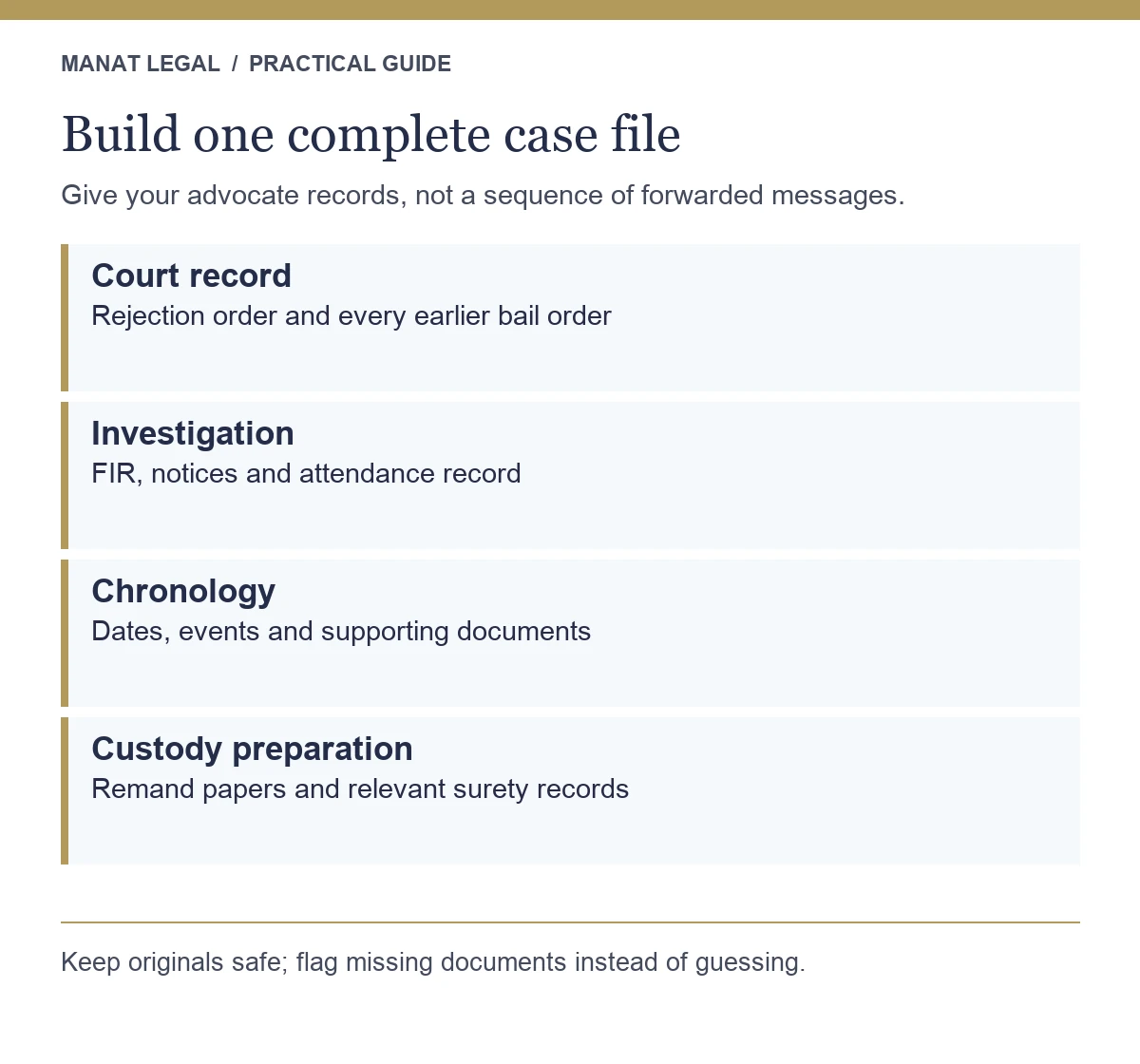
Prepare custody and remand records, medical material where genuinely relevant, information about roots in the community and a realistic plan for complying with conditions. Family members can organise identification and surety documents without contacting witnesses or trying to negotiate privately with the investigating officer.
Our guides to the Magistrate and Sessions Court regular-bail routes and bail documents explain those separate preparation tasks.
7. Keep conduct and communication consistent with the legal plan
The period after refusal is a poor time for improvisation. Do not delete messages, alter records, pressure the complainant or ask someone else to contact witnesses on your behalf. Avoid public posts that disclose private evidence or contradict the account being placed before a court.
A police notice should be reviewed promptly. Tell your advocate when it was received, how it was served, what attendance is requested and whether there are existing court directions. Seeking another bail hearing does not, by itself, suspend a lawful notice.
Choose one family contact to maintain a dated file of orders, notices, attendance records and communications. If a document is missing, record that fact instead of filling the gap with an assumption. Keep originals safe and provide working copies for preparation.
A practical example: the reason for refusal changes the preparation
Consider two hypothetical applicants. In the first matter, the court records that the applicant failed to attend after notices. In the second, it records that a particular document must be recovered and examined. Both families hear ‘anticipatory bail rejected’, but their next files should not look identical.
The first needs an accurate attendance and notice history, including any genuine explanation and supporting records. The second needs advice about the document, its custody and lawful cooperation with the investigation. Neither should manufacture evidence or approach witnesses to improve the record. The purpose of the example is preparation, not prediction of a court’s decision.
Questions to settle before the next filing
Before paying for or instructing another application, ask for a clear explanation of the proposed forum, the relief sought and the evidence needed. A realistic discussion should separate preparing papers, getting a hearing and obtaining an order. Those are different stages, with different uncertainties.
- Which court can consider the next request, and why?
- Is any protection currently operating, and when does it end?
- What was the decisive concern in the rejection order?
- What new or clearer material can properly be presented?
- What is the plan if arrest occurs before the hearing?
- Which notices, undertakings and bail conditions must still be followed?
Frequently asked questions
Does rejection mean the police must arrest immediately?
No automatic conclusion follows either way. The arrest power, statutory safeguards, case facts and any operative protection must be examined. Rejection removes the requested protection unless another order provides it; it is not itself a conviction or a universal direction to arrest.
How many days do I have after anticipatory bail is rejected?
There is no universal grace period created by rejection. Read the order for any express temporary protection or deadline and obtain prompt advice on filing requirements and limitation for the proposed remedy.
Can I file the same application again?
A successive application needs careful review of maintainability, earlier orders and any material change. Repeating the same grounds without disclosing the earlier refusal is not a sound approach.
Does filing in the High Court stop arrest?
Filing alone does not grant protection. The court must pass an applicable order. Check its terms, duration and conditions rather than relying on a filing receipt or listing message.
What should my family collect first?
The rejection order, FIR, previous applications and orders, current notices, a factual chronology and supporting documents. If custody has begun, add the arrest and remand records and discuss the regular-bail route.
If you need advice after an anticipatory-bail refusal in Bengaluru, ManAT Legal’s criminal-law team can assess the order and available records. This is general legal information; the appropriate step depends on the case and the law applicable to it.